Bernadette Demientieff
Gwichyaa Zhee Gwich’in Tribal Government


Gwichyaa Zhee Gwich’in Tribal Government
 First Nations Development Institute (First Nations) is excited to partner with the Henry Luce Foundation (Luce) for a third year of the Luce Indigenous Knowledge Fellowship. In 2020, First Nations and Luce awarded the inaugural 10 $50,000 fellowships to advance and support the work of Indigenous knowledge holders and knowledge makers dedicated to creating positive community change. Beginning in 2021, we expanded the fellowship award to $75,000 over two years to support fellows committed to preserving and sharing Indigenous knowledge with future generations. In 2022, First Nations and Luce awarded 10 $75,000 fellowships.
 The Gwichʹin people, who live in 15 communities across northern Alaska and northwest Canada, have lived off of the Porcupine Caribou for over 40,000 years. They are spiritually and culturally connected, says Bernadette Demientieff, a tribal member of the Gwichʹyaa Zhee Gwichʹin of Fort Yukon, Alaska. “We migrated alongside them and made a vow to take care of each other.”
Demientieff serves as executive director of the Gwichʹin Steering Committee (GSC) whose mission is to protect the Coastal Plain of the 19.3-million-acre Arctic National Wildlife Refuge, or “Izhik Gwatsan Gwoondaii gootlit,” which is Gwich’in for “the sacred place where life begins.“ It is a sacred place for the Gwichʹin people because it is the birthplace of the Porcupine Caribou, where tens of thousands of calves are born every year.
The tribe has always depended on the caribou for about 80% of its diet. But oil drilling and climate change have threatened the way of life for Gwichʹin communities. “Extractive industries have caused sickness to our lands, waters, animals, and relatives. There are thousands of dead fish in our rivers and lakes, and birds are falling out of the sky from starvation,“ says Demientieff.
What’s more, her community in Fort Yukon has not been able to hunt the caribou in about 60 years because the warmer weather has changed their migratory routes, making them harder to track down.
With tepid concern from elected state and federal leaders, the Gwichʹin people have had to defend their homelands on their own. Under the leadership of the GSC executive director, they are speaking out against drilling in the region, and influential people are listening.
“Our ultimate vision is to permanently protect the Refuge through wilderness designation, making it impossible for extraction interests to destroy the calving grounds,” the 47-year-old mother of five and grandmother of seven states. “I am using my voice for them. It is our children’s birthright to have caribou.”
And it is for ─ and with ─ the Gwichʹin youth that this 2022 Luce Indigenous Knowledge fellow will focus her work.
Investing in the next generation
Protecting the Coastal Plain and the Gwichʹin way of life has been a 30-year battle for the tribe, according to Demientieff. “This is going to be an ongoing fight. We need to educate our younger generation of the true meaning of what this place means to us. It is our home, and we have nowhere else to go.”
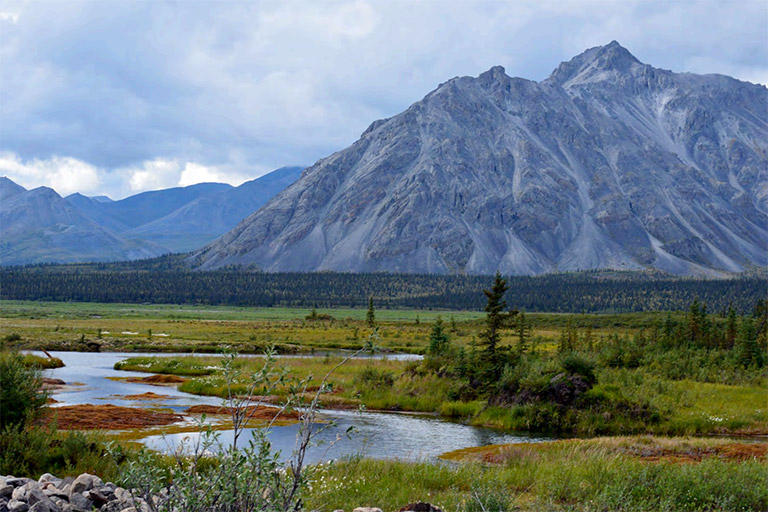
The Coastal Plain of the 19.3-million-acre Arctic National Wildlife Refuge, or “Izhik Gwatsan Gwoondaii gootlit,” is a sacred place for the Gwichʹin people because it is the birthplace of the Porcupine Caribou.
What better way to help Gwichʹin youth understand what is at stake than to bring them out to their traditional homelands? Through the fellowship, Demientieff will organize an immersive Youth Survival Camp on their ancestral lands, where Gwichʹin youth will be taught by adults and elders how to build a shelter, start a fire, cook, clean, and live safely on the land through traditional ways.
Also in the works is a Youth Climate Science Workshop to teach the younger generation about the environmental changes affecting their lands and fish camps. And Demientieff is planning two trips for the Gwichʹin youth: a tour of the lower 48 states to connect with other Native youth; and an all-important fly-in to Washington, D.C., where many of the battles over the wildlife refuge and the Coastal Plain have taken place.
“I want to bombard the Capitol with young Gwichʹin voices and have tough meetings with people who don’t support us,” says the GSC leader, who hopes to inspire this younger generation to step into the leadership role of public speaking and representing the Gwichʹin people.
Her 14-year-old daughter is following in her footsteps. She is now the vice-president of the Gwichʹin Youth Council, founded by her mother, and has already spoken at the United Nations on behalf of her people. “My daughter heard me talking about how the polar bears are drowning in the melted ice due to climate change, and that really got her attention because she loves polar bears,” says Demientieff.
The fight for the future goes on
In her seven years as GSC’s executive director, Demientieff has had to fight hard against the powerful oil and gas industries, lobbyists, and congressional leaders advocating for them. “They put money before people. They do what’s right for themselves and their causes, and not what’s right for the American people.”
After hitting a dead-end in Congress, Demientieff switched gears and appealed to national banks and insurance companies to help the Gwichʹin people protect their sacred lands against oil drilling.
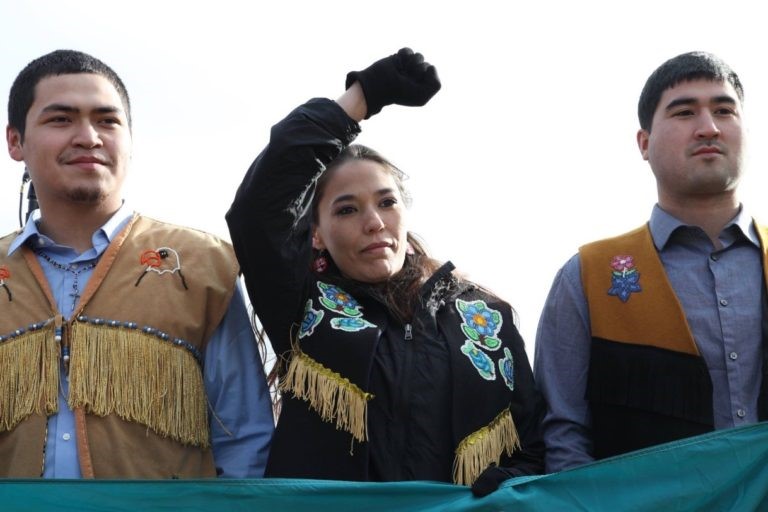
Led by Demientieff, the Gwichʹin Steering Committee successfully petitioned some national banks and insurance companies to stop financing oil drilling on the Coastal Plain.
Finally, she achieved a major victory.
As she wrote in her Luce application, “By the end of 2020, we had received public commitments against financing all drilling from six of the largest American banks and five of the largest Canadian banks.”
One D.C. legislator, stunned by this accomplishment, asked her how she made the impossible happen. She replied, “I just spoke from my heart and let them know that we are real people – mothers, fathers, grandparents. We are not asking for anything but the ability to live off the land that Creator blessed us with.”
Demientieff will continue her successful appeal to the organizations that finance oil drilling. “Giving up is not an option. I am doing this for my children, grandchildren, and the Gwichʹin youth,” she shares what gives her strength. “This work is always on my mind and always in my heart. I don’t want to fail my people.”
The Luce fellow concludes with an appeal to all people to work together in fighting climate change. “It doesn’t care what color you are, whether you’re rich, or poor, black, brown, or white, we are all going to be negatively impacted. It is time we start setting our differences aside and come together for future generations. We do not have any more time to argue about climate change because it is clearly happening. We are stronger together and we need to work together.”