Clarence Cruz
Ohkay Owingeh and Tewa

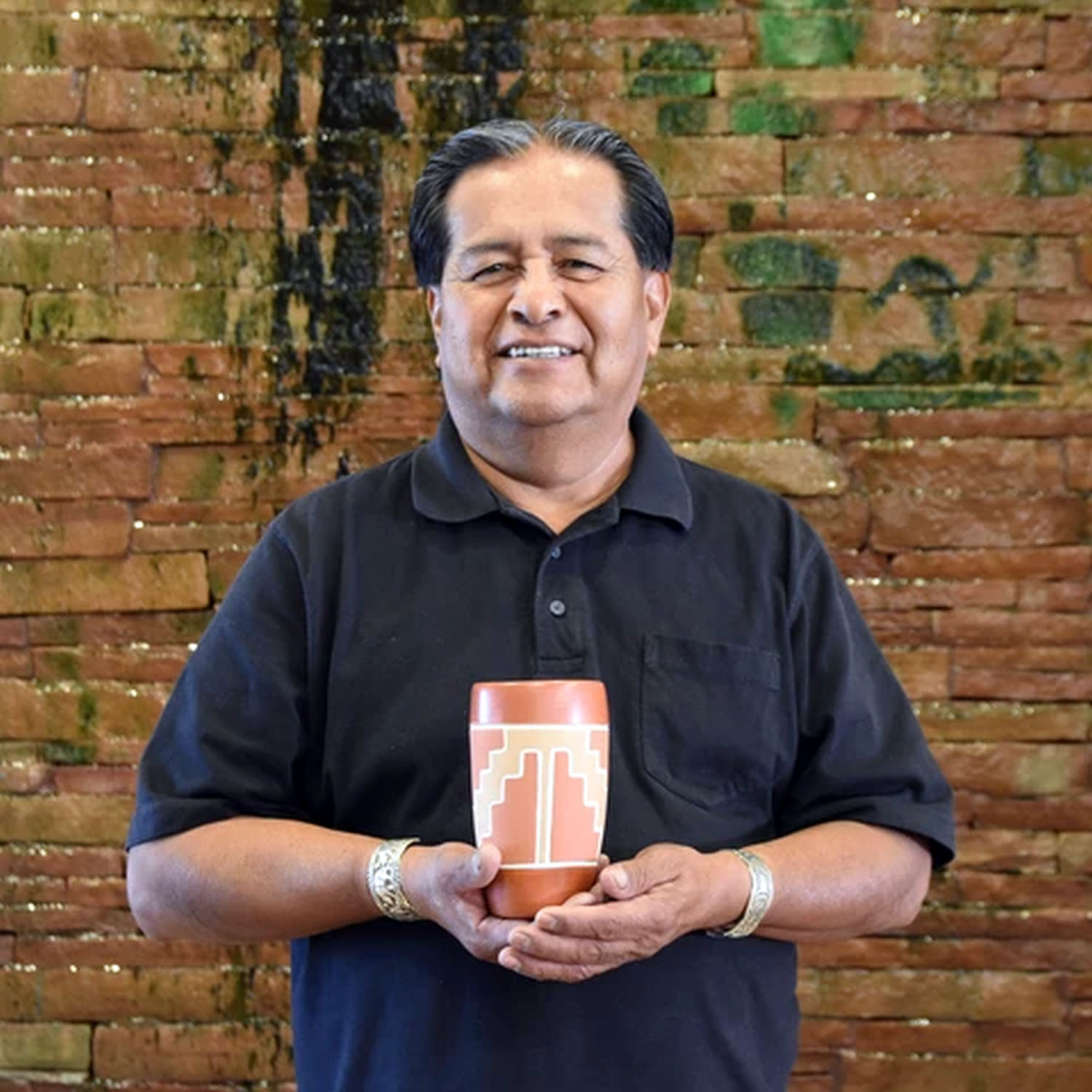
Ohkay Owingeh and Tewa

In 2020, First Nations Development Institute (First Nations) in partnership with the Henry Luce Foundation (Luce) awarded 10 $50,000 fellowships to support Indigenous knowledge holders and knowledge makers dedicated to creating positive community change. The Luce Indigenous Knowledge Fellowship is a 12-month, self-directed enrichment program that provides fellows with the funding and connections necessary to maximize their potential and spark significant innovation and transformation in their communities.
Clarence Cruz (Ohkay Owingeh and Tewa) is among the first cohort of Luce Indigenous Knowledge fellows. He is an elder, former elected tribal war chief, and traditional potter and educator from Ohkay Owingeh Pueblo in New Mexico. Cruz is also an award-winning artist and tenure-track professor at the University of New Mexico (UNM).
He observes: “This fellowship holds us to high standards – the same high standards our ancestors set for us. I believe it will help sustain our cultures and languages, and help us better understand who we are as Native people.”
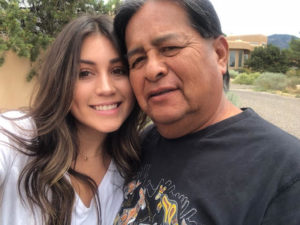
Cruz poses with his daughter, Alexandria.
Clarence Cruz (Ohkay Owingeh and Tewa) is among the first cohort of Luce Indigenous Knowledge fellows. He is an elder, former elected tribal war chief, and traditional potter and educator from Ohkay Owingeh Pueblo in New Mexico. Cruz is also an award-winning artist and tenure-track professor at the University of New Mexico (UNM).
Cruz began his academic journey at UNM, where he received a bachelor’s and master’s degree in studio arts. After graduation, the late Acoma Pueblo potter Mary Lewis Garcia, the daughter of legendary pottery matriarch Lucy Lewis, designated him as her successor in the art of traditional Pueblo pottery.
To pay it forward, Cruz began teaching the art of pottery-making worldwide through numerous classes, workshops, and speaking engagements. “I was given a gift,” says Cruz. “My mentors always told me that they were sharing a gift with me and at some point in my life, it would be my responsibility to teach and share this gift with others.”
Supporting Indigenous knowledge makers engaged in the creation and dissemination of Indigenous knowledge is core to the Luce Indigenous Knowledge Fellowship. In 2020, Cruz applied for the Luce Fellowship to help him share his artistic gift with people and communities, both Indigenous and non-Indigenous artists committed to sustaining the craft.
Photo credit Roberto E. Rosales/Albuquerque Journal
During the fellowship period, Cruz worked on a book titled, “Past and Present Potters of Ohkay Owingeh,” about the art of traditional Pueblo pottery. Additionally, he completed a video on Pueblo pottery making, which will be distributed to New Mexico schools, libraries, and museums.
Additionally, in 2018-2019, Cruz along with potters from six of the Tewa-speaking Pueblos began working on an exhibit to honor and celebrate past Pueblo potters from their communities. The permanent exhibition is titled “Di Wea Powa: Return of Historic Tewa Pottery.” This project was made possible by the Poeh Culture Center, Pueblo of Pojoaque, and the Smithsonian National Museum of the American Indian.
“There are a number of walls and barriers that hinder Indigenous people and the development of Indigenous knowledge,” says Cruz. “This fellowship provides us with tools and resources to achieve a better place for our people.”
Community Background/Impact
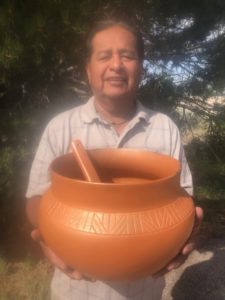
Cruz holding a micaceous cooking pot.
Cruz carries the Pueblo name Khaayay. He was born and raised in Ohkay Owingeh Pueblo located at the confluence of the Rio Grande and Chama rivers. The Pueblo is approximately 25 miles north of Santa Fe, New Mexico.
In 1856, Spanish conquistadores renamed Ohkay Owingeh to San Juan Pueblo. More than 400 years later, the Pueblo’s tribal council restored their pre-Spanish name Ohkay Owinge, which means “the Place of the Strong People.”
Ohkay Owingeh is one of the largest Tewa-speaking pueblos in New Mexico. It is currently the headquarters of the Eight Northern Indian Pueblos Council, a consortium of tribal governments committed to promoting Pueblo wellness through a variety of economic, educational, and social service programs.
Traditionally, pottery has been (and still is) culturally, historically, and economically important to Pueblo people. The main art focus in Ohkay Owingeh is redware pottery, weaving, and painting. Pottery techniques are often passed down through Pueblo families. Cruz learned pottery-making “from his godmother and great aunt Felicita Garcia, whose mother, Tomasita Montoya, along with seven other potters helped revive the historic San Juan pottery style in the 1930s.”
According to Cruz, Garcia taught him that “it is our duty to pass along our knowledge to future generations [similar to our] ancestors before us.” He observes: “Our ancestors fought so hard to have what we have, and gave so much. Now it’s our generations time to step up to the plate. This fellowship allows us to do that.”
Sharing Indigenous Knowledge
Cruz has devoted his life to learning and understanding the past and present significance of Pueblo pottery. As a traditional Pueblo potter, Cruz gathers and processes all the raw materials (e.g, clay, mineral pigments) by hand. He coil hand-builds each pot and then sands, water washes, slips, stone polishes, paints, and fires each pot outdoors.
As an artist, Cruz says that he marries both traditional and western techniques, and enjoys sharing his knowledge worldwide. To merge both traditional and western techniques, Cruz says he experiments with different applique patterns and clay processing techniques.
“I have taught hundreds of Native and non-Native students around the world,” says Cruz. “I believe with teaching, I bring students from different cultural backgrounds together. I try to emphasize who we are as a people and that we share something in common through clay.”
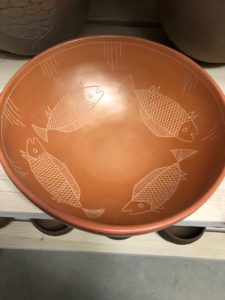
A handmade maicaceous bowl decorated with fish.
In addition to teaching students at the UNM, Cruz has taught ceramics and pottery-making at a number of other local colleges and universities. He has also taught at universities outside New Mexico and was invited to participate in an international visiting artist symposium in China at the Jingdezhen Ceramic Institute with the National Council for the Ceramic Arts (NCECA).
In 2012, The Southwestern Association for Indian Arts honored Cruz with the Allan Houser Legacy Award for perpetuating the tradition of Pueblo pottery. He says: “My life-long work is to protect and preserve traditional Puebloan art, culture, and language through teaching and sharing traditional pottery knowledge. My hope has always been to give back to communities that are seeking knowledge.”
During the fellowship period, Cruz began finalizing his manuscript, “Past and Present Potters of Ohkay Owingeh,” focusing on Pueblo potters and the Pueblo pottery revival movement. The manuscript will be published in spring 2022 and distributed to New Mexico schools, libraries, and museums so that Cruz can share his knowledge of Pueblo pottery art and history with a broader audience.
Like many of the fellows, Cruz’s fellowship plans changed following the Covid-19 pandemic. For instance, he was not able to interview Pueblo potters for his new videos on Pueblo potters. Many Pueblos and museums have been closed over the past year to curb the spread of the virus. In fact, Cruz was even unable to access his own studio, as the UNM campus was largely closed last year, even to most faculty, staff, and students.

One of Cruz’s more contemporary pieces: a raw, unfired Tewa clay pot.
As New Mexico slowly begins to re-open, Cruz hopes to resume working on this project later this summer.
Words of Gratitude
According to Cruz, the Luce Indigenous Knowledge Fellowship has been a “mind-blowing experience.” He says he has appreciated the opportunity to network and share with other Indigenous knowledge holders and knowledge makers around the country.
“This fellowship makes it possible for us to achieve the dreams we’ve always had for our communities,” says Cruz. “Not just our individual communities, but even more broadly among other Indigenous communities.”
Cruz believes the Luce Indigenous Knowledge Fellowship will have a significant and long-lasting impact on Indigenous communities. He observes: “This fellowship holds us to high standards – the same high standards our ancestors set for us. I believe it will help sustain our cultures and languages, and help us better understand who we are as Native people.”