Denise Davis
Mountain Maidu
Mountain Maidu
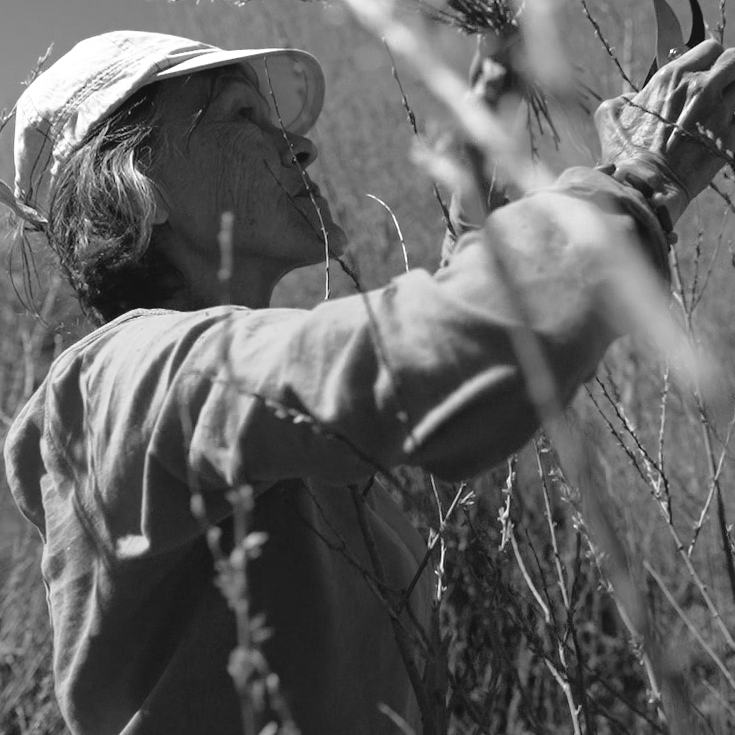
Within the four Maidu Bands of California, there are only two tribal members left who were trained by elders, now gone, in the traditional “old way” of weaving Maidu baskets. Denise Davis (Mountain Maidu), an Indigenous artist and 2025 Luce Indigenous Knowledge Fellow, is one of them.
 “My grand-aunties and great-grandmothers were all prolific weavers. I was taught by the last Maidu family auntie the same processes that they used to weave. I was taught that weaving is a way of life, a process from the plant to the finished piece,” says Davis, a cultural educator who teaches others how to weave baskets using natural fibers, like fern roots, redbud bark, willow, tule, hazel, maple, wild rose, and sedge to create baskets that are not just beautiful, but useful, too. “We use Maidu baskets for storage, ceremonies, and food production, like cooking acorns. Our three rod-coiled baskets are all watertight!”
One of Davis’s primary mentors was Lilly Baker, the last master Maidu basket weaver. Baker and her mother, Daisy, created what are touted as the most exquisite baskets in California Indian basketry. Baker wove baskets with Davis’s aunt, master weaver Selena Young Jackson. Baker later got Davis started on a weaving path of her own. “I didn’t start weaving until after I had my three sons and they were off to school. It was time, and I just had to do it,” the Luce Fellow tells First Nations.
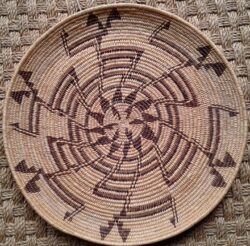
Denise is well known for her signature Maidu baskets that have been displayed in galleries around the world.
Fast-forward 40 years, her children now grown, and Davis has created a basketweaving legacy of her own. She is a founding member of the California Indian Basketweavers’ Association (CIBA), a group that “supports the preservation, promotion, and perpetuation of the traditional art of California Indian basketry.” CIBA is renowned for its Annual Gathering, the organization’s largest multi-day weaving event of the year, where Indian weavers and their families from all over the state gather in June at rotating tribal territories to learn, connect, and celebrate the art of basketweaving.
Davis has dedicated her life to teaching and inspiring the next generation of basket weavers—both here in the U.S. and in Europe, where she met her former husband. She was one of six contemporary California Native artists invited by the government of Czechoslovakia in the 1990s to share their art and cultural knowledge throughout the Czech Republic in various museums and cultural venues.
Since then, Davis has returned to the Czech Republic and other parts of Europe often to teach and lead workshops in Indigenous Czech and Maidu practices of basket weaving using their native fibers. “I also show them how to propagate and grow willows,” adds Davis, whose signature baskets have been displayed in galleries around the world.
The Mountain Maidu Native is also a well-known Indigenous artist, a talented graphics etcher printmaker and painter who calls herself a “colorist.” She says she knew she wanted to be an artist when she was just 4 years old. “I create. It’s what I do, and it has always been my identity for as long as I can remember.”
Her plans for the Luce Indigenous Knowledge Fellowship
As one of only two Maidu teachers proficient in the traditional way to process and weave baskets, Davis’s goal for her Luce Fellowship is simple: She wants to grow the pool of basket weavers in California so that the Maidu basket style and others “will be continued well into the future.”
When Davis first began teaching, she worked with 15 women from a Native American education center. Most of those students, who were older than her, have passed on. One is still weaving. Currently, Davis is mentoring seven weaving students. “They are younger women who have sought me out. And one man has returned to learn more from the first group 20 years ago. I only want to teach the ones who have the desire to carry it forward,” she says.
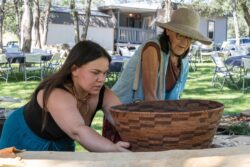
Denise helps one of her students arrange Maidu baskets for an outdoor exhibit and celebration.
With fellowship funds, Davis will teach her students the traditional process of becoming a Maidu weaver, which will require some travel. “The foundation of making a Maidu basket, which takes more than a year to make, is knowing the correct time of year to gather the natural materials and how to prepare them.” Davis will teach novice weavers how to build a relationship with plants and where to find them. “Where you live is what you weave. You can tell where a basket is from just by looking at the plant materials.”
Last fall, Davis went digging for plant materials with her students up in Northern California—to Sacramento, El Dorado, and Shingle Springs. “We dug up lots of sedge, a grass that grows along rivers. Two of my students have a property on the river in the valley, so we were very fortunate to find it in abundance. My students are manicuring it right now,” and it usually takes about a year to dry out once gathered, she adds.
Once her students have finished making their mush bowls, drinking cups, or cooking baskets, Davis will arrange an exhibit for the new weavers to display their work. “Many of my weavers are bringing a Maidu basket back that their families haven’t had in more than 100 years.”
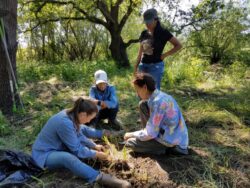
Denise digs for sedge root with her Maidu students.
Recently, Davis hosted a popup in Shingle Springs called “The Happening.” It was a feast celebrating traditional foods, such as quail, deer, smoked salmon, octopus, and acorn mush cooked on hot rocks and served in a traditional Maidu cooking basket. She invited her new students, their families, and other basket weavers. “Basket weavers don’t always get a chance to talk to one another, so we wanted to bring them together in one place,” she explains.
Also during the fellowship period, Davis hopes to accomplish a longtime personal goal. “The Luce Fellowship will also give me the time and resources to collect enough materials to create a large Maidu cooking basket, something I have desired to do for many years.
A documentary in the works
For the last year, Davis has been working with an independent filmmaker on a short documentary about Maidu basketweaving. As the writer, producer, and director—who grew up around Maidu basketweaving—the documentarian has been following Davis and her students all over the state to record footage of them gathering raw materials to make baskets during root season, winter-picking season, and spring season.
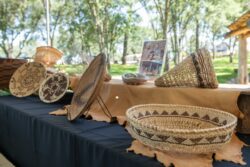
Student baskets on display at the recent popup event called “The Happening” in Shingle Springs, California.
“This 15-minute film will not be produced from an anthropological point of view. But rather, it will be more of an educational tool, a celebration of Maidu baskets because a lot of people don’t even know what Maidu baskets are or where they come from,” Davis claims. “It’s beautiful and exciting. I have already seen some of the footage.”
Davis further explains that many of her students, like herself, come from families of well-known, prolific weavers from all four Maidu tribes. This documentary will cover those stories. “It’s exciting for me to see how much they are willing to participate in the making of it,” she says. Her plan is to have the documentary completed in time to share with families and friends at the upcoming exhibit.
It is yet another novel way that the 2025 Luce Indigenous Knowledge Fellow hopes to inspire a new generation of Maidu basket weavers.