Ernestine Hayes
Tlingit
Tlingit
(Banner Photo Credit: Pat Race)
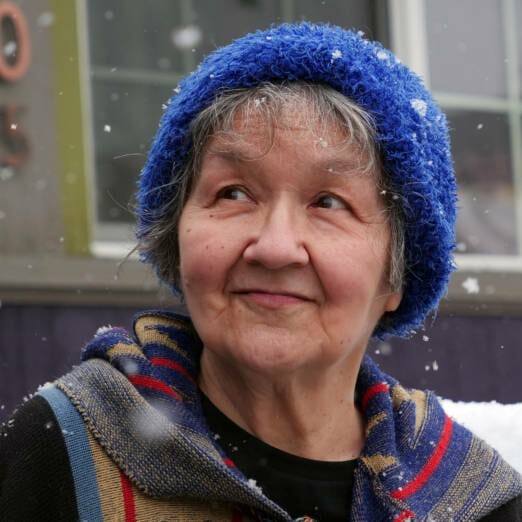
Ernestine Hayes (Tlingit) never finished 10th grade. But she certainly made up for it in her 50s, when she earned a Bachelor of Arts degree from the University of Alaska Southeast, and a Master of Fine Arts in Creative Writing and Literary Arts from the University of Alaska Anchorage, and began her journey as an award-winning writer.
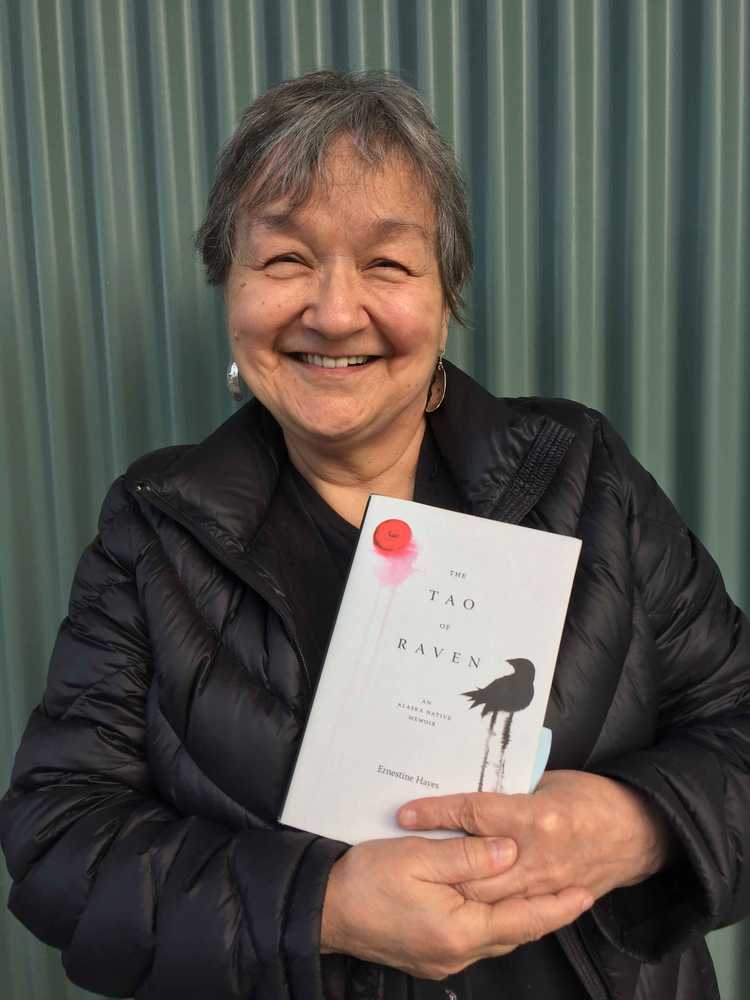
Ernestine Hayes, a 2024 Luce Indigenous Knowledge Fellow, is an award-winning Native author, essayist, and poet, who was named the Alaska State Writer Laureate for the 2017-2019 term. Photo credit: Juneau Empire
“I always said that one of these days, I’ll go to college. So, when I turned 50, it was one of those days,” says Hayes, a late bloomer by most accounts. But it was in the process of blooming, of living her extraordinarily colorful life, that this student of life acquired her wisdom and deep understanding of her Alaska Native heritage and culture, found her voice as an acclaimed writer and Indigenous storyteller, and became a tenured professor at the University of Alaska Southeast, where she taught composition, creative writing, and Native literature. She “reluctantly retired” from the university in 2018.
Of all the titles and professional distinctions associated with Hayes ― prolific author, essayist, poet, scholar, Professor Emerita, and Alaska State Writer Laureate ― the one role she holds most dear is “teacher.”
One of the English professor’s proudest professional achievements, she shares, was designing and delivering an eight-credit accelerated course that prepared students for the rigor of college-level writing. “Each year that I taught this course, all my students produced passing portfolios and entered college-level composition the following semester.”
Now with one more title to her name, First Nations’ 2024 Luce Indigenous Knowledge Fellow continues her cherished role as a teacher ― a knowledge-keeper and knowledge-sharer ― through her gifts as a writer, speaker, and Indigenous scholar. She says she is at an age where “I want what I do now to speak to others who will carry it on.”
In her application for the Luce Fellowship, Hayes makes an impassioned plea in an open letter to other teachers, asking them to be mindful of the responsibility they bear to future generations:
“… We ask you to help our children develop the strength of body, mind, and spirit they will need in order to change the world. We ask you to help our children prepare themselves to maintain social and spiritual harmony. We ask you to help our children respect everyone and everything, for everything is alive and everything has spirit. We ask you to help our children work together, for nothing is impossible when people work together.”
 Her early life in Alaska and California
Born in 1945 in Juneau, Alaska, Ernestine Hayes is a member of the Kaagwaantaan clan of the Eagle moiety (side) of the Tlingit Nation. She speaks openly about her difficult childhood in the Juneau Indian Village, living in poverty with her grandparents while her mother was in and out of the hospital with tuberculosis.
“We had status in the Tlingit culture, but it was lost in Western culture. Everything turned upside down because of colonization.” As the daughter of a white man and a Native woman, she recalls how her family was not welcomed by anybody. “The white people rejected us, and so did the Native people. I was the fatherless child of an unmarried mother with tuberculosis, living with my grandparents. We were poor people who drank. That’s just how life was.”
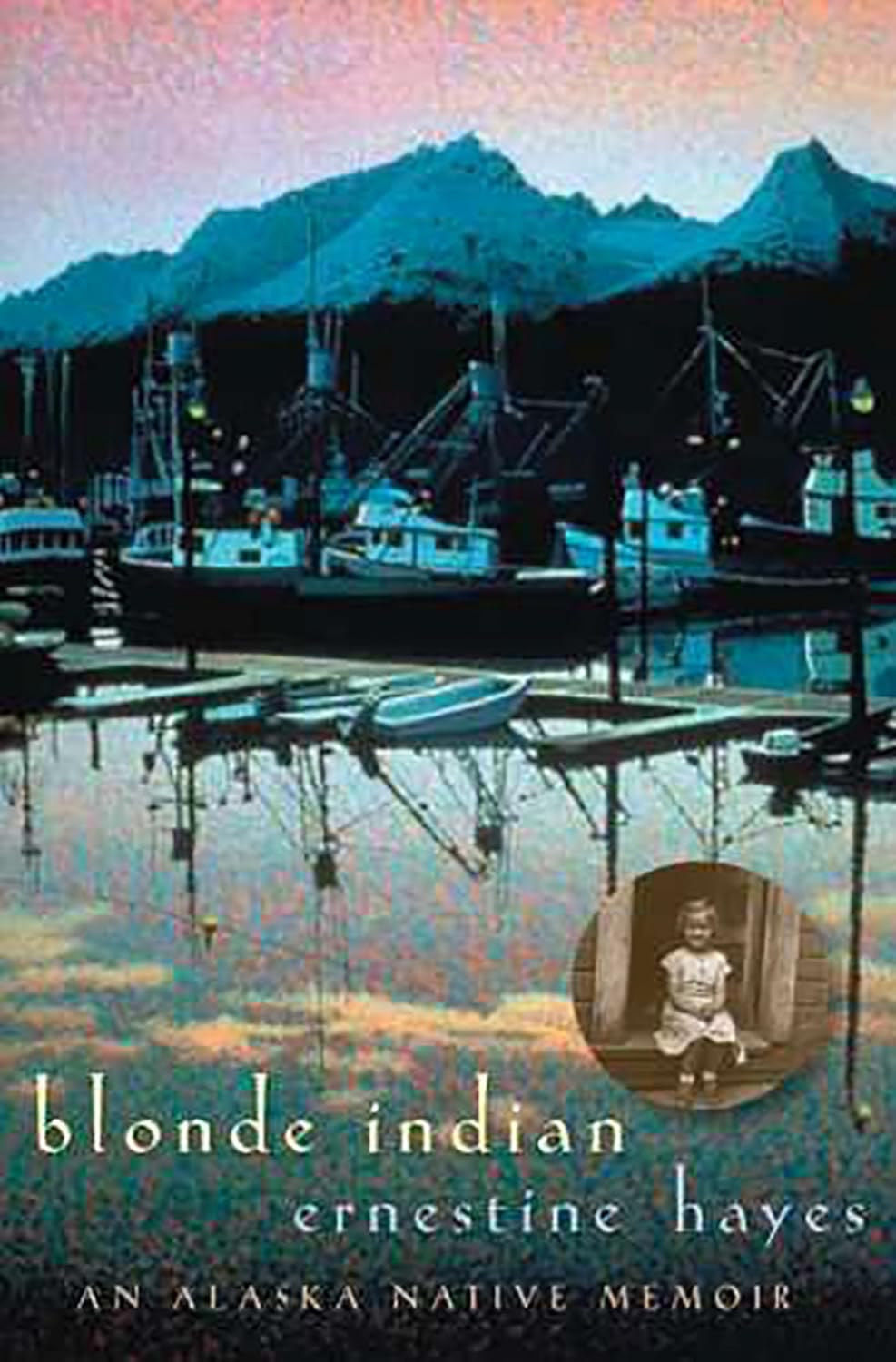
It was her grandmother who gave her the nickname, “Blonde Indian,” which later became the title of her first book. “My grandmother made up a song and dance about me, calling me ‘Blonde Indian’ because I had blonde hair as a little girl.” Hayes credits her grandmother for teaching her how she was connected to the world. “She told me that the bears were my cousin, and the wind was my grandfather, and that I belonged.”
When Hayes was 15, she moved to San Francisco with her mother, where she lived well into her adulthood for 25 years. At the age of 40, Hayes followed her longing and began her journey back home to Alaska. Along the way, she experienced many ups and downs, including a period of homelessness. These challenges and rich experiences later became colorful fodder for her books and essays.
As she tells it, “I’ve done so many things in my life, it is difficult to count them. I’ve cleaned houses and sold tickets at county fairs. I’ve shucked oysters, and I’ve emptied out the albacore hold of a longliner. I’ve spotted keno and dealt poker and taught at colleges.”
The concept of returning ― as the Tlingit Native did when she moved back to her birthplace in Alaska, and as the salmon, bear, and seasons do in every life and every generation, she writes ― is a recurring theme in many of her literary works.
An impressive body of work
Ask Hayes how she became a writer, and she will tell you that she always was one. Her mother was an avid reader and passed on that passion to her young daughter. “The way to become a writer is to read,” says Hayes, a lifelong book lover who discovered her voice as a writer when she went to college in her 50s. “It was a revelation for me to realize that I could write the things that I had always thought about.”
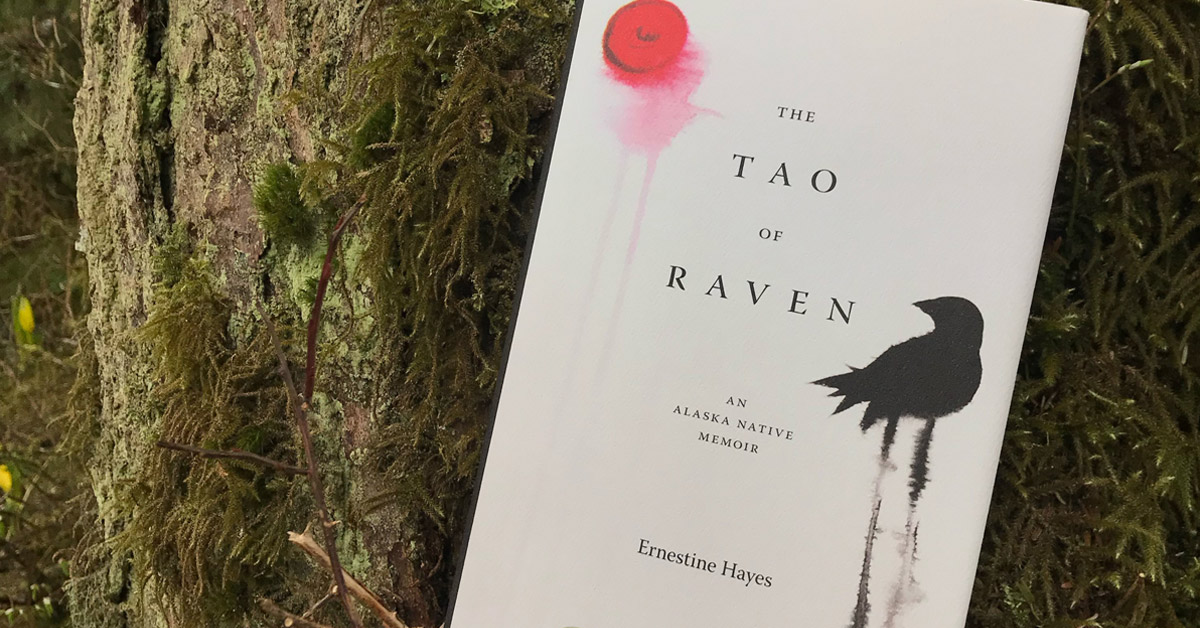
The Luce Fellow’s second book, “The Tao of Raven: An Alaska Native Memoir,” weaves personal experiences and fiction with Tlingit oral history around the Raven. Photo credit: First Alaskans Magazine
Since becoming a published writer more than 20 years ago, Hayes has written two celebrated books and scores of articles, lectures, performances, and presentations. Published in 2006, her debut memoir, “Blonde Indian: An Alaska Native Memoir,” is a culmination of stories she had written over the years; traditional and personal stories mixed with fiction, and told from different perspectives. It received the American Book Award.
Her second book, “The Tao of Raven: An Alaska Native Memoir,” is a continuation of her life’s journey and like “Blonde Indian: An Alaska Native Memoir,” this work weaves personal experiences and fiction with Tlingit oral history around the Raven ― a culturally significant bird to Alaska Natives, considered both a “trickster” and a teacher. As Hayes told the Juneau Empire when the book was released in 2016, “treasure” is a central theme in the book. “I’m redefining treasure, and now, when I say my treasure has been spent, I think I mean years. My years have been spent, and that’s all the treasure we have, in the end.”
Now 80, Hayes is working on her third book, “Bury These Stories.” As she tells First Nations, it is a memoir written in the first person about a woman who married a bear after the betrayal that caused her husband’s death. “It is about the remembering and contemplation of a woman looking back on her life, living between the village and forest, and hearing stories told in the spoken forest.”
Hayes says her writing has evolved and gone through various stages over time due to changing perspectives and interests that come with getting older. These days, she thinks a lot about mortality. “It’s what I find most interesting and compelling.”
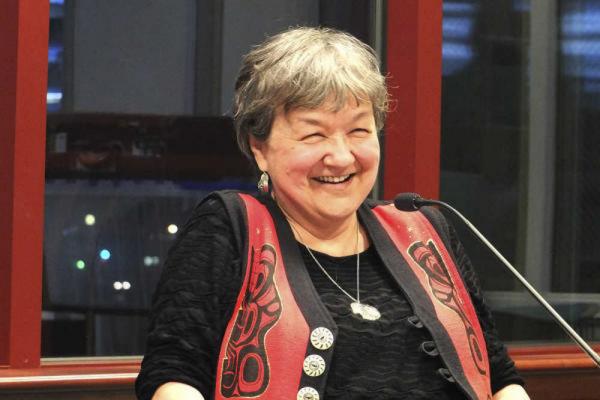
Hayes presented her work at the Storyknife Writers Retreat, a special gathering for female writers in Homer, Alaska.
Plans for her Luce Fellowship
During the two years of her 2024 Luce Indigenous Knowledge Fellowship, Hayes has remained focused on two professional writing goals: She plans to complete her third book to round out the trilogy of memoirs, declaring, “My hope is to be able to finish ‘Bury These Stories’ before I die.”
And over the last year, Hayes has done extensive research and study on the dry period called “the Younger Dryas” at the end of the Pleistocene Era (the Ice Age) for an essay she recently completed and presented at the University of Alaska Southeast called, “Pleistocene Raven.” The essay makes the connection between three traditional Raven stories of fire, water, and daylight, and the stories of Western science. As she explains, “It’s time for the histories told for ten thousand years to hold hands with the events to which those oral histories point.”
Hayes says she is “gratified and humbled” to be part of the 2024 cohort of Luce Indigenous Knowledge Fellows and learn from other knowledge keepers. She is hopeful that convenings with other fellows will “deepen” her understanding of Raven stories and increase her knowledge of other tribal histories. During the First Nations interview, she gave high praise for another Tlingit Native, X’unei Lance Twitchell, a member of the first cohort of Luce Indigenous Knowledge Fellows. Twitchell is a professor of Alaska Native languages at the University of Alaska Southeast who has dedicated his life to revitalizing the Tlingit language.
Hayes, who is not fluent in her Native language, says, “In my opinion, Lance has single-handedly saved the Tlingit language with a combination of determination, knowledge, charisma, and just plain destiny.”
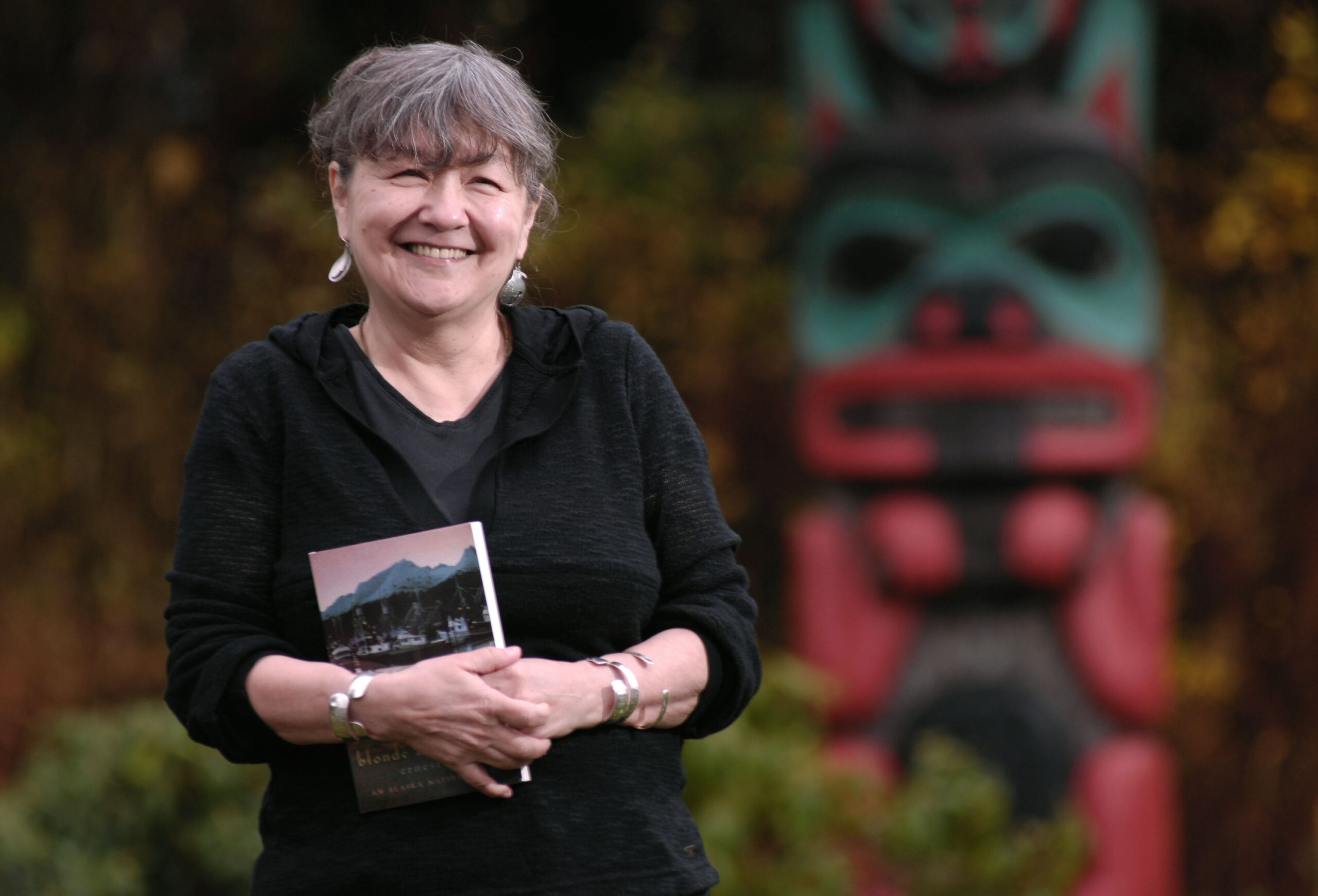
Hayes retired “reluctantly,” she says, from the University of Alaska Southeast, where she was a tenured professor who taught composition, creative writing, and Native literature. Photo credit: Michael Penn
In the writer’s own words
When the lifelong learner isn’t writing, Hayes is usually researching, or tweaking stories she has already written. “I sometimes get obsessed over where to place a comma,” she admits good-naturedly.
As a mother of three sons ― two who live nearby in Juneau and one in Seattle ― Hayes enjoys spending time with them and her three grandchildren. “I am most grateful that my sons and I actively love one another, communicate, and get along well.”
In 2018, a house that Hayes owned, where one of her sons was living, was destroyed in an electrical fire. Fortunately, everyone survived. But it took nearly six years to recover from the fallout, and the stress almost killed her. Hayes says she is thankful that she had family close by to support her and help her through the traumatic ordeal.
Now, what better way to end a story about an acclaimed Indigenous writer than in her own intoxicating words:
“I believe that the things that we learn about balance and sharing and kinship and survival and dependence are not strictly Indigenous values and knowledge. They are human values and human knowledge because we are all human and we share all these human experiences of grief and love and excitement and fear,” writes Hayes. “But also, because here we are together. History and events and circumstances have put colonizers and colonized and oppressed and oppressors, all of us together, here, now, and our only future is a future together, as humans. So, let’s just be human together.”