Gimiwan Dustin Burnette
Leech Lake Band of Ojibwe


Leech Lake Band of Ojibwe
 First Nations Development Institute (First Nations) is excited to partner with the Henry Luce Foundation (Luce) for a second year of the Luce Indigenous Knowledge Fellowship. In 2020, First Nations and Luce awarded 10 $50,000 fellowships to advance and support the work of Indigenous knowledge holders and knowledge makers dedicated to creating positive community change. In 2021, we expanded the fellowship award to $75,000 and 13 new fellows committed to preserving and sharing Indigenous knowledge with future generations.
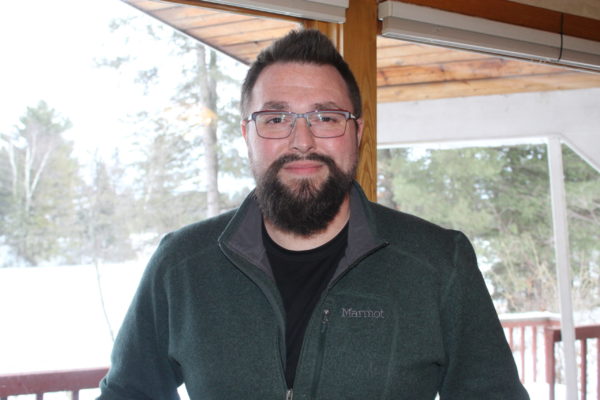
Gimiwan Dustin Burnette (Leech Lake Band of Ojibwe) is an educator and nonprofit entrepreneur committed to revitalizing the Ojibwe language. Over the past 10-plus years, Burnette has worked at several Ojibwe language immersion schools across Minnesota and Wisconsin. He has firsthand experience of the many challenges educators face as they attempt to create and disseminate Ojibwe language materials ― often from scratch.
In 2020, Burnette launched the Midwest Indigenous Immersion Network (MIIN), a community-based organization that promotes collaboration and curriculum development among Ojibwe educators. This network allows Ojibwe language instructors and administrators to informally share resources with one another.
With the Luce Indigenous Knowledge Fellowship, Burnette will formalize the MIIN by expanding the collaborative network into a full-fledged nonprofit organization. He has used fellowship funds to apply for 501(c)3 status, train board members, and establish an online repository where educators can easily access Ojibwe language materials.
Burnette says that the MIIN will save Ojibwe language instructors and administrators “countless hours and dollars that would otherwise be spent producing language materials that are already present in another community.”
This innovative project will empower Ojibwe language instructors to work together and learn from one another as they work to revitalize the Ojibwe language in their respective communities. Burnette hopes the MIIN becomes a model for other tribal communities engaged in language revitalization work.
How his passion for language revitalization developed
Burnette was born and raised in Cass Lake, Minnesota on the Leech Lake Indian Reservation. Eleven communities make up the Leech Lake Indian Reservation known as Gaa-zagaskwaajimekaag in the Ojibwe language.
The Ojibwe language is central to Ojibwe identity. According to Burnette, there are less than 200 fluent Ojibwe speakers in Minnesota, Wisconsin, and Michigan today. Ojibwe is an endangered language at risk of disappearing as elders and older generations die.
Over the past decade, Ojibwe tribal members have amped-up efforts to revitalize the Ojibwe language in local schools. For instance, Bug-O-Nay-Ge-Shig School offers the Niigaane Ojibwemowin Immersion Program, a language immersion program for K-5 students.
After graduating from college, Burnette was recruited to teach at Niigaane. Originally, Burnette planned to teach social studies to high schoolers. However, he soon found himself teaching kindergarten and first grade through the Ojibwe language. This experience ignited a passion in him for language revitalization work.
“During this time, I worked side by side with first-language speakers from Leech Lake and Red Lake teaching kindergarten and first grade,” says Burnette.” I owe much of my personal growth, professional growth, and love for the language to the patience and guidance of these three women.”
 Two years later, Burnette moved to Lac Courte Oreille, Wisconsin, where he continued to teach at another Ojibwe language immersion school in that community. For nine years, Burnette taught fourth- and fifth-graders multiple subjects at the Waadookodaading Ojibwe Language Institute (WOLI).
While teaching, Burnette began working with other Ojibwe language immersion schools throughout Minnesota and Wisconsin. He started to realize that many faculty members were developing the same curriculum and materials. However, they were not sharing resources or ideas because they were at different schools and therefore unaware of one another’s work.
This realization inspired Burnette to establish the MIIN. The network encourages Ojibwe language immersion educators to come together so they can “communicate and collaborate to collectively address their common needs.”
Putting the Luce Fellowship to work
The Luce Indigenous Knowledge Fellowship enabled Burnette to take a temporary leave from teaching so he could officially launch the MIIN. Since stepping back from his teaching responsibilities Burnette has met with stakeholders from all 11 participating communities to sign memorandums of understanding and partnership clauses that will allow each entity to share their intellectual property on a centralized website.
Ultimately, Burnette’s goal is to create an online repository where Ojibwe language instructors can access information and materials about language immersion. He observes that the COVID-19 pandemic has been a blessing in disguise, as it has allowed MIIN members to meet more frequently than expected. MIIN members now meet monthly to discuss how they can best work together to further the common efforts of their field.
“There is a current struggle by many schools and families to find appropriate materials and resources to meet their goals,” says Burnette. “An online catalog and resource center will support efficiency, and allow those working in language revitalization more time to do the work needed to progress our movement.”
Going right to work, Burnette launched the MIIN website. The online language resources and materials are organized by grade level from K-12 to adult learners. Additionally, the online repository includes links and PDFs regarding immersion pedagogy and language assessments.
The MIIN repository is an ambitious online resource that will last long beyond the fellowship period. Indeed, Burnette calls it a “lifetime endeavor.” He envisions the MIIN website as an online repository that he will continue to update as Ojibwe language immersion efforts continue to grow and thrive.
Burnette says: “By combining our resources, knowledge, and individual skill sets, we can open the door to further possibilities of language revitalization for our students, families, and communities.”
‘Thank you, First Nations’
As a teacher, Burnette’s time and resources are limited. However, like many Indigenous knowledge holders and knowledge makers, he is extremely passionate about his work and has sacrificed much of his personal time and financial resources to make the MIIN a reality for his community.
“I would have continued this work with or without the fellowship,” says Burnette. However, he observes that the Luce Indigenous Knowledge Fellowship eased his teaching workload so he could focus more time and attention on building and expanding his nonprofit and online repository.
Burnette is extremely grateful to First Nations and Luce for believing in his vision. He observes that this is the first time he has applied for a fellowship or grant of this kind, and is deeply appreciative of both the personal and professional support.
“It’s not just about money,” Burnette says. “It’s about somebody else having faith and trust in what you’re doing. It really validates the work when an organization outside your community invests in Ojibwe language revitalization. That’s a huge boost!”