Jamie Jacobs
Tonawanda Seneca Nation


Tonawanda Seneca Nation
“The Seneca language is on the brink of extinction,” writes Jamie Jacobs (Tonawanda Seneca Nation, Turtle Clan) in his application for the 2024 Luce Indigenous Knowledge Fellowship. These are fighting words that have motivated the Seneca Native for more than 20 years to do all that he can to preserve the endangered language.

2024 Luce Indigenous Knowledge Fellow Jamie Jacobs has dedicated his life to preserving the Seneca language and culture.
“The Tonawanda Seneca Nation is a very small community. Our territory is only 7,500 acres and we have less than 3,000 tribal members. And unfortunately, we have no more first language speakers left,” says Jacobs solemnly. “I’m 43 years old and I am one of the youngest fluent Seneca speakers in our community.”
It is this sobering reality ― and his passion for preserving his tribal history, culture, and traditions ― that started Jacobs on his journey to revitalize the Seneca language and has kept him impassioned toward that end for decades.
Jacobs credits his great-grandmother, Esther Sundown, for sparking his interest in learning the Seneca language. He grew up on the Tonawanda Territory, near Buffalo, New York, around grandparents on both sides of his family, who were very traditional and ceremonial. But it was Esther, with only a seventh-grade education, who patiently taught him how to speak the tribal language.
“She would translate recordings of her father singing. There were words in the songs that I wanted to understand, so I started singing and that began my journey into learning the language.” Esther, whose whole life was dedicated to Seneca ceremonies and language, according to Jacobs, passed away when she was 96 ― but not before her great-grandson was well on his way to following his path toward revitalizing the Seneca language.
Going down the road of history
When he was in his 20s, Jacobs began translating Jesuit dictionaries, a priority project that he continues to work on to this day. As he tells us, in the mid-17th century, Jesuit missionaries began documenting the Seneca language, an important part of history that not many Seneca people know about. “They were trying to communicate with us and find parallels to Christianity to infiltrate and convert us,” he explains.
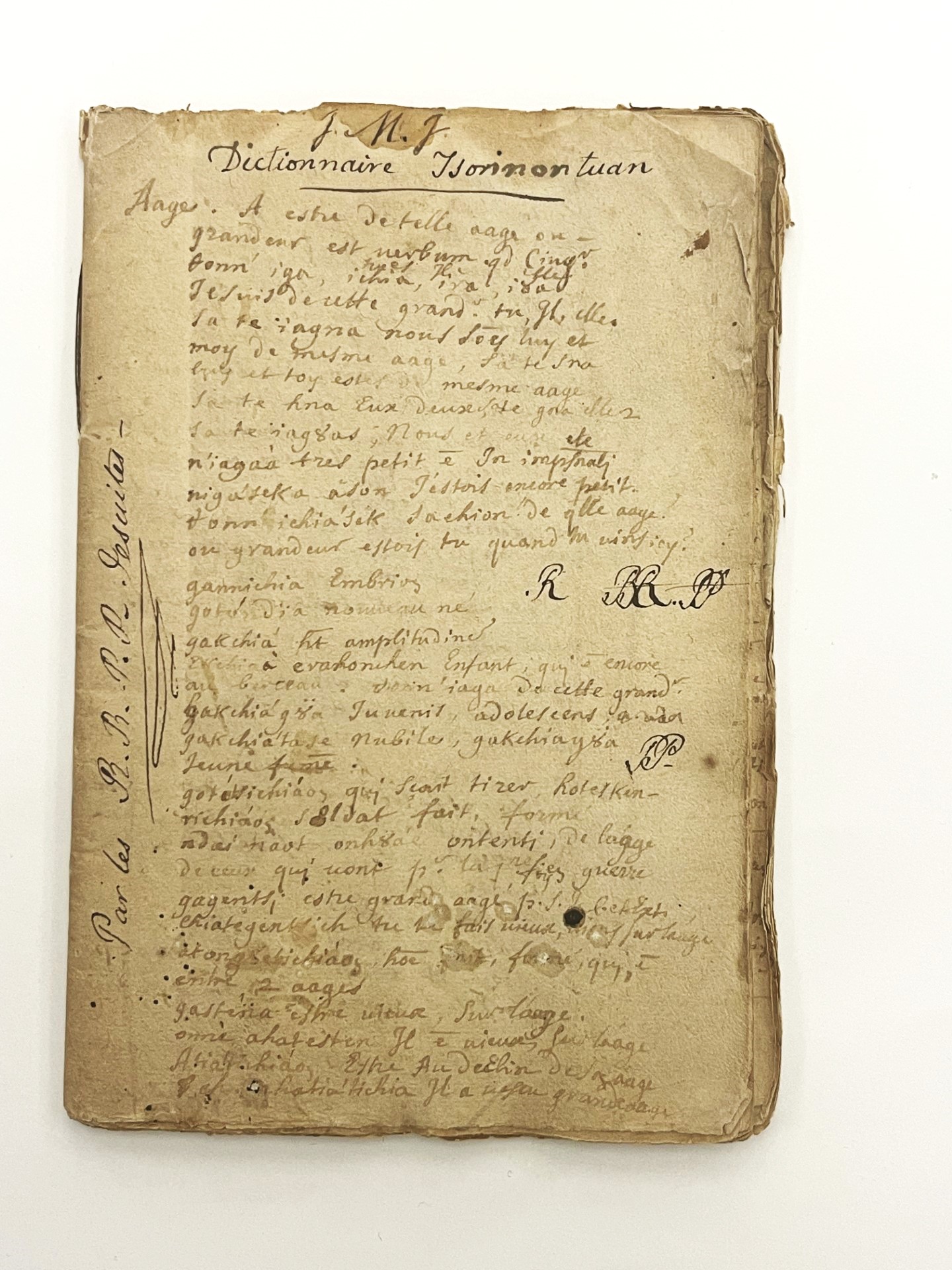
A page from the Jesuit dictionaries that the Luce Fellow has been translating for more than two decades.
Now these journals, written in French and mostly housed in the Jesuit archives in Montreal, Quebec, serve as helpful tools in reclaiming the original meanings of Seneca words spoken more than 300 years ago. “What fascinates me are all the words that we stopped saying because of colonization. And when you peel away those layers, you can see the deeper meaning to words that our ancient ancestors were thinking at the time.”
Another foundational experience in Jacobs’ language-learning journey was the eight-year relationship he forged with Dr. Wallace Chafe, an American linguist and well-known scholar of Indigenous languages with whom he often consulted right up until Chafe’s death. When Jacobs was in his 20s, he attended Chafe’s three-week Seneca language workshop at UC Santa Barbara. The professor taught his students how to learn the language from a scientific perspective. “Dr. Chafe told us that we didn’t need a linguistics degree to learn the Seneca language, and he was right.”
After 21 years of immersing himself in the Seneca language and culture ― learning from his great-grandmother and elders when he was growing up; speaking and performing at traditional ceremonies, like weddings and tobacco burnings; studying with his mentor and friend Dr. Chafe; and deconstructing Jesuit dictionaries ― Jacobs became fluent in the Seneca language in his mid-30s and took up the mantle of passing on the language to other tribal members who wanted to learn.
Jacobs was approached to help start the language immersion program at Tonawanda Seneca Nation, where he taught students how to take apart the Seneca language and put it back together themselves. Now he teaches language classes at Ganondagan, an historic site in New York State dedicated to Haudenosaunee history, culture, and traditions. He is also mentoring about a dozen people at Ganondagan to bring the language into ceremonies and the longhouse. “I am the only person doing historical language research, delving deep into the history of the Jesuits and language history. All three Seneca communities depend on me,” he says.
Today, the 2024 Luce Indigenous Knowledge Fellow is the managing curator of more than 200,000 objects and exhibits for the Rock Foundation Collections at the Rochester Museum and Science Center in New York ― a fitting career for someone who values artifacts and the preservation of Native history. “I curate Seneca ethnological and archeological material that spans prehistoric to contemporary time. This job that I have had for nearly two decades has played a key role in understanding the linguistic past of my ancestors.”

Cory McOmber, a fluent Mohawk speaker, consults with Jacobs on the Jesuit dictionaries at the Jesuit archives in Quebec.
His plans for the Luce Fellowship
Jacobs says he is grateful for the Luce Fellowship because it is allowing him to continue the passion project that he started more than 20 years ago translating four Jesuit dictionaries. The work has been very time-consuming because many of the centuries-old pages were faded and difficult to read.
When he discovered that the remaining Jesuit dictionaries were housed in Quebec, he decided on a different approach before he traveled up there. “I thought I could use my Luce funds to buy a special camera that uses different spectrums of light to make it easier to read faded pages. I saw a PBS special on the Dead Sea Scrolls where this technology was used successfully.”
With an extra $5,000 technology grant from First Nations, Jacobs purchased an ultraviolet camera used by forensics experts that converts images in the ultraviolet part of the electromagnetic spectrum into wavelengths, or colors, visible to the human eye. With the help of the Rochester Institute of Technology, he learned how to use the camera, and he spent a week up in Canada photographing four more dictionaries. “I was able to read faded pages that probably haven’t been read in who knows how long.”
His translation work on the Jesuit dictionaries is ongoing, with 70% of the work completed, and he is excited about other probable discoveries that will inform his Seneca language work. “I wonder, what other words of my ancestors will I learn from these faded pages?”
Jacobs will use his Luce Fellowship to achieve other goals, as well. He plans to share the Seneca language and cultural knowledge through videos and podcasts and publish a book to preserve what he has learned about the Seneca language. “This book will be a model for the revitalization of other Iroquoian languages and language immersion programs,” he says about the project.
Also in the works is a Seneca language dictionary that will include words that offer a deeper understanding of the roots of Seneca culture. For instance, Jacobs tells us that while words like “sweat lodge” are no longer part of the Seneca vernacular today, it teaches him that this was a cultural practice that was lost, one that he is now practicing and bringing back to the Seneca community. “Through continual discovery of lost Seneca language, lost pieces of culture can be found.”
Learning from others, sharing with the world
The Luce Indigenous Knowledge Fellowship has been “life-changing,” says Jacobs. It aligns perfectly with the best advice he ever received was from an elder, who told him to “go learn from others, because we do not know everything, and to take that knowledge and share it with others.”
And that is exactly what the Luce Fellowship has motivated him to do. “What I learn from my cohort of Indigenous knowledge holders about reclaiming endangered languages I hope to take further than where I found it and bring it back to share with my community.”
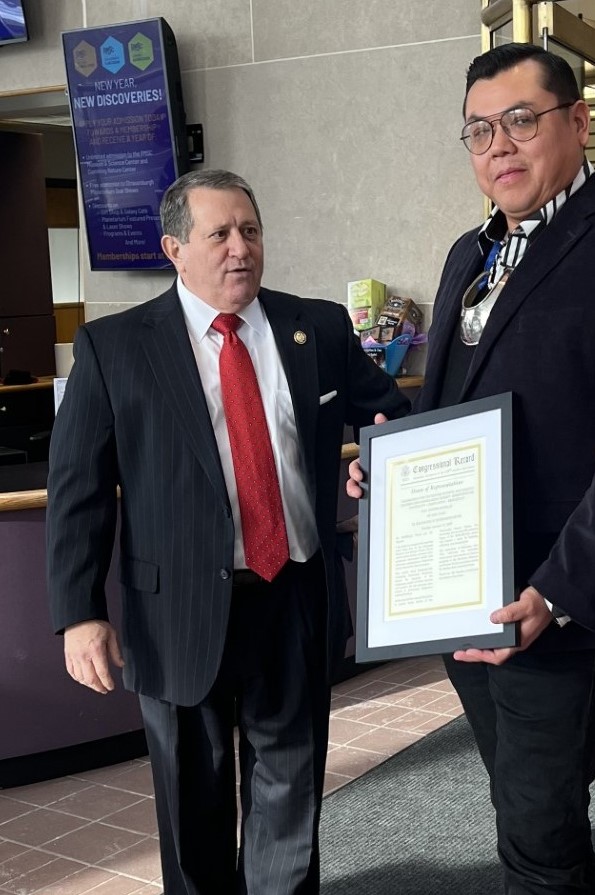
Jacobs displays the Congressional Record read by U.S. Rep. Joseph Morelle (left) on the House floor honoring the Haudenosaunee permanent exhibit he is curating at the Rochester Museum and Science Center.
With fewer than 50 fluent Seneca speakers left in the tribal community, there is no time to waste. Jacobs has been busy spreading the word far and wide about the urgency of keeping the Seneca language alive. He has recorded five episodes for a local podcast at the Seneca Art & Culture Center called “Indigenous People’s Voice,” where he discusses the Jesuit dictionaries and other language projects. And when he was in Quebec photographing the ancient dictionaries, a reporter from National Public Radio came along to work on a story about his language work, which will be aired at a later date.
Worth noting, Jacobs was recently recognized on the U.S. House floor by U.S. Rep. Joseph Morelle of New York for his culture preservation work at the Rochester Museum and Science Center. The permanent exhibit he is curating, “Hodinöšyö:nih Continuity/Innovation/Resilience,” showcases a years-long collaboration with six Haudenosaunee artists who created works inspired by their ancestors and traditions and is “a celebration of the innovation and resilience of a people against the forces of colonialism,” as stated on the museum website.
As for his language work, Jacobs says that while he is hopeful that the Seneca language will survive and be passed down through many generations to come, it is really in the hands of his community. “The Seneca people have to apply themselves, put in the work, and be inspired and motivated to keep the language going. They must be hungry for that, like I am.”
Damian Webster is optimistic, too, but is quick to give credit where it is due. In his letter to recommend Jacobs for the Luce Indigenous Knowledge Fellowship, the executive director of the adult language program on the Tonawanda Seneca Territory who has worked with the Luce Fellow for more than a decade, writes, “I believe Jamie Jacobs is a huge reason why our language and our culture will continue on.”