Jessica Denny
Cheesh'na Tribe

Cheesh'na Tribe
 First Nations Development Institute (First Nations) is excited to partner with the Henry Luce Foundation (Luce) for a third year of the Luce Indigenous Knowledge Fellowship. In 2020, First Nations and Luce awarded the inaugural 10 $50,000 fellowships to advance and support the work of Indigenous knowledge holders and knowledge makers dedicated to creating positive community change. Beginning in 2021, we expanded the fellowship award to $75,000 over two years to support fellows committed to preserving and sharing Indigenous knowledge with future generations. In 2022, First Nations and Luce awarded 10 $75,000 fellowships.
Moosehide tanning, dog mushing, salmon-cutting, and storytelling with her grandma Lena were all a part of Jessica Denny’s idyllic childhood in Tok, Alaska.
 Now 40, the Cheesh’na Tribe Native and mother of three daughters with celestial names – Skylar, Aurora, and Ariel – wants to pass on these traditional knowledge systems and ways of knowing to other tribal members, and at the same time, “build up the fire” of Ahtna, the official language of eight federally recognized tribes along the Copper River in Alaska.
As a 2022 Luce Indigenous Knowledge fellow, Denny is poised to make her vision a reality. She plans to become a specialist in the Ahtna language and develop a land-based Ahtna language program taught through videos and sound files focused on traditional Indigenous activities, such as moosehide tanning, that students can access online via Zoom, YouTube, and other digital platforms.
“I have a really strong desire in my heart to create something where we can use language to tie our people back to the land, to strengthen our connection to the land with the youth and younger generations, and at the same time, strengthen our focus on the Ahtna language,” she tells First Nations. “We may not be using the language to the extent that we used to, but we are getting stronger in it.”
Ahtna is Denny’s second language, even though she grew up in a home where her father was bilingual and spoke Ahtna Athabascan. “My mother spoke the language as a young girl, but teachers would not allow her to speak it at day school, so by the time she was in second grade, she and her siblings didn’t want to speak it anymore.” However, Denny hopes her own daughters are fluent one day. “That is one of the goals and intentions of my heart.”
Denny’s objective for her Luce fellowship ties in perfectly with the mission of the small, for-profit company she launched called Alaska Leadership Group. “We create a modern place and space for sharing traditional Indigenous knowledge to and from Indigenous people,” states the company’s CEO.
She says that many Alaska Natives have moved away from their families to urban areas and don’t have access to spaces to actively participate in traditional knowledge processes, like sewing or beading. “My company creates spaces to do that, and I want people to leave there feeling spiritually charged.”
Becoming a language warrior through the Luce fellowship
With the Luce Fellowship, Denny aims to become an advanced Ahtna language speaker, scholar, and culture expert.
Her vision includes attending graduate school at the University of Victoria, British Columbia, to earn a master’s degree (MEd) in Indigenous language revitalization to qualify to teach university-level Ahtna language and literacy courses in Alaska.
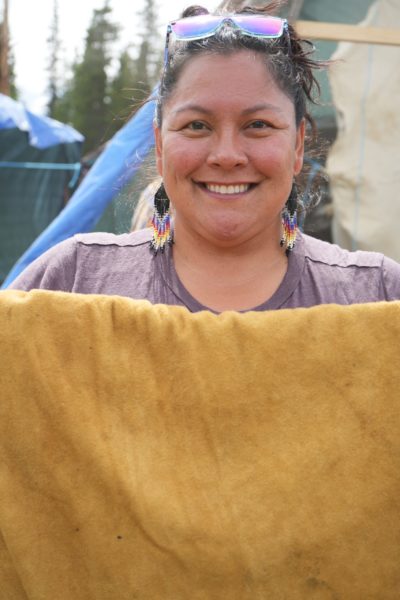
Denny displays her moosehide tanning work.
To help reconnect her people to the Ahtna language, Denny will invest in state-of-the art recording and editing equipment to create a collection of high-quality video and sound files highlighting traditional, land-based activities, such as moosehide tanning, hunting, fishing, collecting plants, travel, sewing, and berry picking. These activities will be taught by knowledge holders and first-language speakers.
The video and sound files will form the foundation for an Ahtna language program made available to tribal members, school districts, and other agencies interested in revitalizing the Ahtna language.
“Our language is who we are. It is tied to our family and community history, our kinship. It gives us strength,” Denny explains why the Ahtna language means so much to her. Ahtna is action-based, and although words are hard to say, they are packed with a lot of meaning. “It is a polysynthetic language, which means all the information is put into that one word.”
Her long-term goal is to create culture camps where people can learn Indigenous activities and the Ahtna language from knowledge holders and first-language speakers who work collaboratively to instruct them ─ both in-person and via Zoom. These camps will be conducted over consecutive days and long weekends to accommodate immersive learning and model a more patient, Indigenous approach to teaching.
“When you teach in this format, the language goes deeper,” Denny explains. “You cannot fast-track Indigenous knowledge. It is so complex, so deep, so much a part of us.” She believes it is harder for Indigenous people to learn their language due to the legacy of colonialism. “So we must take our time in learning it and be kind to ourselves.”
Denny also plans to develop an annual Ahtna Athabascan Language Symposium, where Ahtna tribes, organizations, and tribal leaders can gather to collaborate and share knowledge and resources. “This is a vital component of the project and is necessary to ensure a collective effort to breathe life back into the Ahtna language.”
The Luce fellow adds that her Ahtna language program is not for everybody. Since there are less than 30 first-language speakers across the region, boundaries must be drawn. “People who engage in the language program will have to be tied to our community somehow – whether as an employee, educator or tribal member.”
To help language learners refresh what they are learning and study at their own pace online, Denny is also creating sound files, videos and downloadable guidebooks. Future plans include hosting an annual Ahtna Athabascan Language Symposium.
Paying homage to Grandma Lena, her mentor and advocate
Lena Charley is Denny’s 93-year-old grandmother, mentor, and a tribal leader. Among other impressive accomplishments, Charley was one of the first Alaska Native women to have a big-game guide hunting license. “She was guiding, taking men out to hunt for moose, sheep and grizzly bears and did all that while raising a family. She is remarkable!” Denny speaks proudly of her grandmother.
Charley also helped her granddaughter learn the Ahtna language through a master apprenticeship program at Yukon College. Her guidance and support in language-learning continues today. Charley is helping Denny plan and run language camps supported by the Luce fellowship ─ and she is one of the knowledge holders who teaches students moosehide tanning.
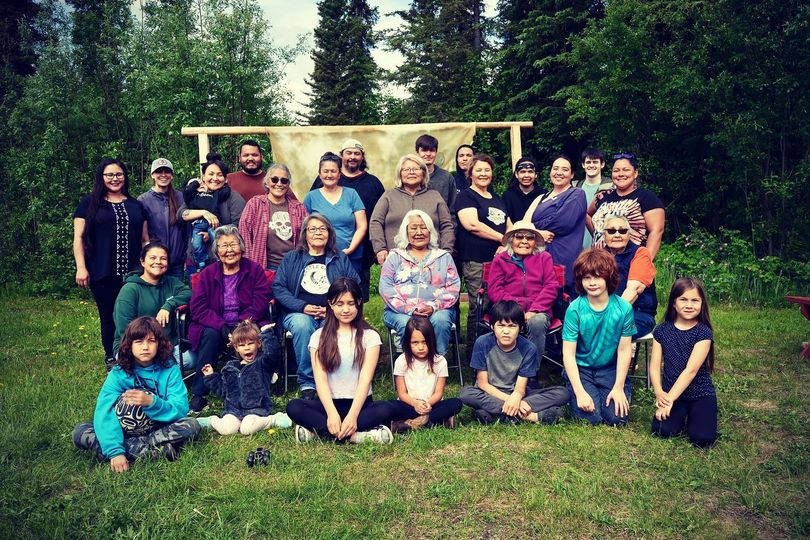
A moosehide tanning camp that Denny and her grandmother ran this summer through her for-profit company, Alaska Leadership Group.
This past summer, Denny and her grandmother ran three moosehide tanning camps. As Denny explains, moosehide tanning is an extensive process where a moose hide is turned into a piece of soft leather that feels like suede. The leather is used to make many durable and wearable items, such as slippers, mittens, fur hats, mud flaps, hoods, gun straps and gun cases.
Denny says she is grateful for all the traditional knowledge that her grandmother has passed on to her throughout her life. “She was always doing something, like moosehide tanning, between feeding dogs and cutting fish and taking care of grandkids. I was fortunate to grow up watching and learning from her.”
She adds that her Grandma Lena continues to inspire her. “The work that is coming from my grandmother is the foundation work of my Luce fellowship.”
Passing on her knowledge to the next generation
Just as Grandma Lena has passed down her traditional knowledge and ways of knowing to her granddaughter, the Luce fellow is also sharing Athabascan knowledge and practices with her own daughters.
“I like to ski with my kids and teach them dog mushing. We are a big dog mushing family,” says Denny about this traditional mode of transportation in Alaska during the winter that involves dogs, usually Huskies, pulling sleds to transport people and goods. It is the official sport of Alaska.
“Dog mushing gives my children confidence that they can take care of themselves in the cold weather. They know they have to plan and prepare,” says the mother of three echoing an important life lesson.
In an online video, Denny stresses the importance of Native youth learning from elders, like her grandmother, and herself one day. “When we share traditional knowledge with our elders, we are creating a blanket … that will wrap our people and protect them … We want to share our elders with others so people can heal and be stronger.”
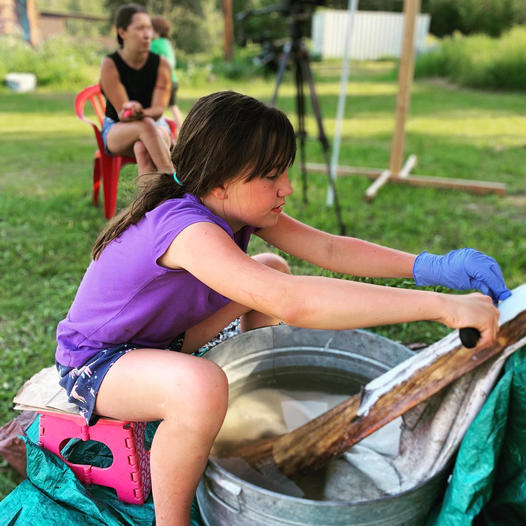
A priority for Denny is to pass on traditional knowledge systems to tribal youth.