Kathy Wan Povi Sanchez
Powohgeh Owingeh (Pueblo de San Ildefonso)
Powohgeh Owingeh (Pueblo de San Ildefonso)
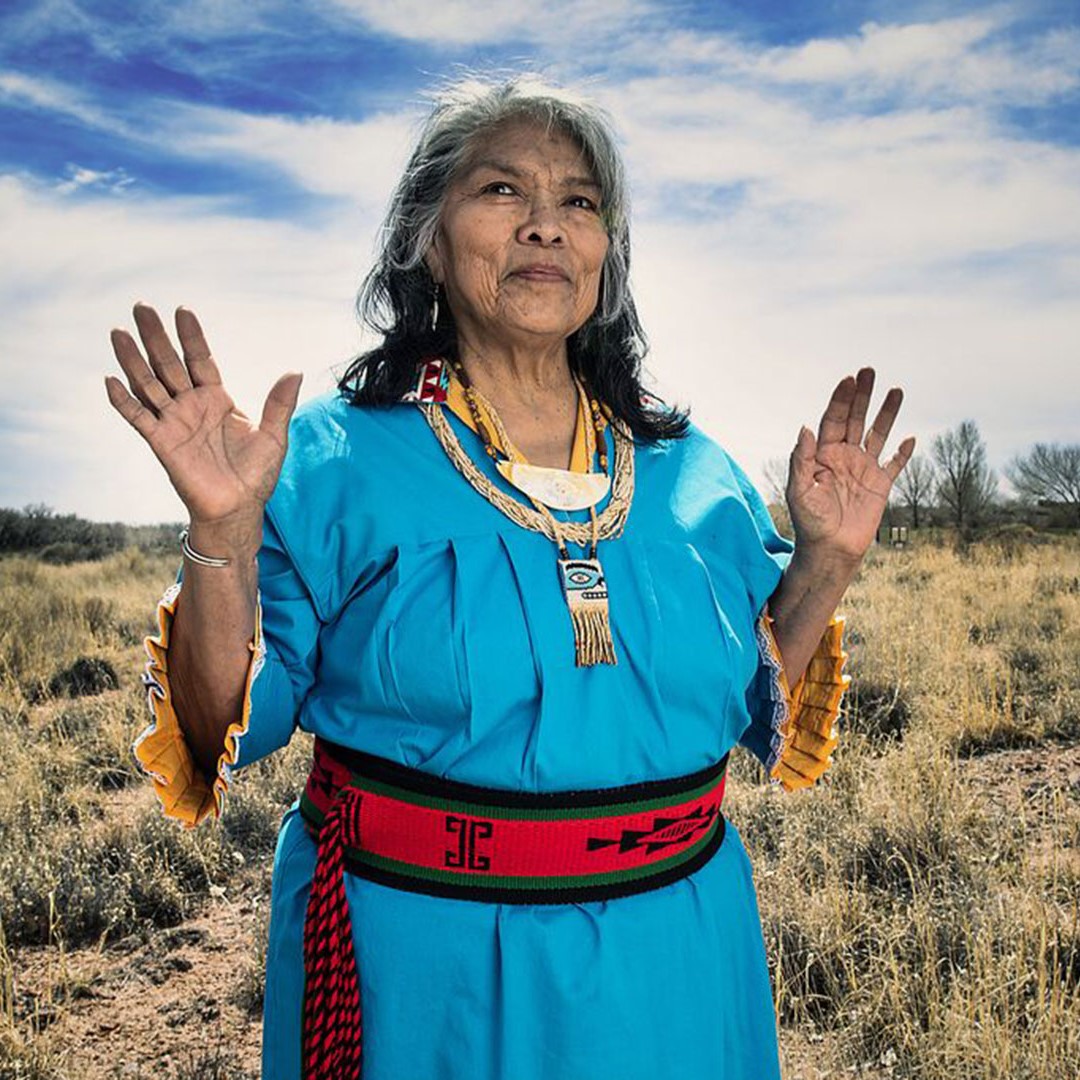
Kathy Wan Povi (Tewa for “Pine Flower”) Sanchez was raised by a strong matriarchy of loving, caring, guiding, wise women from the Pueblo de San Ildefonso. She is a fourth-generation potter who learned the fine art of creating blackware pottery from her mother Anita Martinez, her great-aunts Mella Roybal and Clara Montoya, and her grandparents Adam and Santana Martinez, who also taught her how to speak Tewa, her first language, fluently. Spending time with them and nurtured by expressions of clay, she found it easy to speak and think in the Tewa ways of “becoming a member of Mother Earth’s global family.”
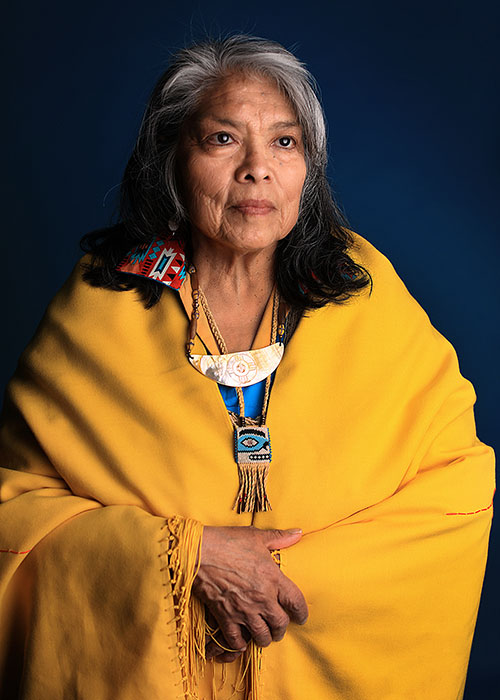
Kathy Wan Povi Sanchez, a 2023 Luce Indigenous Knowledge Fellow, is a fourth-generation traditional blackware potter, social activist, and community educator. Photo credit: Spirit Aligned Leadership
Through the years, Sanchez, now 74, has not only fired up many beautiful pieces of pottery that she continues to sell at the Free Indian Market in Santa Fe, but also, she has blazed many other trails. After earning a bachelor’s degree in education and a master’s degree in special education, she taught at several Bureau of Indian Affairs schools until she left her teaching career to return home to care for her aging relatives, create pottery with them, and document their life experiences to preserve their legacy.
Around that same time, in 1989, a handful of women from six northern Tewa-speaking Pueblos in New Mexico had started an informal support group to empower and help Pueblo women cope with various issues, such as grief and loss, domestic violence, suicide, substance abuse, and sexual violence resulting from “colonization, religious inquisition, and militarization,” as stated on its website.
“There was no safe space for us to go to talk about these things,” explains Sanchez, who joined this group that later became known as Tewa Women United, and in 2001 under the leadership of Sanchez, became a 501(c)(3) organization.
Today, Tewa Women United (TWU) has grown into a multicultural and multiracial organization that offers numerous innovative programs to help women from Tewa homelands, from youth to elders, “reclaim their power to practice self-determination, sovereignty, and interdependence” in their families and communities.
“Elder Kathy,” as Sanchez is affectionately known at TWU, is a founding member of TWU and the coordinator of the Sayain, or “circle of grandmothers and wisdom keepers.” She gives presentations at community gatherings, rallies, and convocations, and leads trainings using the transformative tools she invented ― revealed to her through dreams ― such as the “Two-World Harmony-Butterfly Model” and “Trauma Healing Rocks.”
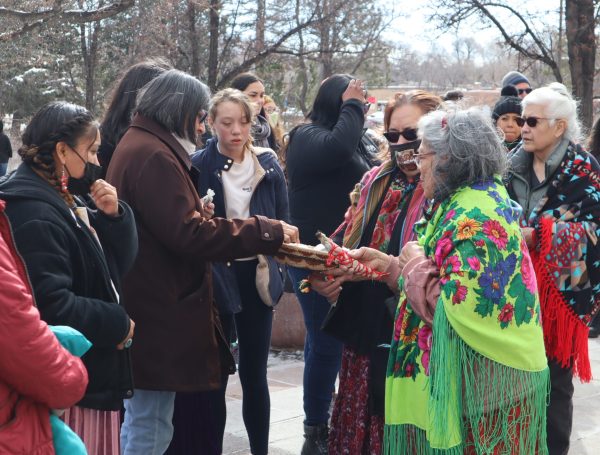
Elder Kathy (in green) leads a “Sayain” in Santa Fe, which translates to “a circle of grandmothers and wisdom keepers.”
As a 2023 Luce Indigenous Knowledge Fellow, Sanchez plans to share her proprietary “dreamspace” tools with the Indigenous community ― both in person and digitally through video and audio recordings ― to help people with their life journeys and to heal intergenerational childhood traumas.
This innovative teacher is also focused on increasing participation among young Tewa girls with their grandmothers through the “Bumble Bee Dance,” a participatory exercise that inspires the two groups of women to share and learn from one another to help bring about positive social change.
“I envision using these tools to move people’s hearts back into a beloved community, which will lead to a transformative change of damaged soul woundings,” says Elder Kathy, who considers herself a mentor for the mind, body, heart, and spirit.
The Two-World Harmony-Butterfly Model and Trauma Healing Rocks
Sanchez is renowned in the Pueblo community for creating the Two-World Harmony-Butterfly Model, a concept that came to her in a dream from her ancestors, she vividly recalls. The model visually represents the duality of Indigenous people living traditional Native lifeways, while also navigating in a Euro-American society.
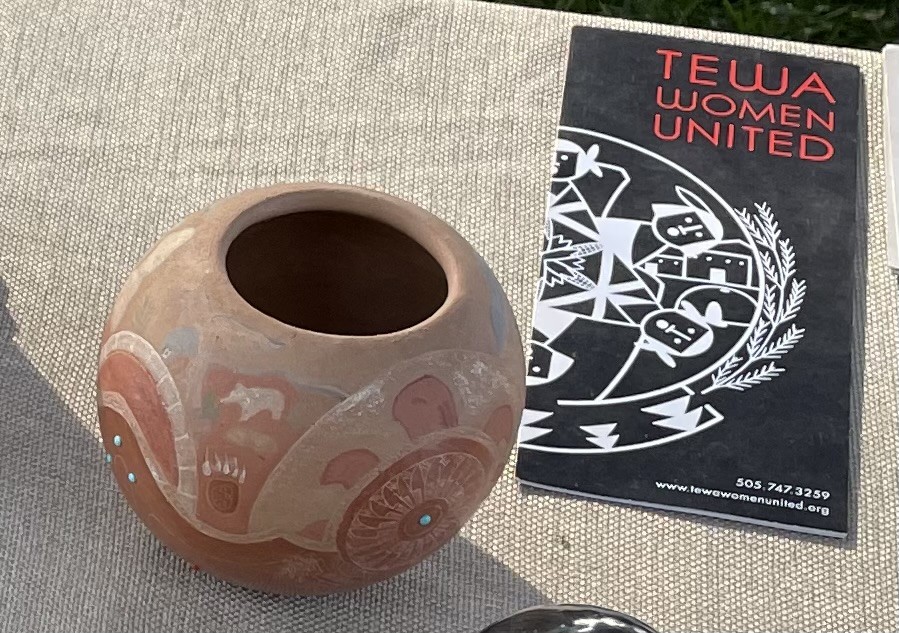
Sanchez continues to make beautiful blackware pottery, like the pot above, and sells her creations at the Free Indian Market in Santa Fe.
The contradiction of Native Americans living in these two different worlds first became evident to Sanchez when she was attending college. She recalls hearing some professors mischaracterize the Natives sitting in the back of the room as “lazy, nodding off, and not paying attention.” What these professors did not know, says Sanchez, is that many of these Native students had to drive great distances to get to school because they could not afford to live in the city. They also had to hold down jobs and take care of extended family members.
Elder Kathy took that frustrating, exhaustive feeling of living in two worlds into her dreams to get support from her ancestors. It was in that dream space where she began developing the Two-World Harmony-Butterfly Model.
“This holistic model allows us to understand, address, and manage today’s contrasting ways of life, where many Indigenous people are forced to navigate social systems established by colonizers, while still maintaining relationality with our cultural, innate knowingness,” she writes in her Luce application. The Luce Fellow believes that although Indigenous people can spend energy in both worlds, they can live respectfully and “honor one’s duality.”
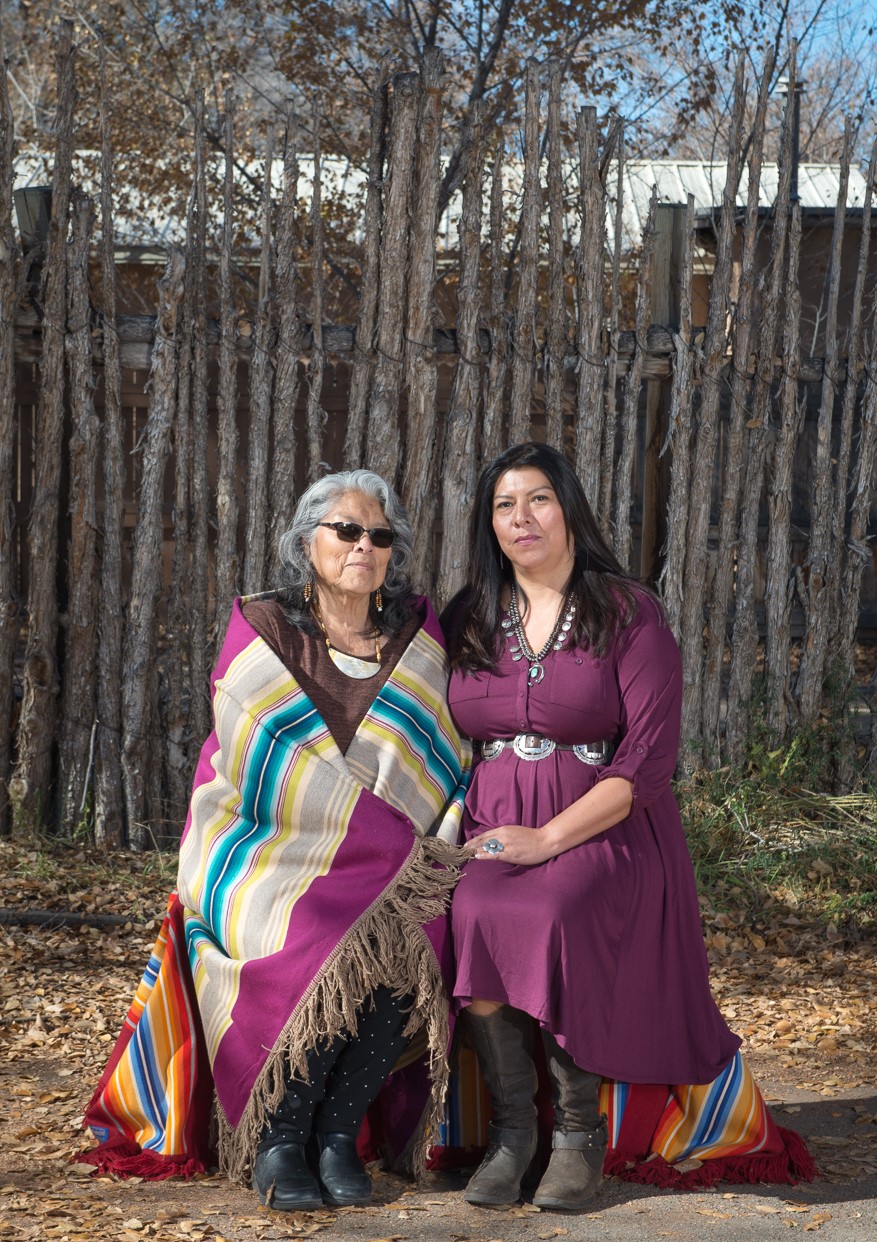
Elder Kathy poses with her daughter, Dr. Corrine Sanchez, the executive director of Tewa Women United (TWU). Photo credit: Brandon Soder
Her daughter, Dr. Corrine Sanchez, TWU’s executive director, explains the cultural significance of the butterfly symbolism, which serves as the foundational, philosophical model for Tewa Women United. “The Butterfly Model is based on the image of the butterfly, which to Tewa people, signifies transformation, mobility, vulnerability, and power to impact the multi-verse because of, and despite, its delicacy.”
Sanchez and her daughter have been working side by side for many years to deliver TWU’s message of hope and healing to Pueblo women. For their dedication and commitment to help sustain Pueblo lifeways, the two women were recently acknowledged by the Pueblo governors for their life’s work.
Another invaluable tool that Sanchez uses in her many presentations to teach Native communities how to identify and heal generational trauma are the “Trauma Healing Rocks.”
Why rocks? “It allows people to visualize what it is like to carry the heavy weight of guilt and anger in our souls if we don’t break the silence and talk about the trauma that’s harming us. It grows exponentially, generation to generation.” Sanchez adds that she has used the demonstration of the Trauma Healing Rocks quite successfully in her presentations to many Indigenous communities.
The Mother Earth gathering
Sanchez, a member of the “Sun Clan,” knows firsthand of the destruction mankind is causing to Mother Earth and the resulting trauma that has been created for generations of Indigenous people.
The Los Alamos National Laboratory (LANL), made famous in the movie “Oppenheimer” as the birthplace of the atomic bomb, has been a “forced occupier” on her ancestral homelands of San Ildefonso since the Manhattan Project of 1943. Her people became the first victims of a nuclear blast ― long before bombs were dropped on Hiroshima and Nagasaki.
“Oppenheimer saw our homelands as a secret city where he could create the first atomic bomb. But that legacy has harmed our children and our genetics, has killed our plants, and has poisoned our sole source of drinking water, the aquifer, with nuclear waste and chemicals,” says Sanchez, who has decried the toxicity of the nuclear age in her longtime role as a staunch environmental health and justice advocate.
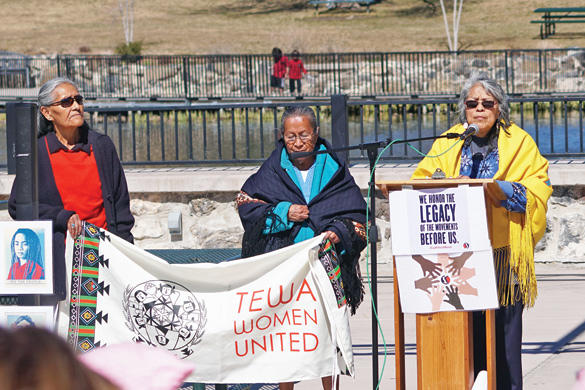
A blessing is given by Elder Kathy near the Los Alamos National Laboratory, a “forced occupier” on her ancestral homelands since 1943. Photo credit: John McHale
In 2003, she was an Indigenous representative and presented at the United Nations Nonproliferation Treaty Preparatory Committee in Geneva, where more than 90 countries came together to work on a global treaty to eliminate nuclear weapons.
“My environmental justice work addressing nuclear weapon proliferation places me within social and governmental systems designed by, and operated under, Euro-American thought and principles,” says Sanchez, promising that as a Luce Fellow, “I will continue to take opportunities to reach and un-pollute their heart-centered energy, releasing it from the culture of violence which takes our Earth Mother as natural resources to be used for their profit and gain,”
For 23 years, Sanchez also helped host “Gatherings for Mother Earth,” an event whose purpose was to bring people together from all Nations to “share love, healing, and gratitude for Mother Earth and ourselves.”
Unfortunately, COVID shut down the annual event and since then, it has been modified into a new event called “Gathering for Mother Earth’s Waters,” during which small groups make treks to the Rio Grande to honor the land, air, and water.
Helping to curb suicide among Native youth
According to the National Alliance on Mental Illness (NAMI), suicide is the second leading cause of death among American Indian and Alaska Native youth, ages 8 to 24.
As a mother of four children, grandmother of six, and great-grandmother of one, with another on the way, Sanchez is focused on creating transformative change in this area for generations to come. Her final goal for the Luce Indigenous Knowledge Fellowship is to create a suicide prevention tool for Indigenous youth.
Working with a circle of young, Indigenous “movers and shakers,” her collaborative team is developing a tool kit comprised of short video clips of elders and grandparents telling stories of their own journeys ― both the good and bad, and the ups and downs.
Sanchez has high hopes that her suicide prevention tool will encourage conversations among Indigenous youth who are struggling with depressive issues, such as addiction, poverty, unemployment, and intergenerational trauma.
The 2023 Luce Fellow believes that breaking the silence ― and defining different ways to have courage and belong to global communities of loving, caring nurturing people living in a “relationaltivity” model ― will create many generations of strong, heart-centered young people.
Elder Kathy offers a fitting blessing in Tewa: “Be woh wa yi ni (Be with life).”
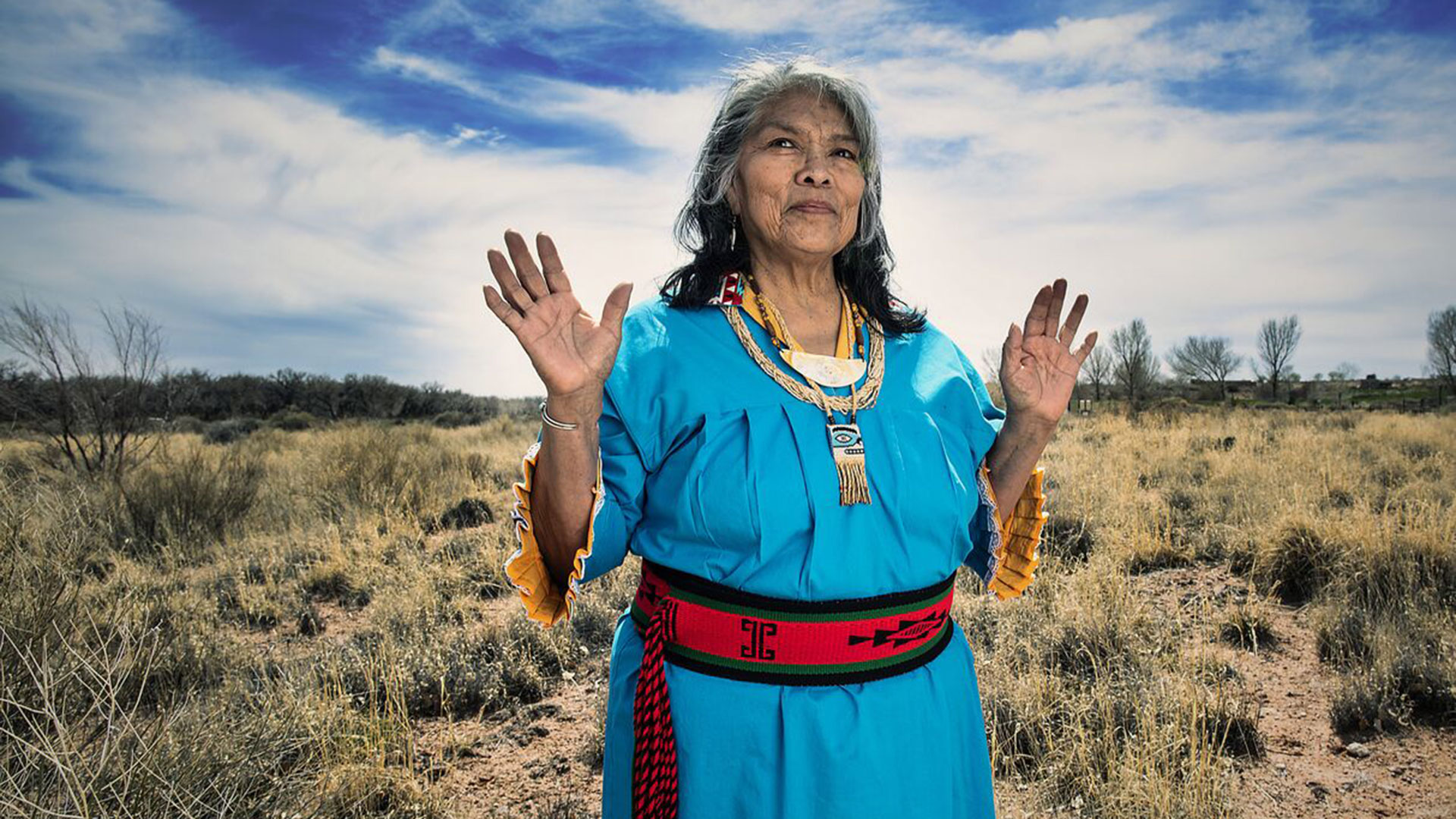
Photo credit: Spirit Aligned Leadership