Kekaiokalani Naone
Native Hawaiian


Native Hawaiian
‘Two left feet are better than one!’

Native Hawaiian Kekai Naone, a 2024 Luce Indigenous Knowledge Fellow, is passionate about teaching hula to everyone. “My hālau is open to all. We don’t require any financial contributions.”
For many Native Hawaiians, learning to dance hula is a meaningful way to explore traditional Hawaiian culture. But it can be very expensive, too.
Kekaiokalani Naone understands these economics all too well. When Naone was in high school in O’ahu, where he was born and raised, he yearned to learn more about his own culture and took hula lessons from two different teachers. Unfortunately, paying for those hula lessons became too much of a financial burden for his single mother, so he had to stop taking them.
That personal experience became the cornerstone of his application for the 2024 Luce Indigenous Knowledge Fellowship.
“What is ingrained into the core of my being is that I don’t want money to get in the way of people eager to embrace their roots, like it did for me,” says Naone, now 29. “So, I have made it my mission to ensure that enthusiasm and passion for cultural learning are not eclipsed by financial limitations.”
Naone is a kumu hula who has been running a hula school out of his garage in Hilo since 2020. “It’s very traditional to run classes this way,” he says. But what is out of the ordinary is that he does not charge his students for the hula lessons, which is how most hula teachers in Hawai’i make a living.
“My hālau is open to all, and we do not require any financial contributions. Instead, we ask that members serve the community through ceremony,” which Naone says is a wonderful way to empower his students to discover their cultural heritage and contribute to the healing of their communities.
The Native Hawaiian is employed as a lecturer at Hawai’i Community College, where he teaches the Hawaiian language and culture. Hula is part of his curriculum. “Hula is the language of the heart, therefore the heartbeat of the Hawaiian people,” he references a quote by King David Kalākaua. “It is one of our oldest practices that has never died and has never been interrupted by colonization.”
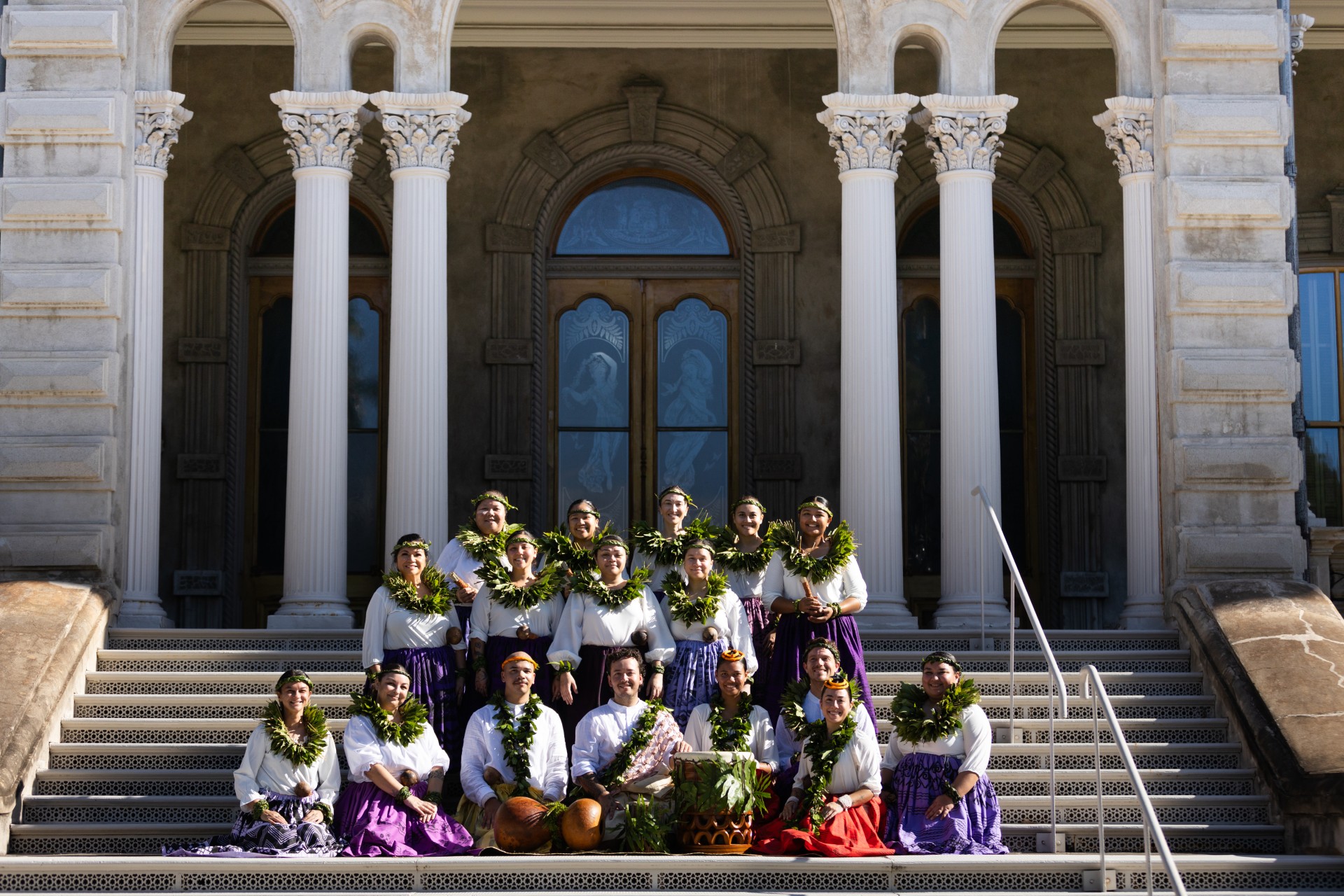
Students from Naone’s O’ahu hula class pose on the front stairs of ʻIolani Palace, where they performed for the public to practice for their upcoming graduation ceremony.
One of his goals for the Luce Fellowship has been to bring hula back to the neighborhood in O’ahu where he grew up and teach for free. “The culture on the Hawai’i Island, where I currently live, is very different than O’ahu, which is a very big city, overpopulated, and go-go-go. People have lost the old-style ways of life there, although it exists in small pockets. Whereas here, on the Hawai’i Island, cultural perspectives, like hula, have been maintained in a rural, small-town setting. So, everything I have learned in Hilo about Hawaiian culture, like hula, I have wanted to take back home.”
Last year, Naone delivered on his conviction to bring back hula to the place he calls home. Once a month, for eight months, Naone flew to O’ahu to teach the cultural dance to 20 students, men and women of all ethnicities, ages 22 to 53. “The majority were Native Hawaiian and only a few had ever danced in their lives and were a little nervous. But I told them, ‘Two left feet are better than one!’”
The class was such a success that Naone arranged a public performance for students at the iconic ‘Iolani Palace, where Hawaiian kings and queens once lived, to give his dancers some “practice” before the big graduation ceremony in front of family and friends. They all made their own lei, pāʻū, and skirts, in different shades of purple. Several students told him good-naturedly that if they had known all the things he wanted them to do from the beginning, they would never have signed up.
“One day, my hula students will look back on that experience and think, ‘Whoa, I never would have imagined myself dancing at the palace.’ But by pushing them a little bit here and there, they were able to do it, and it was awesome,” he says proudly.
His journey to become in step with Hawaiian culture
Although Naone was not raised in traditional Hawaiian ways, he became enamored with the culture in his teens. He took four years of Hawaiian language courses in high school and went on to major in Hawaiian studies at the University of Hawai’i, Hilo. By the time he graduated in 2018, he was fluent in the language.
“The Hawaiian language is similar in structure to other Indigenous languages,” he makes a comparison. “I would say the hardest part about Hawaiian is that we have about 11 pronouns, depending on how many people you’re talking to.”
While in college, he was invited to join a two-year cohort of 30 hula dancers-in-training, just for fun. It was here that he began his transformation to become a kumu hula. “No one sets out to become a kumu. It’s just something that happens to you.” He credits his hula teacher for seeing the promise in him and encouraging him to ‘ūniki, which means to graduate in hula.
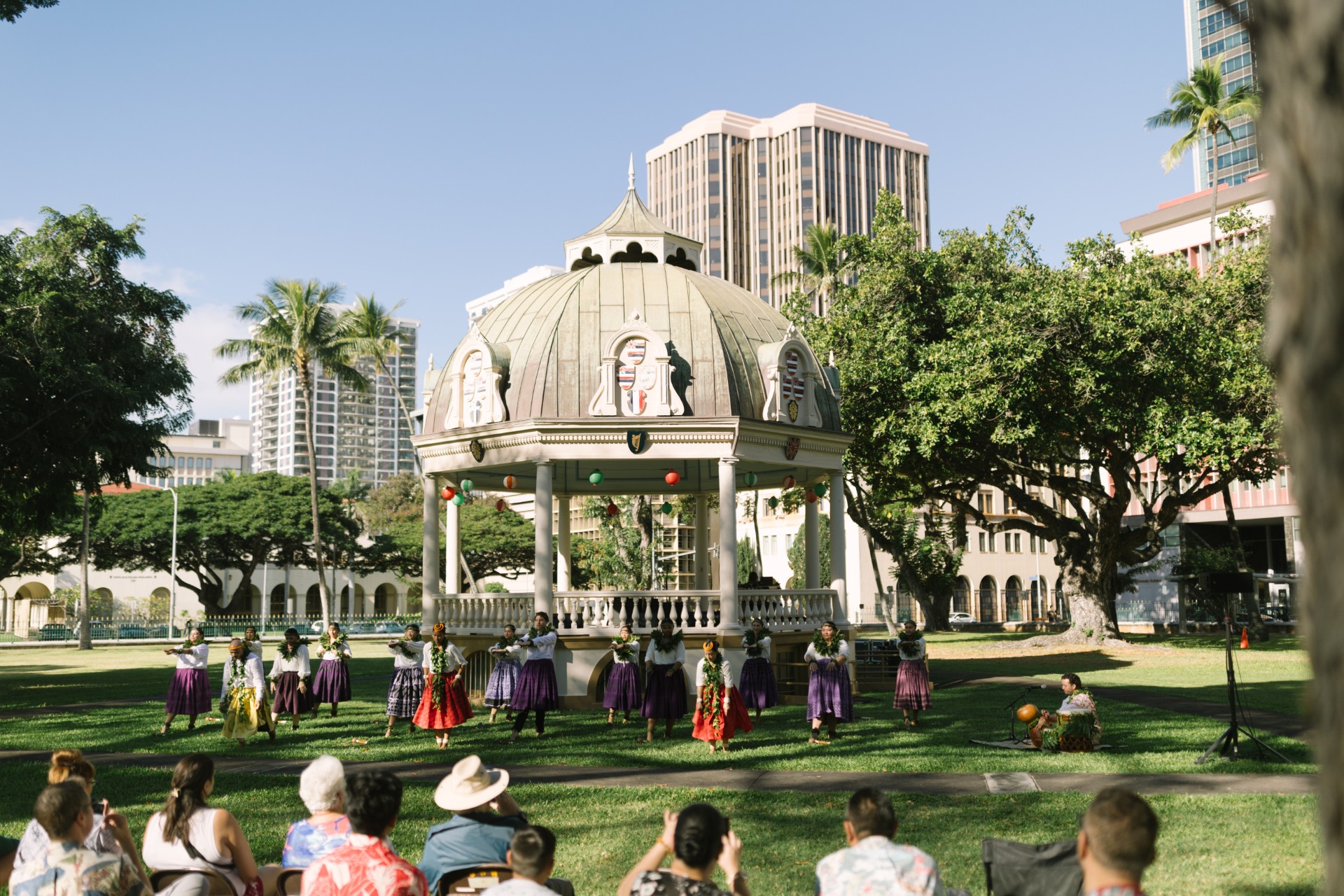
Naone’s hula students perform at the coronation stand of the ʻIolani Palace.
“‘Ūniki is a really special, selective thing. It’s not like a Western school where you do hula for four years and graduate and become a teacher. I know people who have danced for 40, 50, 60 years and they are still students.” Naone adds that his two-year journey to becoming a kumu hula was an extraordinarily fast, abridged one. It usually takes six to eight years.
Naone says he is passionate about promoting wellness and healing through hula, especially for future generations. As a lecturer at Hawai’i Community College, he teaches a class on Hawaiian spirituality through the lens of hula. Students learn a few dances and then examine the words and chants for their spiritual context and cultural threads.
“I believe hula, and all it encompasses, offers a unique opportunity to connect with our ancestors and the environment, fostering a symbiotic relationship that promotes harmony and balance,” he explains.
His plans for the Luce Fellowship
With the help of the Luce Fellowship, Naone will work on several big goals. First off, he will return to O’ahu to teach free hula classes to enthusiastic students in his old neighborhood. “I believe that sharing knowledge is critical to preserving our culture and ensuring that future generations have the same access to resources and information that I have had the privilege to learn.”
Secondly, he will conduct research in museums to study photographs and learn more about the fashions and fabrics hula dancers wore during different time periods to help inform what hula dancers should be wearing in contemporary times. Traditionally, costumes are made from cotton and muslin. But what would modern fabrics and cuts look like, he wonders?
Naone emphasizes that hula is not just about dancing. “We make our own implements, like leis, and skirts. Hula dancers must know about the environment and the ecosystem. If we are dancing about a certain area on the islands, we forage for plants indigenous to that area to create dyes and incorporate them into our costumes.”
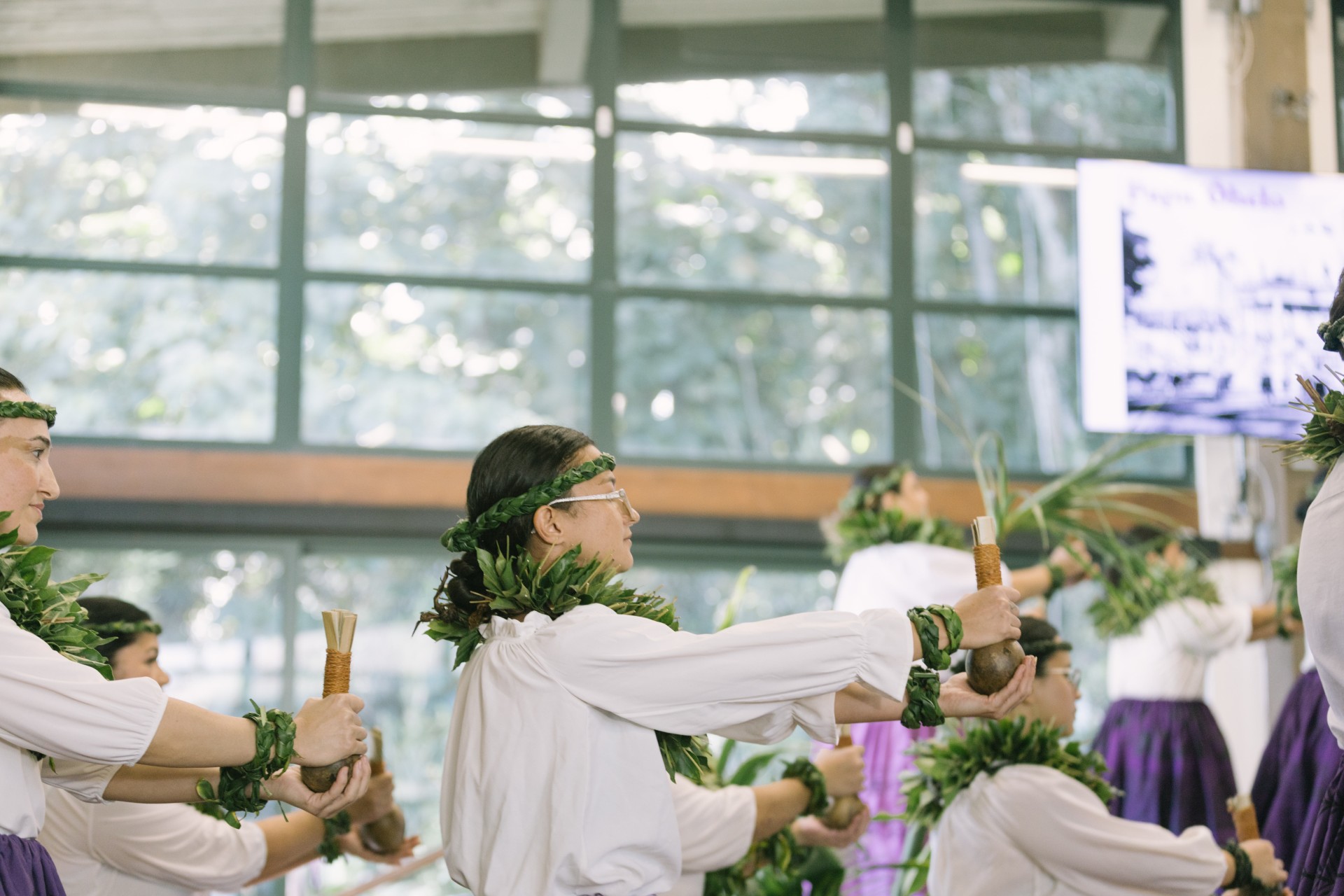
Traditional hula dancers make their own leis and skirts, and forage for plants to create dyes for costumes.
The kumu hula, who believes that everyone should be able to learn the storied, traditional dance, plans to create new, more simplified hula dances that even the most left-footed student can master. “By distilling movements and gestures into their most fundamental forms, hula can become accessible to all.”
Keeping in step with this idea of accessibility, the Luce Fellow also wants to create new ceremonial experiences that are available to all who are interested, not just a privileged few knowledge-holders. “I don’t want people to think that they have to be part of a hālau or traditional school of medicine to participate in traditional ceremonies.”
Recently, he took his students from the hula class down to the ocean for a sunrise ceremony. “During difficult times or life transitions, people go to the ocean to release their current state because the ocean will absorb whatever you give it.”
He shares that these new ceremonies will give all Native Hawaiians an opportunity to connect with their culture and ancestors in a meaningful way. “By extending an open hand to those who wish to engage, while meticulously preserving the sacred thread that holds our traditions together, we create a space that honors both the past and present.”
A passion to preserve ceremony and culture
Naone says his family looks to him as the expert in Hawaiian culture. “I have a lot of family who are very supportive of what I am doing, but do not engage in the same Hawaiian activities that I do,” even though they, too, are Native Hawaiians.
Similarly, he adds that many of his students say that they do not feel “Hawaiian enough” to dance hula or engage in traditional practices. “I think there is a little identity thing that holds some Hawaiians back from learning more about their culture.”
And the 2024 Luce Indigenous Knowledge Fellow is working hard to change that mindset. “A lot of Native Hawaiians need to heal from colonization. They think Western ways are more valuable and important than Hawaiian ways, and these are the people I want to reach out to.”
The Luce Fellow and kumu hula also plans to create new ceremonial experiences accessible to everyone, not just a privileged few knowledge-holders.
He is excited about an upcoming cultural event in Hilo called “Merry Monarch.” He will pay for his O’ahu hula class to fly to Hawai’i Island to participate in the opening ceremony of what is billed as the world’s largest hula competition. “It’s like the Olympics of hula. But we are not competing; just performing.”
Even though his hula class has already graduated, students are eager to continue dancing at various events, like Merry Monarch. And it is witnessing this kind of enthusiasm for carrying forward the Hawaiian culture that really lights Naone’s fire.
“My journey is guided by the belief that cultural preservation is a duty, an honor, and an opportunity to kindle the flames of curiosity and understanding in all those who cross my path. As I continue to engage with communities, institutions, and sacred traditions, I am driven by the knowledge that each step I take is a stride toward a future rich in cultural continuity and reverence.”