Kyle Nahoi
Native Hawaiian

Native Hawaiian
 First Nations Development Institute (First Nations) is excited to partner with the Henry Luce Foundation (Luce) for a fourth year of the Luce Indigenous Knowledge Fellowship. In 2020, First Nations and Luce awarded the inaugural 10 $50,000 fellowships to advance and support the work of Indigenous knowledge holders and knowledge makers dedicated to creating positive community change. Beginning in 2021, we expanded the fellowship award to $75,000 over two years to support fellows committed to preserving and sharing Indigenous knowledge with future generations. In 2022 and 2023, First Nations and Luce awarded 10 $75,000 fellowships each year.
Every weekday, Kyle Nahoi commutes from the west side of Oahu to the east, where he works as a resource teacher at a public, Hawaiian-focused charter school. During every morning drive, he sees firsthand the rapid erosion of white-sand shorelines from the rising sea levels caused by global warming. As the sea water pushes inland, it will continue to contaminate fresh water sources on the island, profoundly impacting food security for the Hawaiian people.
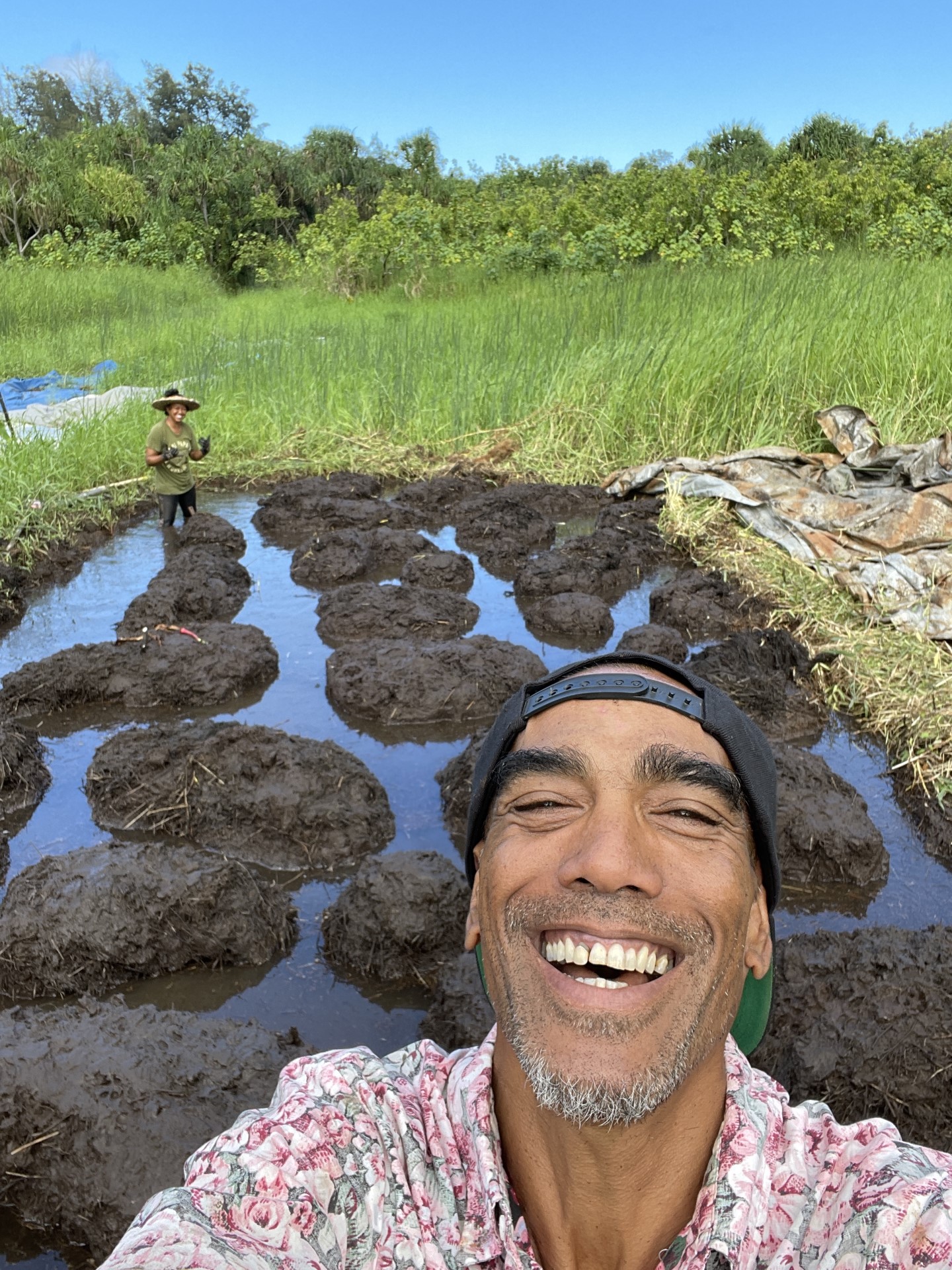
Kyle Nahoi, a Native Hawaiian, is using his Luce Fellowship to study how well taro grows in inceptisol soil. His research could help improve food security for the Hawaiian people.
While it saddens Nahoi to see this gradual devastation to his homeland, he has always been motivated by challenges. For Nahoi, the solution to a potential food crisis on the islands is Native Hawaiian taro, a superfood grown in Hawaii for many generations. Taro is gluten-free, hypoallergenic, and packed with vitamins, fiber, and other essential nutrients. In Hawaiian mythology, Nahoi explains, taro is considered an ancestor and eldest sibling. “When you respect, revere, and care for taro like it is both an ancestor and a child, you ensure survival into the future.”
According to the Hawaii Ocean Project, when taro was at peak production, it grew on approximately 35,000 acres across the islands. These days, it’s a grim reality, with diminishing taro production covering less than 350 acres, forcing the state to import two million pounds a year to cover demand.
Over the last decade, Nahoi has embarked on an independent research project to increase taro production among his people. He is trying to determine which one of 53 taro varieties that he has access to grows best in different soil types and locality.
He is currently in the fifth year of his research project, and as a Luce Indigenous Knowledge fellow, he is studying how well taro grows in inceptisol soil. “Because inceptisol soil is saturated all the time, it degrades in a certain way. I am trying to find out what taro varieties thrive most in this soil, and which are salt-tolerant due to the monthly and annual high and king tides,” says Nahoi. He will use Pu’epu’e-style cultivation and build hills to create taro-growing beds above water based on the area’s oral and written history. To combat erosion, he is planting native trees for soil-loss mitigation.
The Native Hawaiian, considered one of the island’s leaders in taro farming, has been working with other farmers on his research project. At the time of this interview, he and his partner had distributed more than 60,000 seeds to thousands of farmers on the islands of Maui, Molokai, Hawaii, Oahu, and Kauai. The farmers will be asked to supply him with data on their own varieties of taro seed cultivation in their soil types, and by “seed” he does not mean grain-of-rice-type seeds.
“These seeds are actual baby plants or ‘hula’ that come from the mother plant.” He explains that propagation of the actual seeds must be done by hand, and that type of ancestral science has not been done in two generations. To help with propagation, Nahoi will attempt to follow a step-by-step guide created by one of his partners, the University of Hawaii, which is available online.
“My research is ongoing and is a matter of survival,” Nahoi says emphatically.
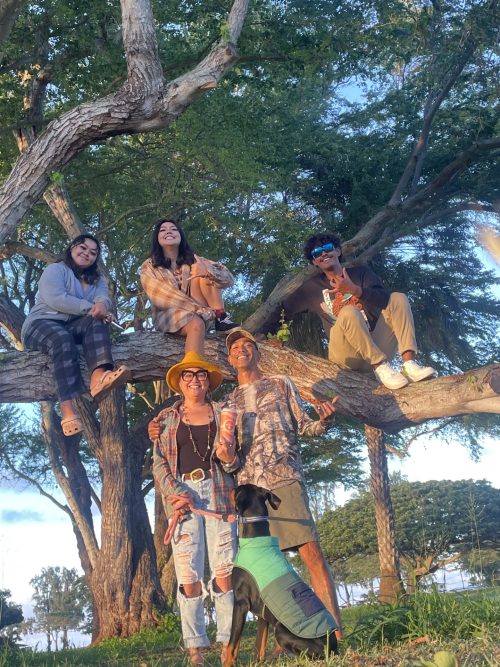
Nahoi poses with his family.
His journey to taro farming
Nahoi began farming taro in Maui as a young boy, at the age of 7. He says with a laugh, “I have a lifetime of taro farming and being a slave for my uncles.”
But it was a family tragedy that really motivated Nahoi to push forward with his taro farming project. In 2017, his beloved 21-year-old son passed away from cancer. “This extreme personal loss catapulted me into studying food’s role in human health and well-being,” he writes in his Luce application. “I made a 100% commitment to the preservation of taro, its lands, and its first-right water designation, as well as to its well-being from cultivation, its affordability in the community, and ensuring that people’s diets and lives would be uplifted.”
Nahoi is also focused on inspiring future farmers to carry on the tradition of taro cultivation. He says that no one wants to be a taro farmer. “You make no money, there are no subsidies for taro, you are hit with crazy farming taxes. It is almost insane to be a taro farmer.”
However, farming taro has never been more important to securing, preserving, and saving Hawaii for Hawaiians, according to the Luce Fellow. Water designation and first rights, by law, are for taro and taro cultivation. “This single activity can stave off the relentless desecration of our lands and is a keystone species vital to Hawaii’s future,” he says.
He believes the future of taro cultivation and preservation lies with the Hawaiian youth. In addition to working on his soil project, this father of five also invests his time in teaching Hawaiian children how important taro is to the culture. “My passion is teaching the kids and uplifting the next generation.”
Through his work as a resource teacher with the charter school, he takes the schoolkids to his taro farm weekly. With no internet access out there, the students cannot get distracted by their cell phones. “I tell them to leave their electronics in the car because they don’t work here.”
Nahoi says he teaches them about a different kind of connection, instead. “I teach them to love the land they are genealogically from, the miracles of survival of their ancestors, and to have a genuine appreciation of life. I tell them to take off their shoes and feel the land beneath their feet because it is THEIR land.”
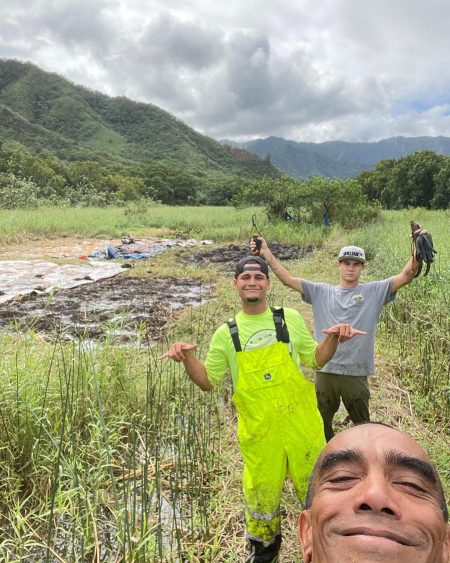
The 2023 Luce Fellow works with students on his taro farm.
How the Luce Fellowship will help
With financial assistance from the Luce Fellowship, Nahoi can stay focused on his current soil research and continue to inspire Hawaiian youth to pursue farming one day.
Through the fellowship and continued partnerships with farmers, the University of Hawaii, and other organizations, Nahoi will create a collaborative, comprehensive collection of knowledge on the different varieties of taro cultivation and disseminate this vital information to farmers, future farmers, educational institutions, and anyone else seeking this important cultural information to aid in long-term food security.
What’s more, he will be able to expand his farming operations from 30’x40’ gardens to 50’x100’ plots, and eventually ¼-acre lots. The funds will also help him buy necessary farming equipment, such as posts, shovels, and fencing to keep wild pigs from destroying the garden beds.
“My goal is to create one acre of each variety of taro for food and to create a seed bank,” he shares his vision, adding that he is always up for new learning opportunities around farming. “Taro farming makes me happy,” says the Luce fellow. “It uplifts my spirit and my soul. As Hawaiians, we were born to be stewards of the land, and to take care of that which takes care of us.
“Until my last breath, aloha!”