Lynda Teller Pete
Diné/Navajo


Diné/Navajo
 First Nations Development Institute (First Nations) is excited to partner with the Henry Luce Foundation (Luce) for a third year of the Luce Indigenous Knowledge Fellowship. In 2020, First Nations and Luce awarded the inaugural 10 $50,000 fellowships to advance and support the work of Indigenous knowledge holders and knowledge makers dedicated to creating positive community change. Beginning in 2021, we expanded the fellowship award to $75,000 over two years to support fellows committed to preserving and sharing Indigenous knowledge with future generations. In 2022, First Nations and Luce awarded 10 $75,000 fellowships.
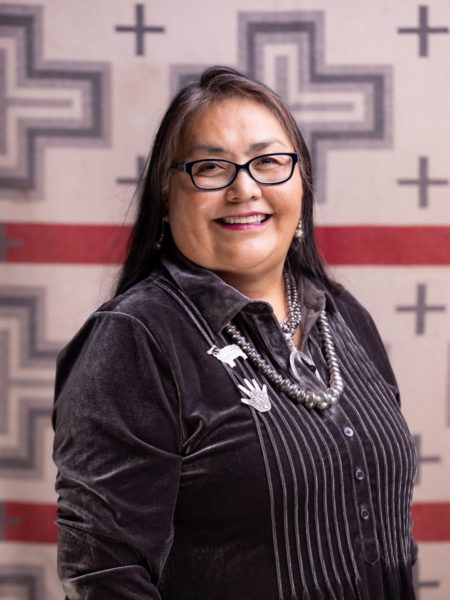 Lynda Teller Pete comes from a long line of Navajo weavers. Five documented generations of them, and likely more. “My earliest memories are of waking up to the sounds of my mother and grandmothers working at their looms at our ancestral home in Newcomb, New Mexico, on the Navajo Nation,” says Teller Pete, who learned how to weave sitting in her mother’s lap when she was only 6 years old.
Now a celebrated Navajo weaver, textile artist, teacher, and author, the 64-year-old Teller Pete is working passionately, alongside her sister, Barbara Teller Ornelas, to create renowned Two Grey Hills tapestries ─ in demand by collectors from all over the world ─ and to pass on the art of Diné weaving to the next generation.
According to Teller Pete, Two Grey Hills tapestries ─ named after the trading post where she and her siblings grew up ─ are known for their exceptional quality. “It is the most expensive type of weaving because we don’t use dyes, everything is naturally blended and handspun. People buy them as investments.”
When Teller Pete was 12 years old, she won her first blue ribbon for weaving at the Gallup Inter-Tribal Indian Ceremonial and sold the rug for $50 ─ practically a “fortune” for a young girl, she says. Now, her handmade wool tapestries command an asking price of between $2,500 and $15,000.
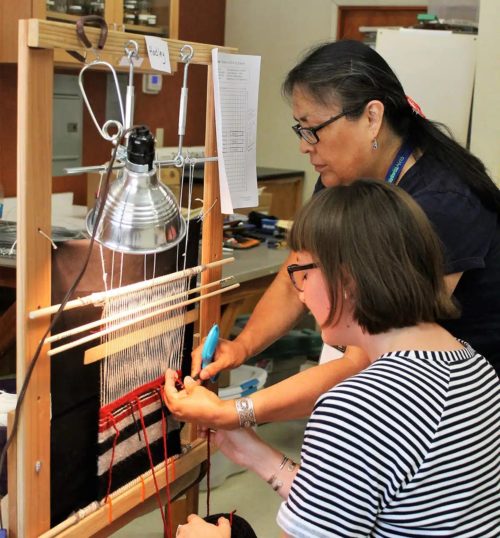
The Luce fellow instructs Hadley Jensen, a former graduate student, who is now a curator Lynda is working with on two major Navajo textile exhibitions.
But for Teller Pete, tapestry weaving is so much more than a first love and reliable source of income. It is a calling. “I have a responsibility to carry on my ancestors’ work and create opportunities for current weavers and future generations,” she declares.
To that end, the Luce fellow, who earned a Bachelor of Science in criminal justice from Arizona State University, left her 19-year career with the U.S. Department of Labor in 2010 to pursue Diné weaving full time, as both an art form and teachable cultural practice. “You know how people have pets for emotional support? I think the loom is my emotional grounding force.”
She and her sister, Barbara, have blazed many trails teaching Diné weaving to audiences all over the world through online and in-person workshops, lectures, and exhibitions. For 23 years, the sisters have taught weaving at the Idyllwild Arts Summer Program, and have turned novices into master weavers at the Heard Museum.
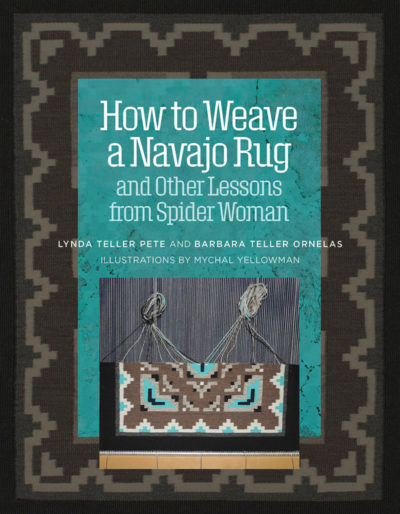 Together, they have written and published two weaving books ─ the first ever to be written by Diné weavers: “How to Weave a Navajo Rug and Other Lessons from Spider Woman” and “Spider Woman’s Children, Navajo Weavers Today.”
“All other books about Diné weaving have been written by non-Natives, and are stereotypes attached to our art form. We wanted to correct history and all the inaccuracies surrounding our craft,” explains Teller Pete.
How she will apply her Luce Fellowship
The Navajo weaver has big plans. First, she wants to use some of the Luce funds to purchase a camera, sound equipment, and a computer to carry on the tradition her mother started of archiving their family’s textile work through pictures she took long ago at the Two Grey Hills trading post. “My mom always had a small, Instamatic camera in her hand,” she recalls.
Like their mother, she and her sister are also documenting Diné weaving through their two books, currently written only in English. Plans are underway to work with a Diné language expert to translate the instructional book on how to weave a Navajo rug into the Diné language, along with a spoken version that can be used in language immersion classes at the Heard Museum.
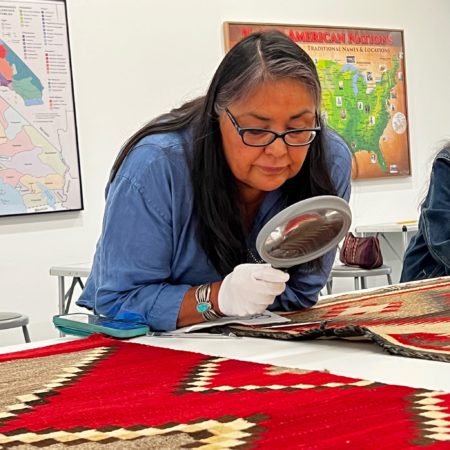
Lynda examines a tapestry during a textile consultation at Benton Museum of Art, Pomona College.
Many Navajos stopped weaving during the boarding school era, says Teller Pete, and she hopes this book will reconnect them with their culture. “I want to help those lost Navajo generations find their weaving linkages.”
The translated weaving book is projected to be completed by this fall.
She also plans to travel to Peru, Oaxaca, and Canada to learn about weaving practices in other Indigenous communities. “We don’t use plants to dye our wool at Two Grey Hills and Newcomb. Through my travels, I hope to learn more about dye plants.” Thanks to a collapsible loom her husband, a mechanical engineer, created, she can take her weaving on the road.
‘The future of weaving is strong’
Despite a long and sometimes difficult history around Native weaving that has been omitted from textbooks, according to Teller Pete, this important cultural art form still lives on.
“Our people have endured so much, with the U.S. army, slavery period, abuse from non-Native trading-post owners and livestock reduction. All that has put a strain on weavers, but our people are still weaving, and the future of weaving is strong,” she says, adding that her family, now seven generations, continues to work hard to keep the art of Diné weaving alive.
The Luce fellow’s work is in high demand. She has been commissioned by the Museum of Indian Arts & Culture (MIAC) to create a 24”x36” period tapestry for its permanent collection.
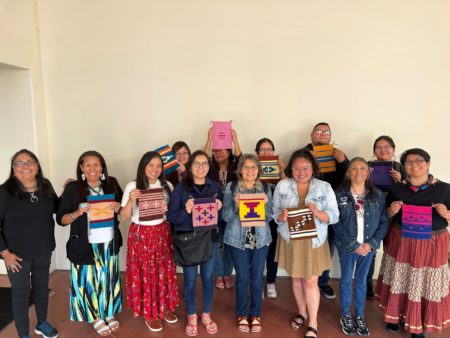
Lynda (far left) poses with her students at the Heard Museum in Phoenix, Arizona.
One of her passion projects is a series of women’s mantas, known as wearing blankets. “All the collectors want the male wearing blankets, or ‘chief blankets.’ But women’s mantas are much prettier and woven with such beauty,” she says.
And Eighth Generation has taken notice. The Seattle-based company owned by the Snoqualmie Tribe has partnered with Teller Pete to use one of her manta designs for their famed Native wool blankets. “When the CEO saw my mantas at the Santa Fe Indian Market, she said, ‘You HAVE TO BE one of our designers!’”
Teller Pete has been humbled by all the attention. Recently, she and her sister, Barbara, were honored with the MIAC Legacy Award ─ traditionally given to only one person ─ for preserving the art of Diné weaving and sharing its storied history. “We were surprised by the award. I didn’t think people noticed what we were doing. But I guess they did.”
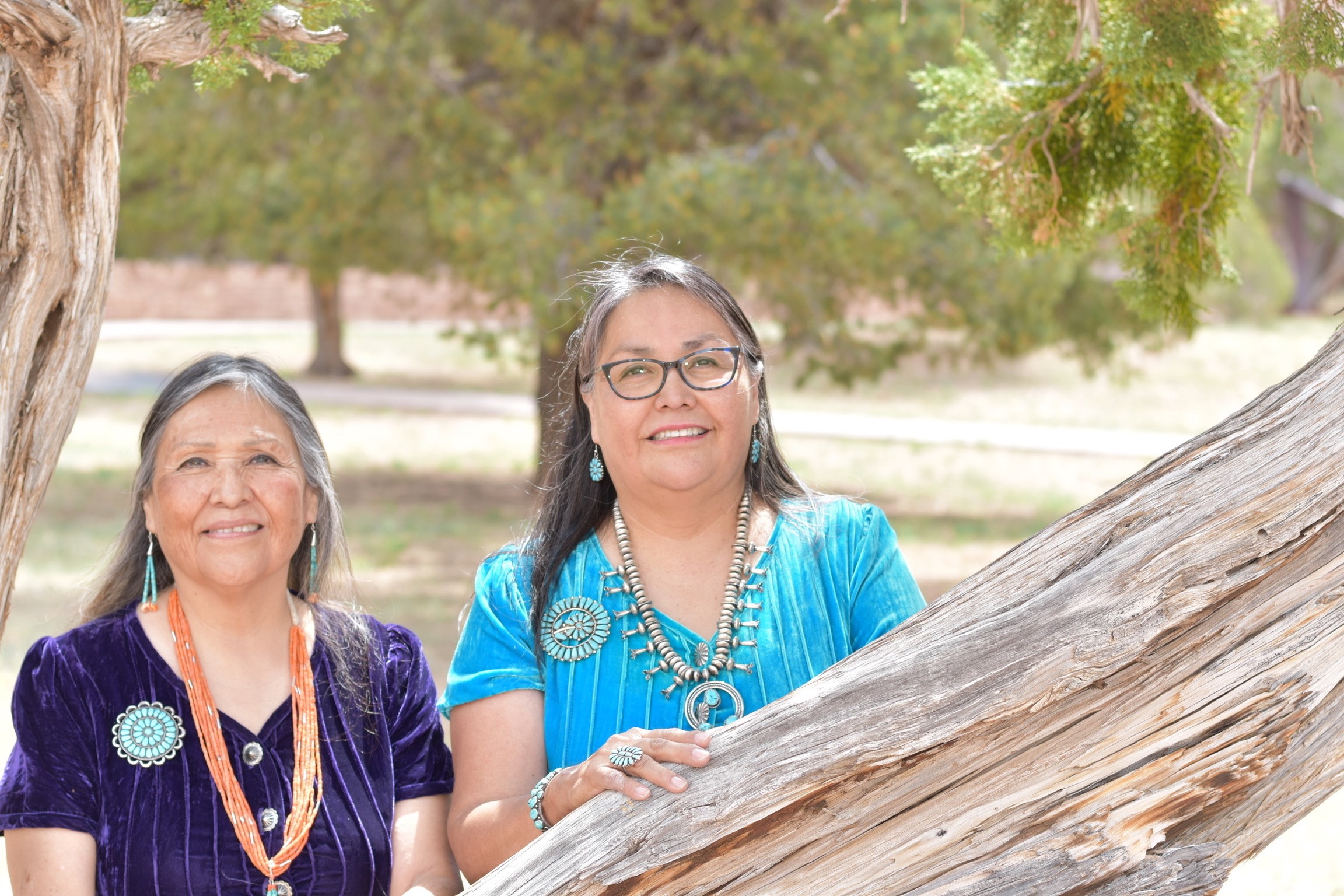
Lynda Teller Pete (right) and her sister, Barbara Teller Ornelas, are well-known, award-winning Diné weavers, authors, and longtime teachers of traditional Navajo weaving.