Matthew Vestuto
Barbareño/Ventureño Band of Mission Indians (Chumash)


Barbareño/Ventureño Band of Mission Indians (Chumash)
Matthew Vestuto has taken on an ambitious, but vital task. Ever since he was a young man, Vestuto has been on a mission to save the official language of his 150-member tribe, the Barbareño/Ventureño Band of Mission Indians (Chumash), for which he currently serves as tribal chairman.
The tribal language, mitsqanaqan, also called “Ventureño Chumash,” has been teetering on endangerment since the last first-language speaker passed away in the 1960s. “We like to say that our language has gone to sleep, and we are waking it up,” says Vestuto, pointing out that there are only 20 to 30 speakers left in the tribe. He is one of them. “The good news is, we were blessed with a huge archival record that is helping us revitalize the language.”
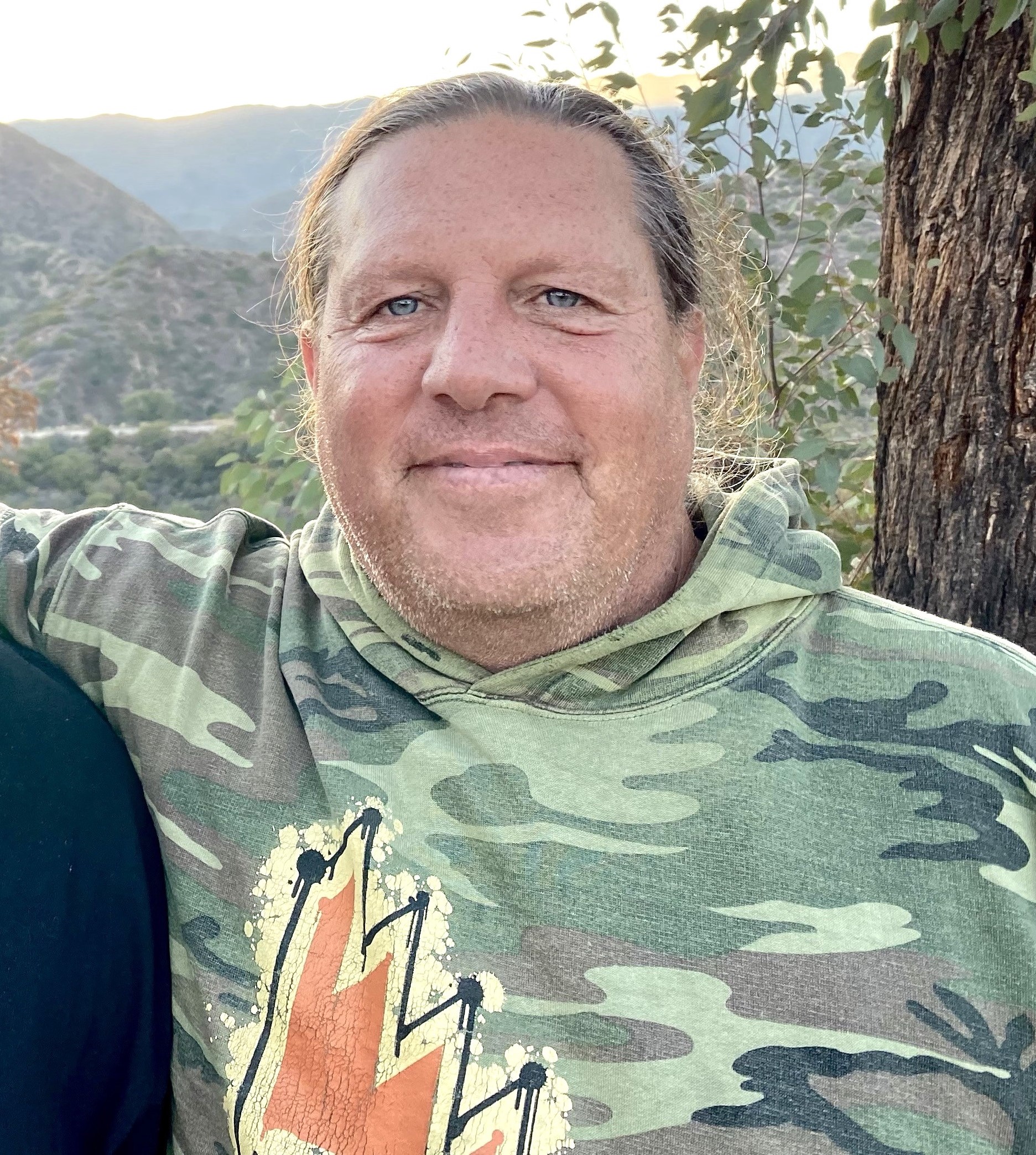
Matthew Vestuto, chairman of the 150-member Barbareño/Ventureño Band of Mission Indians (Chumash), has dedicated himself to revitalizing the Chumash language known as “mitsqanaqan.”
Vestuto is referring to the recordings of John Peabody Harrington, an American linguist and ethnologist who documented and recorded more than 130 Indigenous languages in North America, many spoken by California tribes. When Vestuto was 28 years old, he received xeroxed copies of Harrington’s notes from the University of California, Davis, and began transcribing and learning the mitsqanaqan language on his own.
“I worked in construction by day and transcribed at night. I realized the Harrington notes were so voluminous, that I would have to devote my life to this,” he recalls the beginning of his decades-long journey.
His goal was always to acquire the archival record from the Smithsonian Institution. In 2013, after many years of multiple requests to the Smithsonian, the museum finally repatriated to him all Harrington’s Chumash notes―more than 100,000 digitized pages. Vestuto is transcribing the notes pertaining to the mitsqanaqan language and culture.
Now at 58, as a 2024 Luce Indigenous Knowledge Fellow, Vestuto aims to complete the monumental undertaking he started 30 years ago. “My goal as a Luce Fellow is to finish transcribing the 28 reels of digitized microfilm. It’s pretty much done; there are just some stragglers that need transcription,” he says. “The larger project is to organize the material and package it into useful curriculum development to support language revitalization for a broad array of cultural topics, such as history, ceremony, songs, storytelling, and more.”
When asked what drives him to do this important, but arduous work, the Chumash Native says, “I want to see our culture live.” The Barbareño/Ventureño Band of Mission Indians (BVBMI), whose ancestors descended through the Santa Barbara and San Buenaventura missions, has not been given federal recognition, but the tribe is working toward that end. “I believe it is our tribe’s sovereign responsibility to usher our culture and language into the future. And I want to contribute to that.”
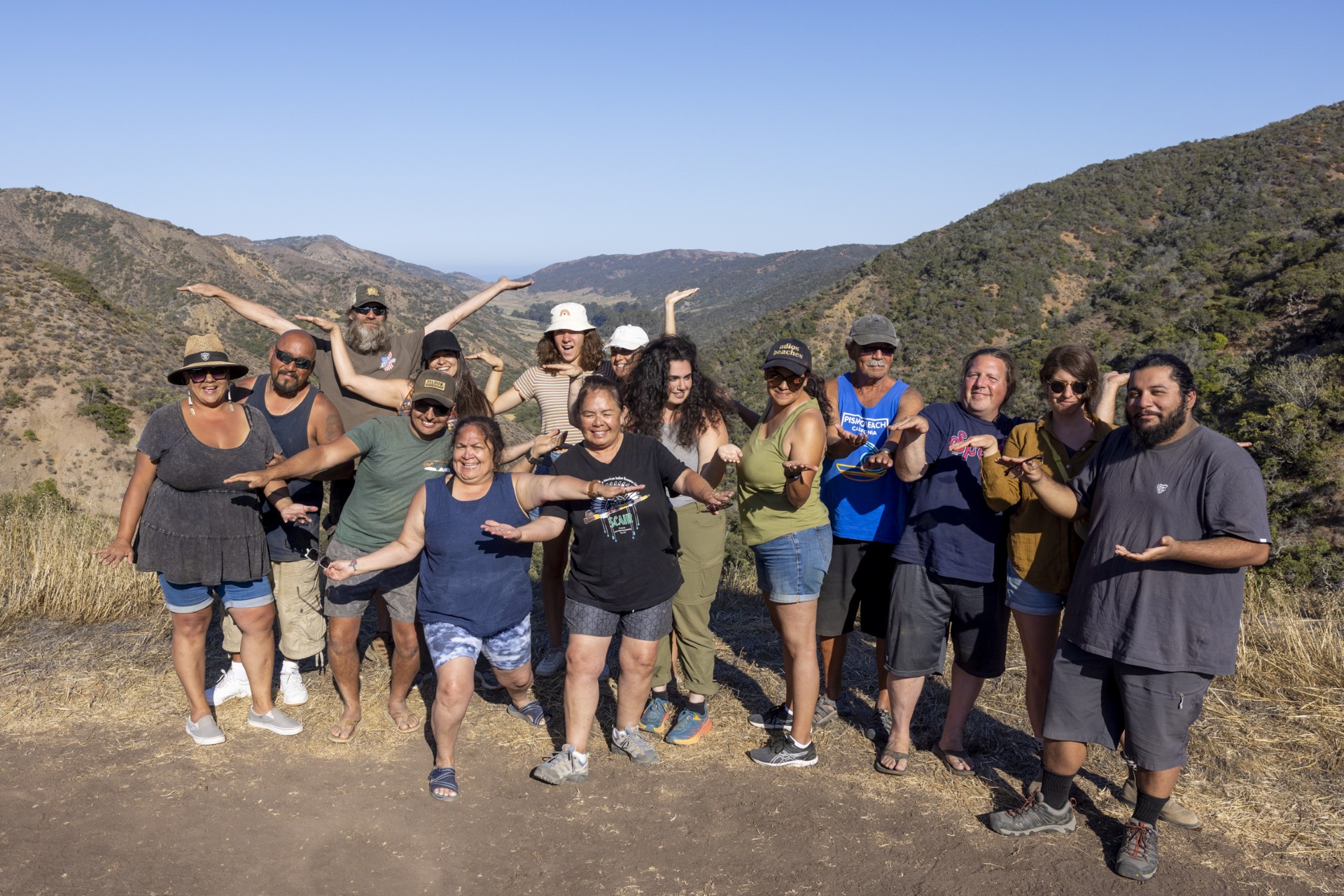
Vestuto with members from three of the four Chumash bands visiting limuw (Santa Cruz Island).
How he became a language warrior
Vestuto has always had a hunger for learning. His mother, a teacher, taught him to read before he entered Kindergarten. However, Vestuto admits he wasn’t always the best student. Instead of heading off to college with his peers, he went to the library and dug into self-study.
“I was interested in so many things. I had a mentor who told me to follow my bliss, my intuition. He told me, ‘You’re young; you have an empty bag. Go fill it with experiences and skills and knowledge that you will need in the future.’”
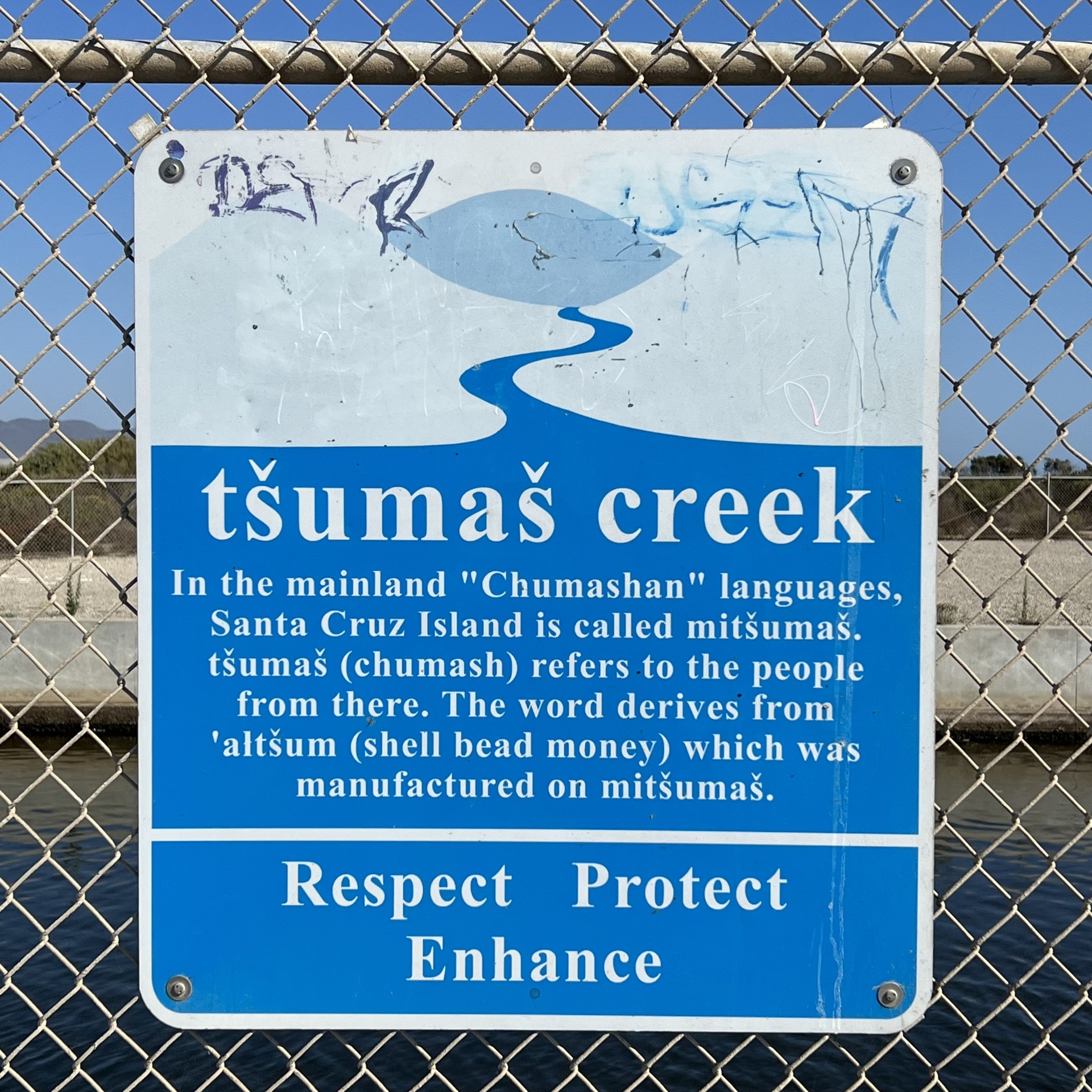
In 2015, Ventura County renamed one of its watersheds to “tšumaš creek.” Vestuto says, “It was really supportive of them to use our writing system and support our language revitalization.”
While working construction and transcribing Harrington’s notes on the side, Vestuto began to see his life’s path more clearly: “I realized that I needed to revitalize our language because that’s the key to understanding our culture.” He later went on to earn an interdisciplinary degree in language revitalization, linguistics, and media from The Evergreen State College in the state of Washington.
In 2018, Vestuto became BVBMI’s language program coordinator and began teaching the mitsqanaqan language to the Chumash community. His students range in age from 12 to 70, and most of the teaching or “facilitating,” as he calls it, is done once a week through Zoom, since many tribal members live at a distance. “Our work really blossomed during COVID restrictions.”
The goal for language-learning, says Vestuto, is not fluency. But rather, expanding the number of speakers. “Fluency is a vague concept. What I am aiming for is to get more people to use the language more often with more people.”
And the way he works to achieve that goal is through language nests.
Language-learning begins in the bathroom
Vestuto’s approach to teaching the mitsqanaqan language is a modification of the way the Maori, the Indigenous people of New Zealand, taught their language to the young through immersion-based language nests, or specific settings.
His language mentor, Zalmai ʔǝswǝli Zahir or “Zeke,” modified this concept within the context of a language nest by focusing on a specific space in the home and reclaiming the “domain,” which refers to a small, manageable portion of the language. “Zeke started with the bathroom because everyone has one and everyone performs activities there,” Vestuto explains.
For his students, the bathroom is their first classroom. While washing their hands and brushing their teeth, they use the Chumash language to describe those activities. “We do one domain a week and slowly build up our capacity to kick English out of the bathroom and claim it as a language nest for mitsqanaqan,” says Vestuto.
Once language nesting has been achieved in the bathroom, the classroom moves to the kitchen, then the bedroom. “The ultimate goal is to have a program where we can learn our language inside of two years and have a pretty good command of it.”
Other language work and collaboration with Luce fellows
The Luce Fellow has also been instrumental in creating an online Chumash dictionary with a graduate student in linguistics at the California State University Channel Islands (CSUCI), which hosts the website. “We add new words all the time,” he says.
Most visitors to the website are Vestuto’s students, but he emphasizes that the dictionary is available to anyone interested in learning mitsqanaqan. “When you limit access to the dictionary to only Chumash, you are contributing to the death of our language.”
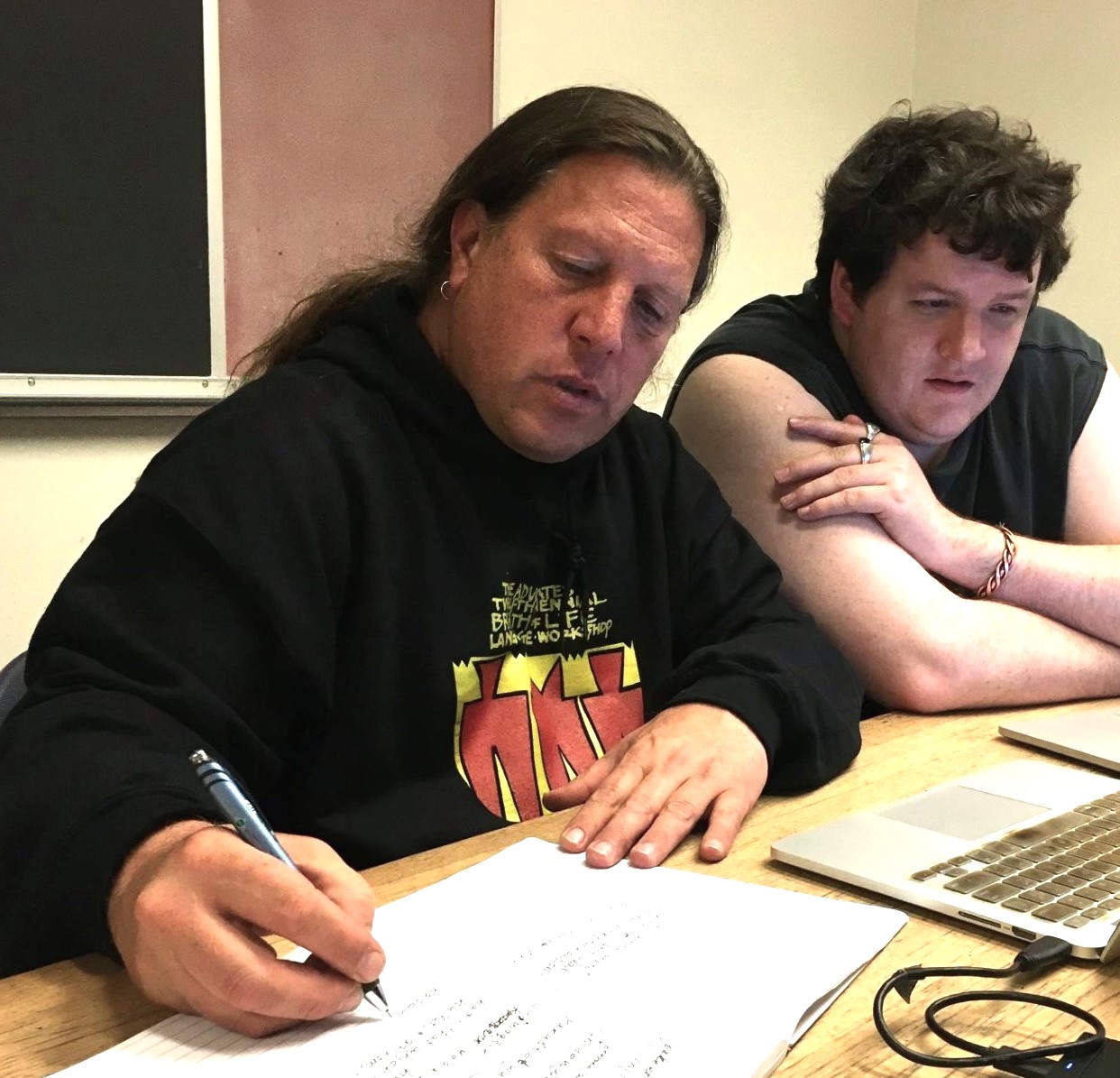
Timothy Henry (right), a linguist who earned a Ph.D. in mitsqanaqan, also called “Ventureño Chumash,” helps Vestuto with transcription work.
To further educate the community about his tribe, and as another avenue to teach the Chumash language, Vestuto recently founded a nonprofit organization called the Lulapin Chumash Foundation. He explains the mission:
“We are a big-tent, Chumash-led nonprofit intending to work with four Chumash bands to build a healthy, empowered community through education and events” and field trips to Santa Cruz Island, BVBMI’s homeland. The foundation is still in its infancy. “I like to say I built a pair of clown shoes, and I have baby feet in them,” he says metaphorically.
One of the benefits of being a Luce Indigenous Knowledge Fellow is networking with others in the cohort and sharing knowledge with those doing similar work. Vestuto is happy to report that he has connected with two other 2024 Luce Fellows involved in language revitalization ― Warlance Chee and Jamie Jacobs. “We are developing friendships, and I am eager to learn from them,” he says.
The good news is, other Chumash tribal members are stepping up to help Vestuto revitalize their ancestral language. “A lot of young people are really thirsty and hungry to do this work,” he says.
Young and accomplished Natives like Alanna Cronk, a graduate of Georgetown University and a recipient of numerous fellowship awards. She writes in her Luce Fellowship recommendation letter for Vestuto: “I cannot overstate the gift Mr. Vestuto has given me and so many others in my tribe. I see elders casually use greeting phrases in our language. I see community members singing songs together. I see young kids asking their parents for our traditional rattle―all thanks to the tireless efforts of Mr. Vestuto bringing our cultural knowledge into our community.”
Cronk concludes with her highest recommendation. “Creator has given the Chumash people a gift in placing the mission of knowledge-keeping on Mr. Vestuto’s heart.”