Melody Redbird-Post
Kiowa Tribe


Kiowa Tribe
 First Nations Development Institute (First Nations) is excited to partner with the Henry Luce Foundation (Luce) for a third year of the Luce Indigenous Knowledge Fellowship. In 2020, First Nations and Luce awarded the inaugural 10 $50,000 fellowships to advance and support the work of Indigenous knowledge holders and knowledge makers dedicated to creating positive community change. Beginning in 2021, we expanded the fellowship award to $75,000 over two years to support fellows committed to preserving and sharing Indigenous knowledge with future generations. In 2022, First Nations and Luce awarded 10 $75,000 fellowships.
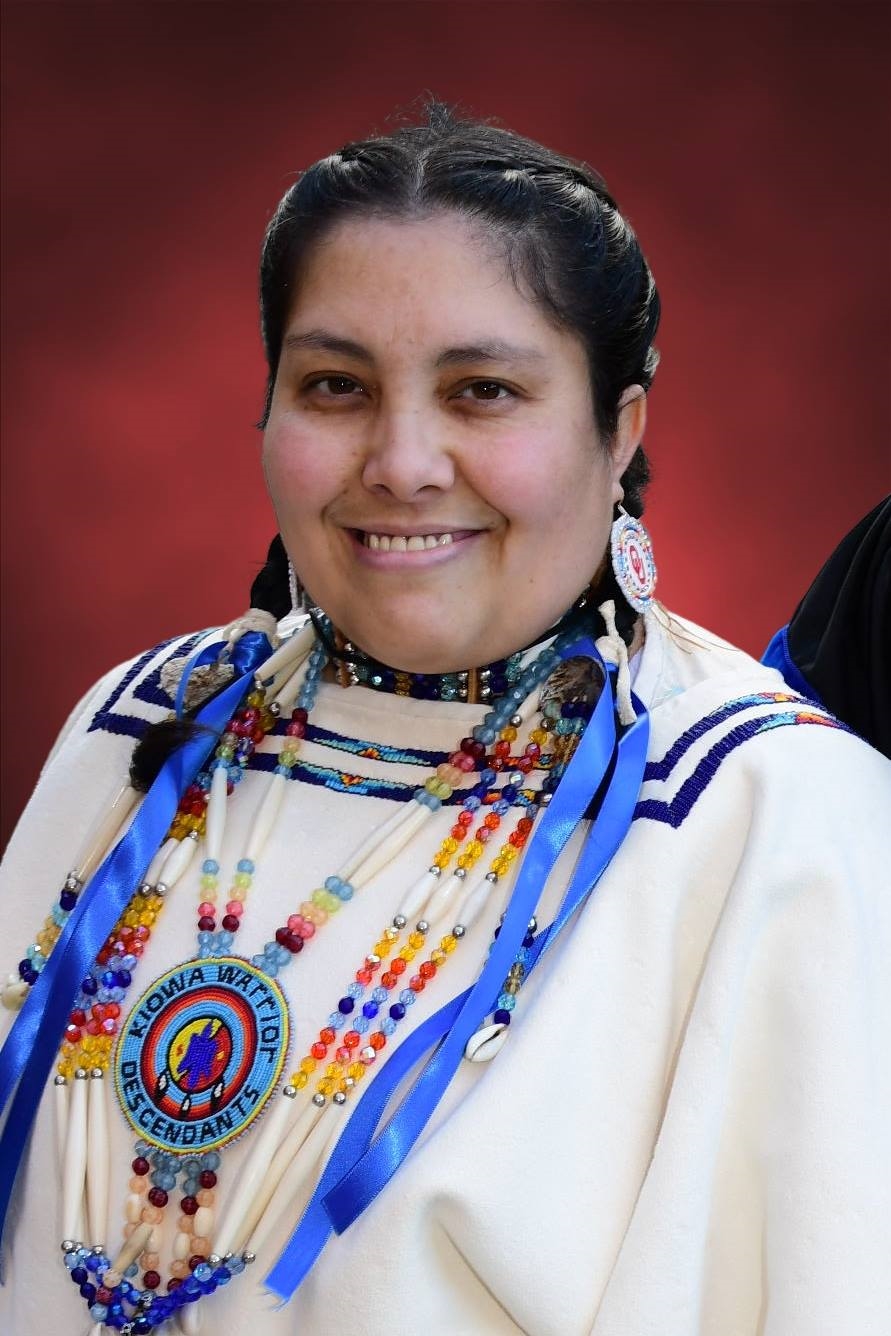
Melody Redbird-Post
Melody Redbird-Post’s paternal grandmother, Ruth Whitefox Redbird, told her something when she was just 10 years old that stuck with her and shaped her entire life. She said, “The day we stop speaking our language is the day we cease to exist as Kiowa people.”
With the words of her grandmother guiding her, Redbird-Post started on a life‘s journey to help revitalize the Kiowa language when she was a 19-year-old summer youth worker that continues to this day. “Our language is severely endangered and only spoken by our great-grandparents,” she outlines the urgency to preserve it. “These elders are our last real connection to our Tribe’s language and our Tribal knowledge.”
Before the pandemic, Redbird-Post says there were around 50 fluent speakers of the isolate language in a Tribe of about 10,000 enrolled members. Since then, they have lost many more. “It has been my personal motivation to take up the charge left by our elders to ensure that our Kiowa knowledge systems remain.”
And she has gone above and beyond to do just that. Through the years, the Kiowa Tribal member, now in her 40s, has worked in numerous capacities in language and culture revitalization, and curriculum leadership and development. She recently earned a doctorate degree in early childhood education focused on developing curriculum in Tribal language immersion programs to inform immersion possibilities for the youngest Kiowa Tribal members.
On her own homefront in Oklahoma, Redbird-Post and her husband are doing all they can to immerse their five children, ages 11 to 19, in Kiowa ways and language. “We sing, dance, and participate in our Kiowa ceremonies,” says Redbird-Post, a second-language learner who also found time to earn a special credential from the Tribe through the Kiowa Language Credentialing Board to teach the Kiowa language in schools and colleges.
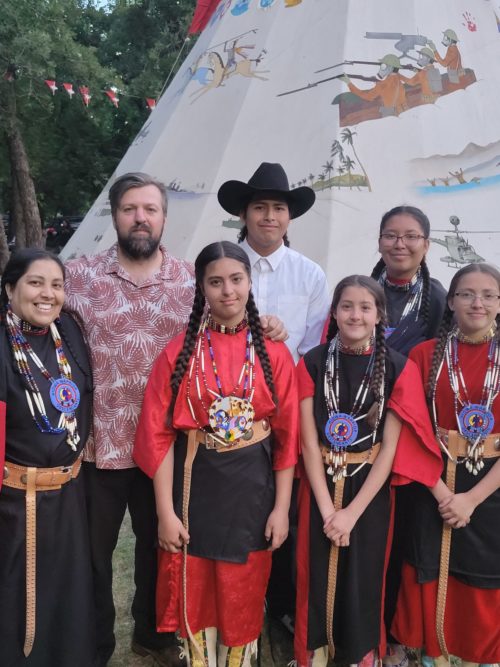
The Luce Indigenous Knowledge fellow poses with her husband and five children.
The specific goal of this Luce Indigenous Knowledge fellow is to define Kiowa ways of learning around how Kiowa children grow. “I want to ensure that our Kiowa community has a foundation on which to embrace our Kiowa knowledge and bring our Kiowa understanding of child development back into being.“
Redbird-Post aims to develop something that is Kiowa-specific, developed for and by Kiowa people.
While no one in the Tribe has yet to create a specific theory of knowledge for early childhood education, she notes that in the 1990s, Alecia Keahbone Gonzalez, a fluent Kiowa speaker and educator, embarked on a similar journey and developed a Kiowa curriculum for the Kiowa Tribe Head Start program, and later, a Kiowa language textbook that Redbird-Post incorporated into other curriculum work for the Tribe.
Other influential Kiowa educators that have both mentored and inspired Redbird-Post include Martha Addison and Brenda Sullivan.
How she will use her Luce Indigenous Knowledge Fellowship
What does it mean to be a Kiowa person? How do you instill a Kiowa identity from the moment a child is born all the way up through adulthood? What are specific “Kiowa ways of knowing” that should be passed on from grandparents to parents to children?
These are the questions informing Redbird-Post’s fellowship work.
“My plan is to gather and compile the knowledge and wisdom that has been shared with me by our elders over the years into a guide for parents and teachers that can be accessed in a printable PDF and digitally on our website, learnkiowa.org, which is currently under construction,” she explains, and is quick to give credit to a team of 12 people and organizations assisting with this project. “It’s a very collaborative process.”
Redbird-Post and her team will also develop videos to accompany the guide, which will contain Kiowa songs, dances, and traditional stories, including Saynday stories for children that feature a larger-than-life fictional character who teaches lessons and Kiowa values during his adventures.
One of the greatest Kiowa values ─ and a good example of a “Kiowa way of knowing” ─ is “respect.” According to Redbird-Post, Kiowa children must be taught how to respect their elders, parents, teachers, people in the community, animals, nature, the earth, and themselves. “Without respect for all these things, we really cannot interact as a Kiowa person,” she says.
As part of her Luce fellowship, Redbird-Post meets weekly with elders to translate hundreds of recordings owned by the Kiowa Tribal Museum that were created by fluent Kiowa elders in the 1970s over a period of six years. Although these 15 elders have long since walked on, they left behind a “treasure trove” of Kiowa resources and knowledge that no one has ever translated from Kiowa into English.
These recordings cover many topics central to the Luce fellow’s work, such as Kiowa childcare, how Kiowa babies and youth are treated, and the roles of Kiowa men and women.
“Every elder I work with now spends every single moment just trying to share another story or a phrase or a word they haven’t heard in a while. They know that every moment is precious, and they don’t have much time left to pass on the Kiowa language and our tribal knowledge,” Redbird-Post shares with First Nations.
Prioritizing Kiowa children and the future
Just as Redbird-Post’s grandmother passed on her knowledge and wisdom to her granddaughter, who the elder affectionately referred to as “Windsong Woman,” the Luce fellow now embraces her obligation to educate the current generation of Kiowa children.
“I really want our kids to represent the future generations of Kiowa people. I want them to be proud of who they are as a Kiowa person and understand their own identity,” Redbird-Post speaks of her greatest dream, adding that “we need to turn off our English brain and see the world through Kiowa eyes.”
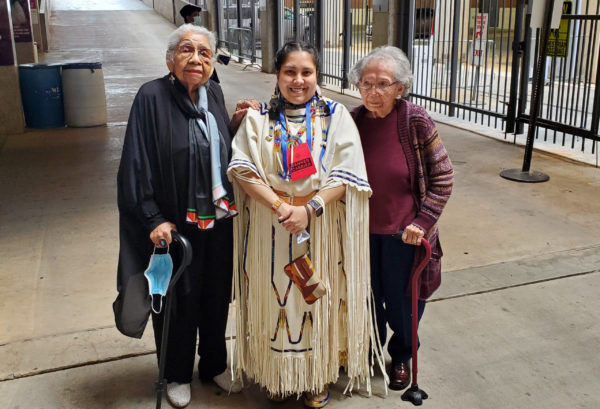
Redbird-Post is pictured with her two mentors: Dorothy Whitehorse DeLaune (left) and Delores Toyebo Harragarra (right) at her doctoral commencement ceremony at the University of Oklahoma.
Everything she does is not only for Kiowa children, but also to honor the legacy of her grandmother, her predecessors, and the living elders. “I stay motivated because the elders with whom I’m working really want to know that they have left an impact, that they won’t be forgotten, and that their knowledge will live on.”
Her primary mentor has been Mrs. Dorothy Whitehorse DeLaune, a Kiowa elder and first-language Kiowa speaker. “This work is very important. This has never been done before and it is so valuable,” says DeLaune about Redbird-Post’s project on bringing back traditional Kiowa child development knowledge. To emphasize the importance of this work, DeLaune adds, “ì:p’àu:gáut sáutdèk’yágôñbàu á dáu [ee-p’aw-gawt saw-tday-k’yah-kohn-baw ah daw.” Translation: “Babies are the little people that come behind us and follow our example.”
Redbird-Post is grateful to First Nations for choosing her for the Luce Indigenous Knowledge Fellowship. “They have created this amazing opportunity and space for us to be who we really are, honor Indigenous knowledge, and make some of our dreams a reality. I know that the elders are especially grateful.”