Rahnekawę̀·rih Montgomery Hill
Skarù·rę Tuscarora Indian Nation

Skarù·rę Tuscarora Indian Nation

In 2020, First Nations Development Institute (First Nations) in partnership with the Henry Luce Foundation (Luce) awarded ten $50,000 fellowships to support Indigenous knowledge holders and knowledge makers dedicated to creating positive community change. The Luce Indigenous Knowledge Fellowship is a 12-month, self-directed enrichment program that provides fellows with the funding and connections necessary to maximize their potential and spark significant innovation and transformation in their communities.
Among the first cohort of Luce Indigenous Knowledge fellows, Montgomery (Monty) Hill is a Tuscarora and Oneida speaker, linguist, and language activist. As part of the Luce Indigenous Knowledge Fellowship, Hill is translating the Great Law of Peace in ways that are meaningful and relevant to his tribal community.
“A Tuscarora translation of the Great Law of Peace will strengthen and empower my community,” says Hill. “The creation of this document will give my community the means to restart the process of the intergenerational transmission of our knowledge as Haudenosaunee people.”
Montgomery (Monty) Hill (Skarù·rę Tuscarora Indian Nation) is among the first cohort of Luce Indigenous Knowledge fellows. Hill is a Tuscarora and Oneida speaker, linguist, and language activist. He earned his Ph.D. in linguistics at the University of Buffalo in New York.

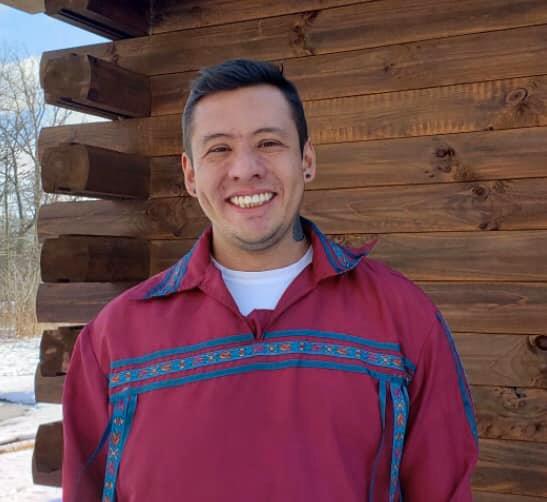
Montgomery (Monty) Hill in front of the Haudenosaunee longhouse where he organized men’s meetings to create a safe space for Tuscorora language speakers.
As a Haudenosaunee citizen, Hill is responsible for serving as one of the speakers at his tribe’s longhouse for ceremonies, and delivering speeches on behalf of his nation’s chiefs during local and grand councils. “It is necessary [for me] to ensure that knowledge of these practices and the meaning behind them are accessible to my community from now and into the future,” says Hill.
Toward this end, Hill started transcribing and translating these speeches so that he can share them with the rest of his community. Specifically, as a doctoral student, Hill began translating the Haudenosaunee’s Kayanere’kó:wa or Great Law of Peace, an “intergenerationally communicated record” that encompasses Haudenosaunee culture, history and values. Translation is a tricky and time-consuming process that must account for cultural and linguistic nuances.
The Luce Indigenous Knowledge Fellowship has provided Hill with the time and space necessary to translate the Great Law of Peace in ways that are meaningful and relevant to his tribal community. His goal is to translate these speeches into Tuscarora and English so that younger generations might have access to these documents at school and during community events.
“A Tuscarora translation of the Great Law of Peace will strengthen and empower my community,” says Hill. “The creation of this document will give my community the means to restart the process of the intergenerational transmission of our knowledge as Haudenosaunee people.”
Community Background and Impact
Hill carries the Haudenosaunee name Rahnekawę̀·rih. He is a citizen of the Haudenosaunee (Iroquois) Confederacy, and specifically he is a member of the Tuscarora Nation Beaver clan.
The Haudenosaunee or the People of the Longhouse is comprised of six distinct nations (Mohawk, Oneida, Onondaga, Cayuga, Seneca and Tuscarora). Each nation consists of multiple clans or groups of people who come together as families.
Although each nation and clan is related, it is important to note that each community has their own distinct languages, cultures, and histories. However, due to the devastating effects of settler colonialism, many Haudenosaunee languages are dwindling.
The Mohawk language is the strongest with more than 3,000 fluent language speakers throughout the U.S. and Canada. The Tuscarora language, on the other hand, has all but been lost. The last Tuscarora speaker, Howard “Howdy” Hill, passed away in 2019.
Before his passing, Howdy Hill spent many hours making recordings and working with Haudenosaunee language teachers to revive the Tuscarora language. Howdy Hill was one of Monty’s elders and mentors. Monty feels a strong sense of responsibility to follow in his elders’ footsteps by learning and sharing the language.
In 2013, Monty was invited to become a speaker at the community’s longhouse. Longhouse speakers are responsible for learning the oral language and sharing its teachings with community members. In an attempt to share the language, Hill organized men’s meetings to create a safe space to help cultivate other speakers within the community.
He also began translating and transcribing these speeches and oral teachings to print form to share with other community members, particularly tribal youth and young adults. As a doctoral student, Hill began translating the Haudenosaunee’s Kayanere’kó:wa or The Great Law of Peace into Tuscarora and English.

Monty with his partner Rosemarie Sampson at the Haudenosaunee longhouse.
The Great Law of Peace
During the fellowship period, Hill continued translating the Great Law of Peace, which is a great oral narrative that documents the formation of the six Haudenosaunee nations. In addition to oral teachings, it is also commemorated on beaded wampum belts.
Hill explains, “The Great Law is a set of principles and procedures that lay out the responsibilities of every Haudenosaunee citizen on how to conduct ourselves as individuals and collaboratively in order to maintain peace, exert our sovereignty and have a good life.”
Although the Great Law of Peace has already been translated and transcribed into Mohawk, Oneida, and other Haudenosaunee languages, a Tuscarora version of the Great Law of Peace does not currently exist. Hill’s goal is to translate the Great Law of Peace into Tuscarora and English so that these cultural principles and values can be incorporated into curricula for tribal youth.
Translating the Great Law of Peace into Tuscarora is not an easy feat, especially since there are not any more living fluent Tuscarora language speakers. As a result, Hill also has been working with other Haudenosaunee language speakers, primarily Mohawk and Oneida speakers, to help him better understand and translate the Great Law of Peace into the Tuscarora language.
Hill notes that translation is more than exchanging a word in one language for a word in another language. Translators must also consider how to incorporate cultural context and linguistic nuances into their translations. “In many ways, it is like writing poetry,” observes Hill.
On the surface, the Great Law of Peace might seem like a straightforward narrative about a hero and his various adventures. However, Hill notes that the hero’s journey is actually a moral story that imparts cultural lessons and values. As a translator, then, Hill must also figure out how to “capture the philosophical and moral values” embedded in the narrative.
“At first, I was disappointed that I didn’t accomplish more during the fellowship period,” says Hill. “However, I realized that I’m laying the groundwork for [my life’s work] and that I need to pace myself.”
Gratitude
The recent pandemic, without a doubt, slowed Hill progress. For example, during the fellowship period, he was unable to meet with elders or community members in person to flesh out his translations. Also, like many people during the pandemic, he spent much of his time helping his five children with online school.
Despite the impacts of COVID-19, however, the Luce Fellows continued to meet online via Zoom, which many of the fellows noted was a saving grace during such a challenging and difficult time. Hill says he drew strength and inspiration from the fellows in his cohort.
Although each Luce Fellow possesses a different tribal background or area of expertise, Hill notes that they all bonded over similar concerns in their communities. “Although we each have different backgrounds and skill sets, we deal with a lot of the same struggles,” he says. It’s really cool to be in touch with so many smart Indigenous people working together to envision a positive future for their communities and Indigenous people as a whole.”
Hill is grateful to First Nations and the Luce Foundation for bringing this cohort together. He says, “These fellowships are really significant. They are given to individuals who turn around and put it right back into their communities, directing it toward those areas that need it most.”
Hill encourages other philanthropic partners to follow this lead and empower Indigenous people to address the needs of their communities on their own terms. He says, “First Nations and the Luce Foundation are entrusting people in the community to take care of their own communities. I am so grateful for being given this opportunity.”