News
Thought Leadership
Protecting Resources, Uplifting Alaska Native Communities in the Bering Sea
Spanning 878,000 square miles, the Bering Sea is one of the largest bodies of water in the world, providing habitat for an abundance of birds, whales, seals, sea otters, and at least 419 species of fish, including salmon. For millennia, more than 70 Alaska Native communities have shared a deep, reciprocal relationship with the Bering Sea.

Mellisa “Maktuayaq” Johnson (Nome Eskimo Community Tribal member)
As a collaborator with First Nations’ community partner Arctic-Yukon-Kuskokwim Tribal Consortium, Mellisa “Maktuayaq” Johnson (Nome Eskimo Community tribal member) has dedicated her life to upholding responsibilities of stewarding land and sea resources to sustain lifeways and community well-being. She grew up going to her family’s fish camps outside the Nome area, next to the Bering Sea. Her grandparents taught her that the marine ecosystem is family and that she is part of that ecosystem. “They taught me that nurturing the Bering Sea is our responsibility as Native people,” she says.
Maktuayaq carries those words with her as she advocates to protect the Bering Sea through her involvement in the North Pacific Fishery Management Council (NPFMC) – one of eight regional councils responsible for managing federal fisheries across the United States. On this council, she serves on a 21-member advisory panel, representing Alaska Native perspectives in federal fisheries decision-making and advocating for policies that protect salmon, subsistence lifeways, and the long-term health of the Bering Sea ecosystem.
Stories of Iqaluit
Maktuayaq’s grandparents also taught her that Iqaluit – salmon – are not just food. They are a gift. Salmon are central to the identity, culture, and survival of Alaska Native communities. This relative sustains Alaska Native families through winters; supports sharing networks within and across communities; and connects people to ceremony, traditional knowledge, language, land, and stories.
“Salmon teach us responsibility, respect, and balance with the environment,” she says. “I grew up in the Nome fish camp areas, where summers were centered around salmon. Some of my earliest memories are at camp – hearing waves along the shore, smelling driftwood smoke to keep flies away, and watching my grandparents carefully prepare salmon so everything was used.”
Over her lifetime, Maktuayaq has witnessed noticeable declines in salmon abundance and experienced increasing unpredictability in runs. Communities that depend on reliable harvests are facing restrictions that impact food security and cultural practices. These changes highlight the urgency of addressing the root cause of salmon decline.
The bycatch problem
Salmon populations in the Bering Sea have been declining for decades. Maktuayaq strongly believes bycatch has significantly contributed to the decline of salmon runs. Bycatch refers to fish and other marine life that are unintentionally caught while fishing for another targeted species. “On a community level, bycatch means fewer salmon returning to our rivers and fewer opportunities for our families to harvest traditional foods. It means empty fish racks, increased food insecurity, and the loss of cultural practices that rely on salmon. Bycatch is not just a fisheries issue – it is a food security and cultural survival issue for Alaska Native communities.”
Chinook and chum salmon make up the majority of salmon bycatch, according to the NPFMC. NPFMC designates salmon as a Prohibited Species Catch (PSC), meaning that fishermen are not allowed to retain or sell salmon that are caught incidentally while targeting other species, including in fisheries that use pelagic trawl gear.
“In 2021, it was estimated that over 3 million pounds of halibut were being discarded as bycatch. Alaska Native tribes and community leaders are advocating for zero bycatch in pollock fisheries, as the wasteful disposal of salmon leaves Alaska Native communities of the interior, including First Nation Canadian Peoples, unable to access traditional food.” – Protecting Bering Sea Ecosystems, First Nations Development Institute
Increasing Native voices
Native voices and representation at fishery management meetings are essential to restoring balance to marine ecosystems. Unfortunately, many Alaska Native people have been excluded from decision-making bodies, such as the NPFMC. During NPFMC meetings, major decisions are made on fishing issues – such as harvest specifications, bycatch, climate readiness, and fishery closures – that will have a profound impact on Alaska’s marine life, ecosystems, and Native communities.
Maktuayaq is one of only three Alaska Natives serving on the NPFMC advisory panel, and she argues that it should be the reverse. “Alaska Natives should be the majority on these management bodies because we have stewarded these waters since time immemorial.”
Maktuayaq has testified in public forums highlighting the significant inequity in Native representation on the NPFMC Advisory Panel. Most seats are occupied by small boat fishermen and representatives from the industrial fishing industry. “Most concerning, the NPFMC that we report to, which has all the decision-making power, has only one designated tribal seat, serving as the voice for the 229 federally recognized tribes in Alaska.”
The work continues
Many years ago, Maktuayaq’s grandmother, Daisy Jack, was interviewed for a story about the scarcity of food in her village and how her family relied on salmon fishing in the warmer months to get them through the winter. Daisy’s story was so compelling that it was written into the Alaskan Congressional Record in 1966 – a part of Maktuayaq’s family history that brings immense pride and keeps Maktuayaq focused on her advocacy. She writes:
“I must remain optimistic because I am doing what my grandmother started generations ago. I am going to keep doing what I am doing in the name of salmon – for our ancestors, for our children, and for the generations yet to come, so our people never lose the lifeways that define who we are, because stewardship is not a choice – it is our responsibility.”
First Nations affirms this commitment. Without fully addressing the challenges driving population decline – such as bycatch, climate change, and habitat disruption – any one measure alone is unlikely to bring lasting recovery. To truly support the health of salmon and the well-being of Alaska Native communities, change is needed. There must be greater investments in local stewardship and traditional knowledge, stronger intertribal coordination, greater Alaska Native representation on decision-making bodies, and support for Alaska Native youth as the next generation of ocean and river protectors.
 First Nations created the Protecting Bering Sea Marine Resources project to uplift the lifeways of Alaska Native tribes and communities in the Bering Sea region. Over the last three years, eligible tribes and Native-led organizations, including Arctic-Yukon-Kuskokwim Tribal Consortium, have received funding and technical assistance to strengthen their efforts in safeguarding Bering Sea marine life.
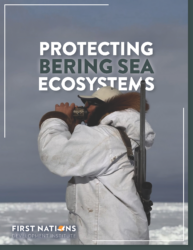
Our new report, Protecting Bering Sea Ecosystems, features the work of the 2022 Community Partners, including Kawerak, Inc.; Alaska Nannut Co-Management Council; Aleut Community of St. Paul Island; Arctic-Yukon-Kuskokwim Tribal Consortium; Atux̂ Forever: Restoring Attuans’ Freedom; Bering Sea Elders Group; and the Qawalangin Tribe of Unalaska. The report outlines key regional challenges stemming from climate change, commercial fishing, chronic underinvestment, and limited infrastructure, as well as the impacts these challenges inflict on Native communities. Download the report here.
Through our Environmental Sovereignty and Justice focus area, First Nations continues to support efforts to protect Bering Sea resources, and defend tribal homelands from harmful policies, extraction, and pollution. It is an honor for me to be involved with this work through the Stewarding Native Lands program at First Nations.

Jacque Demko (Mandan, Hidatsa, and Arikara Nation)
Director, Stewarding Native Lands