This Week at First Nations: August 4, 2023
 The Eldests: Stories of Economies
In Nonprofit Quarterly this week, First Nations’ A-dae Romero-Briones explores how our stories connect us all to each other and the world around us, describing how our life sources help conceptualize what is possible. When it comes to economies, we are still telling a story. And while mainstream economies panic at the sign of failure, Tribal creation stories recognize the importance of “absence.” “This part of the story is just as important, because it establishes limits, ends, and the concept of exhaustion as part of natural and recurring cycles. Life sources or resources, if we are not mindful, can be exhausted,” she writes. Read more from A-dae here.
 Final Reminder: Native Agriculture & Food Systems Scholarship
To encourage more Native American, Alaska Native, and Native Hawaiian college students to enter agriculture and food systems fields so that they can better assist their communities, First Nations will award 20 to 25 $1,000 to $1,500 scholarships to Native college students majoring in agriculture and agriculture-related fields. The application window for scholarships for the 2023-2024 academic year is now open. Apply here by August 10, 2023.
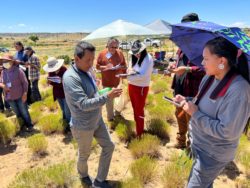 Pinon Conservation Planning Training Advances Ecological Stewardship
Last week, staff from First Nations’ Stewarding Native Lands program hosted a five-day Conservation Planning Workshop in Pinon, Arizona, where 24 local farmers and ranchers learned about conservation stewardship through four classroom sessions and one full day in the field. Participants discussed range and farm monitoring, resource management, and conservation practices. In the field, they focused on soil evaluation practices, rangeland plant identification and production, and wildlife and rangeland assessment practices. The sessions also included information about USDA NRCS standards, requirements, and opportunities for farmers and ranchers. At the end, participants shared their conservation plans for their farms and rangelands and next steps for moving forward.
 Register Now: Limited Spots Open for Conservation Planning Train-the Trainer Workshop
With support from the USDA Natural Resources Conservation Services — and in collaboration with Southwest Indian Polytechnic Institute (SIPI) — First Nations is hosting a 1.5-day Conservation Planning Train-the-Trainer Workshop. Participants will receive training on First Nations’ Conservation Planning Guide for Native American Ranchers. They will leave informed and empowered to conduct conservation practices for their own land, and bring vital training to their communities – increasing knowledge and investment in Native-led conservation plans. The training is August 17 and 18, 2023, at SIPI. Participation is limited. Learn more and register here.
 More Conservation Training: Next Workshop in Ganado Community
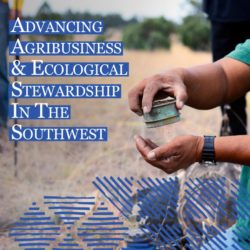
First Nations is hosting another five-day Conservation Planning Training & Workshop through our Advancing Agribusiness & Ecological Stewardship in the Southwest project. Hosted in collaboration with Tolani Lake Livestock and Water Users Association, the training helps Native agricultural producers develop and complete their conservation plans to seek support for USDA programs like the Environmental Quality Incentive Program.
The training will be held August 21 to 25, 2023, at the Ganado Chapter House in Ganado, Arizona. Registration is first-come, first-served, and limited to 20 Native agricultural producers in the Ganado community. Learn more and register.
 In Arizona Water Ruling, the Hopi Tribe Sees Limits on Its Future
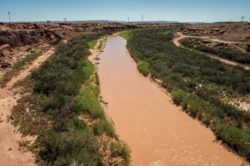
Since 2001, Arizona has operated from its own approach to determining water rights, one that has offered tribes an opportunity to shape their own plans for how they want to use water by examining their culture, history, economy, and projected population. But for the Hopi Tribe, this process “came at a high cost with uncertain outcomes,” reports ProPublica. A legal decision in Arizona has resulted in the awarding of less than a third of the water sought by the Hopi Tribe after its four-decade effort to secure its right to water. Read more.
Photo credit Russel Albert Daniels for ProPublica and High Country News
 They Asked Me to Cut My 6-Year-Old Son’s Hair — I Taught Them About Native Cultural Erasure
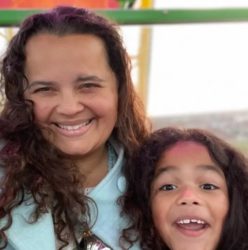
“Denying my beautiful boy as his authentic self — with a hairstyle that wasn’t hurting anyone — is a poignant form of cultural erasure. It disrespects the heritage that we have been trying hard to preserve for generations.” In a piece at HuffPost’s “Voices,” Ashley Lomboy discusses her family’s advocacy efforts after a public charter school in North Carolina said her son must cut his long hair to comply with the school’s dress code. “I want my son to be strong, self-possessed, and proud of who he is. I’m realizing that this could require his constant effort to educate others about our culture and, subsequently, why they should respect it,” she writes. Read more.
Photo credit HuffPost, Ashley Lomboy
 Yupiit School District Aligns Itself with Traditional Knowledge
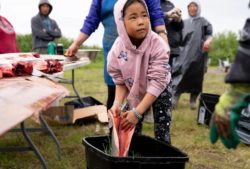
The Yupiit School District was formed in 1985 by Akiachak, Akiak, and Tuluksak community members who sought to provide the best education possible, while teaching that kindness, like snow, beautifies everything. As part of its mission to embrace traditional Native knowledge, this year the district successfully lobbied the state of Alaska to allow the district to operate on a calendar that provides students and staff with freedom to participate in seasonal subsistence harvests. This report at Alaska Public Media shares how the new calendar makes it possible to not only improve attendance, but also better pass along traditional knowledge that cannot be gained in the classroom. Listen to the report.
Photo credit Alaka Public Media, MaryCait Dolan/KYUK