This Week at First Nations: December 15, 2023
Tribal and Native-Led Organization Reps Meet at Inaugural First Nations Co-Management Convening
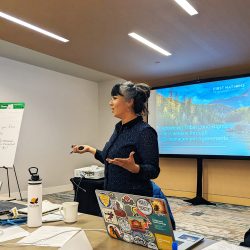
As Tribes enter into “co-management” and “co-stewardship” agreements with federal entities, it is increasingly important for these agreements to prioritize actions that will benefit them and recognize Tribal Sovereignty. To address this issue, First Nations hosted the inaugural Native Nations Land and Resource Co-Management Convening, a small convening of staff from Tribes and Native-led organizations from across the nation, in Denver this week.
The convening created an opportunity for First Nations to hear feedback on needs and priorities, and for all attendees to share resources and stories on best practices, law and policy, and potential funding partners; network with each other; and pursue individual and collective goals. The convening will strengthen upcoming funding, trainings, and technical assistance opportunities that First Nations will launch in 2024. Pictured here is First Nations’ Program Director of Stewarding Native Lands, Mary Adelzadeh (Diné).
Watch for more information about this emerging project in the New Year.
 Addressing Challenges and Exploring Opportunities for Native American Agriculture
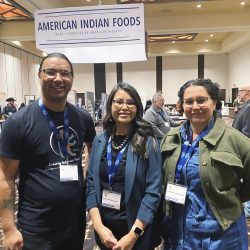
This week, First Nations joined tribal leaders, ranchers, farmers, producers, and traditional food practitioners at the Annual Conference of the Intertribal Agriculture Council in Las Vegas. The conference brings participants together to collectively address historical and contemporary challenges in Indian agriculture to increase economic opportunities for tribal communities nationwide. For First Nations, it was an opportunity to explore synergies and solutions across our program areas for Native food and agriculture, Native land stewardship, and meeting the unique needs of California Native communities. Pictured here are Richard Elm-Hill (Oneida Nation), Leiloni Begaye (Diné), and Sabine Talaugon (Samala Chumash).
 ‘Invisible No More’ Showcased at Book Club Event
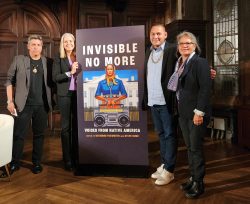
Last week brought several First Nations staff members to New York City for an MCF Book Club event featuring Invisible No More: Voices from Native America and a conversation with First Nations President and CEO Michael Roberts, Marguerite Casey Foundation President and CEO Dr. Carmen Rojas, and book contributors Trisha Kehaulani Watson and Heather Fleming.
Invisible No More is a groundbreaking collection of stories by Native American leaders who are advancing cultural grounding and nation-building in the areas of community, environmental justice, and economic justice. As part of our ongoing work toward Building a Movement for Native Justice, First Nations’ Jackie Francke and Catherine Bryan joined Mike at the event, along with Invisible No More Co-Editor and First Nations former Vice President Raymond Foxworth, Ph.D. Order the book here.
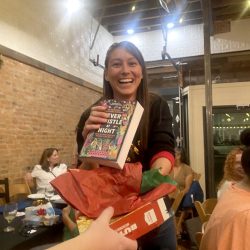 First Nations Staff Celebrate the Holidays, Exchanging Books and Laughs
First Nations’ headquarters staff came together this week at our holiday party in Longmont, Colorado. A highlight of the evening was the annual book exchange, which not only introduces new titles, but also provides for some friendly competition. Here, Associate Director of Stewarding Native Lands Jacque Demko (Mandan, Hidatsa, and Arikara Nation) laughs at making a swap for one of the popular picks of the night: Never Whistle at Night: An Indigenous Dark Fiction Anthology. It was a great evening, and we thank everyone for coming out for the holiday cheer.
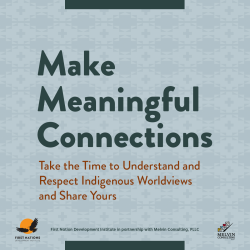 Honoring our Relationships and Taking the Time to Ask and Listen
To encourage greater investment in Native-controlled and -led initiatives, this month we’re sharing insights from our new guide “Being a Good Relative,” developed in partnership with Melvin Consulting, a Hopi-founded and -led firm.
Relationship-building and storytelling are the cornerstones of effective partnerships. They also help build bridges of understanding so we can do great things together and increase funding to grassroots nonprofits. Funders are encouraged to take the time to listen to stories and learn from nonprofit partners. It’s also important for nonprofits to better understand the people who work in philanthropy in order to build stronger relationships.
Download the publication to learn more and look for more insights all month.
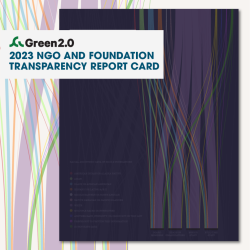 Green 2.0 Underscores Accountability in 2023 NGO and Foundation Transparency Report Card
This week, Green 2.0 released its seventh annual NGO & Foundation Transparency Report Card, a publication designed to hold organizations, and the environmental movement at large, accountable for commitments made to diversity, equity, inclusion, and justice. Among the takeaways: We need diverse representation in funding spaces. Entire racial and ethnic groups are missing from leadership at environmental foundations. In addition, environmental funding has flowed to predominantly white groups, underscoring that foundations must take proactive steps to ensure people of color are represented among leadership and their grantees. Read more.
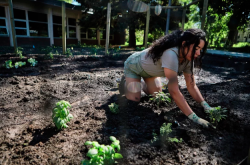 Indigenous Communities Embrace Food Sovereignty
Community gardens grown from ancestral seeds, along with restoration of buffalo-centered food systems, are adding to a growing movement to promote food sovereignty for reservations and Native communities. NPR showcases the Montana Indigenous Food Sovereignty Initiative and the Buffalo Nations Food Systems Initiative, a collaboration at Montana State University, and efforts to develop community gardens, share knowledge of traditional ingredients, and bring bison and other foods of the Northern Plains Native American diet in line with modern palates. Read more.
Photo credit NPR, Adrian Sanchez-Gonzalez/Montana State University