Impact Story
2024/2025 Artist
“Winter Gatherings”
 ɬu l̕ es ʕistčy še i qmqim u epsk̓ʷɬʕc̓x̌ncut, qʕ es lemtm ɬu syʕʷyʕʷots qɁ x̌ʷlč̓musšn u qʕes nlemlmlsy t st̕ulyxʷ u t qʕnple. ɬu t sʕstčmnuxʷ u qʕ es nɬkʷk̓ʷɬulls ɬu qʕ es qʷecɬls t nk̓ʷelyxʷ u ɬu qʕ nšy̓tusɬls t qlyxʷɬnk̓ʷul̕mn. kʷmiɁ i kʷ qmqemt u i kʷ yʕʷyʕʷot u i x̌e syʕ̓mncut ye l̕ sʕstčmnuxʷ.
Nsélišcn, a Salish dialect, translated by Tachini Pete.
AS THE WINTER DAYS BRING REST AND REFLECTION, WE GIVE THANKS FOR THE STRENGTH OF OUR ANCESTORS, AND THE GRATITUDE WE HOLD FOR THE LAND AND ONE ANOTHER. THIS SEASON REMINDS US OF THE WARMTH OF COMMUNITY AND THE TRADITIONS THAT GUIDE US FORWARD
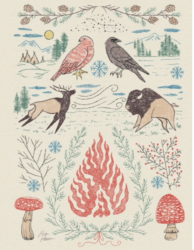
Paige captures the essence of winter, celebrating both the beauty of nature and the traditions of the cold months. At the center of the design, a fire burns brightly, symbolizing the warmth of storytelling and the gatherings that bring families and communities together. Surrounding the fire are animals significant to our environment: a hawk and a crow perched watchfully, a bison standing strong, and an elk representing resilience. The scene is set against snow-capped mountains, with winter mushrooms, pinecones, and other plants evoking the connection between the natural world and seasonal changes. This artwork reflects the harmony between our traditions and the winter landscape, inviting feelings of peace, gratitude, and community.
About “Medicine for the New Year”
 ɬu qʕ tyxʷsx̌lx̌alt u qʕ puteɁstxʷ ɬu qʕ syʕʷyʕʷot u qʕ nʕx̌tčmlscutn. ɬu qʕes čnʕc̓x̌aqs u qʕ qes nšy̓tusɬls t nmuslstn u t syʕʷnuntn še t nx̌sx̌saqs u qʕes tʕx̌lusy.kʷmiɁ i kʷ x̌est ci l̕ sic nk̓ʷspentč še kʷ epsyʕʷyʕʷot u kʷ epɬnp̓ʕxʷaqs.
Nsélišcn, a Salish dialect, translated by Tachini Pete.
WITH EACH NEW DAY, WE HONOR OUR STRENGTH AND THE RESILIENCE WITHIN US TO KEEP MOVING FORWARD. AS WE LOOK AHEAD, MAY HOPE LEAD US, AND MAY THE LESSONS FROM THE PAST GUIDE US TOWARDS NEW PATHS. WISHING YOU A YEAR FULL OF HOPE, STRENGTH, AND THE PROMISE OF A BRIGHT FUTURE.
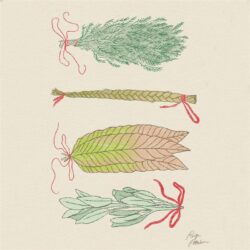
This New Year’s card features a delicate illustration of cedar boughs, tobacco leaves, braided sweetgrass, and sage, each representing the powerful medicines that offer blessings for the coming year. Cedar symbolizes protection and cleansing, while tobacco is a gesture of gratitude and connection. Braided sweetgrass embodies unity, with its strands woven together for strength, and sage represents purification, clearing the way for new beginnings. Together, these sacred plants create a message of hope, resilience, and positive energy, offering the strength and well-being needed to carry us forward into the new year.
 About the Artist
Paige Pettibon is a mixed-race descendant of the Bitterroot Salish of the Confederated Salish and Kootenai Tribes, Black & White, raised on Coast Salish territories alongside one of the country’s largest urban Native populations. She draws on her lived experience to create images that highlight the complexity of Indigenous identities, and uplift shared community values. Paige works across many media, from digital design to painting, writing, handcrafted jewelry, and public art.
Learn more about Paige’s work at PaigePettibon.com
Find her on Instagram at @Paige_Pettibon
2023/2024 Artist
 “Buffalo Run”
Okwanla unkicicupi iyecel wicaunkupi kte hecel ehani iyapi hena ta wowaste na ta wowaunsila ki wicoicage. Upi hena taku hopeca na wicozani tokatakiya iwaste pi kte
Lakota language, Translated by Leland Little Dog, Educator, Siċaŋġu Co
MAY WE ALWAYS GIVE AS WE RECEIVE, HONORING THE STRENGTH AND GENEROSITY OF OUR ANCESTERS, FOR THE BEAUTY AND HEALTH OF FUTURE GENERATIONS
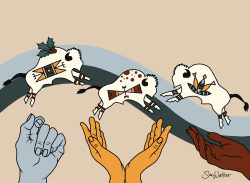
The thatháŋka, buffalo, are centric to the Lakota people. They are part of our creation story and they are our relatives. The buffalo gave up its flesh and fur to clothe and feed us. They protected and provided for us in so many ways. The White Buffalo Calf Woman gave us our ceremonies and taught us the path we need to walk as Lakota people. Through this piece, the artist conveys the strength, beauty, and gratitude our community has for these sacred relatives.
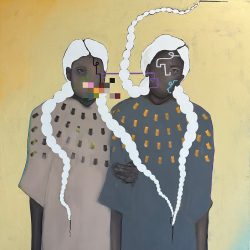 About “You Took My Heart”
Omaka teca ecunhan ake opiya ho wanjila wowasake nahan wopila nahan igluonihan unyun unyunwanjilapi kte yelo
Lakota language, Translated by Leland Little Dog, Educator, Siċaŋġu Co
MAY THE NEW YEAR BRING NEW OPPORTUNITIES TO JOIN OUR VOICES IN STRENGTH, GRATITUDE, AND PRIDE
Translated as “You Took My Heart,” this image is inspired by old stories of wíŋkte, who — as healers and spiritual leaders — walk between the world of the masculine and feminine and exist between the natural and supernatural. This piece is about telling our stories, demonstrating resilience, and having pride in our culture, customs, and ways of life. Danielle describes how we carry this forward in strength and gratitude for being able to utilize our voices and take actions, privileges for which our ancestors had to fight for many generations.
 About the Artist
Danielle SeeWalker is a Húŋkpapha Lakhóta citizen of the Standing Rock Sioux Nation in North Dakota. A mother, artist, writer, curator, activist, and businesswoman, Danielle works across disciplines to explore the intersections of Native American stereotypes, microaggressions, and colonialist systems. Drawing on au courant color palettes, expressionistic art strategies, and her Lakota traditions, Danielle spins her work into a contemporary vision to elevate historical perspectives.
Danielle’s images have been featured in multiple First Nations’ materials in 2023, including the Justice Through the Eyes of Native Artist project. Learn more about Danielle’s work at seewalker.com.
2022/2023 Artist
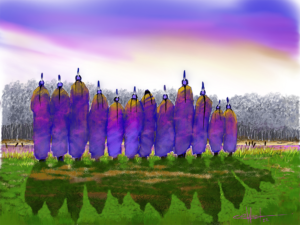
“Seasonal Teachings”
Mąąnį hįįraijiwira, hatak hanįrusikjawi, raašgųnį ranįšekjanawira hinįįgirawi. Waža warara waarakižu stoo rakįkjanawira nąga wookixete, woiperes, anąga homąšją wąągook’ųirawira woonįgižawawi roonįįgigųwi.
Translated by HŲŲWĄXETE, Hoocąk Linguist at the Hoocąk Waziija Haci Language Division
In honor of the winter season upon us, we wish you peace, good health, and time to gather with your loved ones and celebrate the love, knowledge, and strength within us all.
As the seasons change, female relatives, from grandmothers to great-granddaughters, gather by the water’s edge to offer their taanį (Hoocąk word for tobacco). It is also a time for them to share teachings and stories of their ancestors.
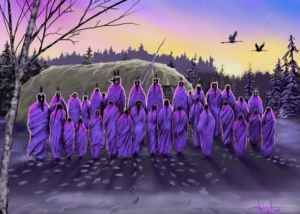
“New Beginnings”
Mąącek huuhaakrera haahuhuxjį hįįpewira wiiwewįra hanąąc hija hįįkaranįwigi. Wažącek hųųginąkikjanawigi raašgųnį anąga nąącge pįį hųųgiwekjawi.
Translated by HŲŲWĄXETE, Hoocąk Linguist at the Hoocąk Waziija Haci Language Division
Join us in welcoming the New Year with new beginnings full of positivity, growth, responsibility, and intention.
This image is inspired by Indigenous ceremonial practices of cleansing, reflection, song, dance, and community. These practices have survived, adapted, and evolved, being passed down through the generations.
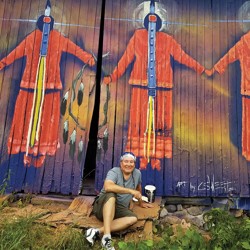 About the Artist
Christopher Sweet is a Ho-Chunk/White Earth Ojibwe artist and muralist who has been artistic since childhood. In 2016, Sweet first showcased his art in a solo exhibition, and since that time , his art career continues to grow. Christopher recently opened Blue Bear Studio, a creative space and gallery for his art located in Baraboo, WI.
2021/2022 Artists
Holiday Card Artist: Gordon Coons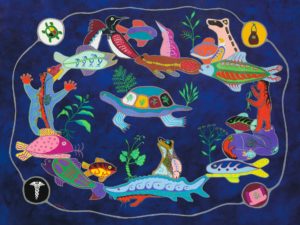
Gibagosenimigoo minoseyan, mino-ayaayan miinawaa
minawaanigwendaman gabe-gikinoonowin
da-odisigoyan noojimowin ani-gitiziyan endasogiizhig.
With every season, throughout every stage of life, we wish you good health, happiness, and healing.
About “Ginanaadawi’igoom” (We Heal You)
This image, painted in the Ojibwa Woodland Art Style, depicts healing. On the left side, a man is inside Makwa (Bear) learning to be a healer. When man’s training is complete, he will emerge as a healer. On the right side is a woman holding sweetgrass for healing. Around the combined individuals is a shared stethoscope. The four directions, four seasons, four races, and the four stages of life, are represented by the four circles and gray spirit lines of communication that connect all. The Spirit of the Four Circles has guided the Native People throughout time. Plants of healing are used in this image — Tobacco, Sweet Grass, Sage, Red Cedar, Yarrow, Alum, and Chokecherry. On the shell of the Turtle — White for North is sage, Yellow for the East is sweetgrass, Red for the South is tobacco, and Black for the West is red cedar. Ojibwa Woodland Style Art is created from the combination of Ojibwa petroglyphs (drawings or carvings on rocks) and images from birch bark scrolls. The images can also be identified as X-ray vision.

First Nations thanks Gordon for his talent and vision in this artistic representation of Indigenous Knowledge.
About Gordon Coons (Lac Courte Oreilles Ojibwa/Ottawa)
Based in Minneapolis, Gordon Coons (Lac Courte Oreilles Ojibwa/Ottawa) is a painter, printmaker, and fumage artist. Largely self-taught, he paints in the Ojibwa Woodland style and creates fumage, smoke art, by burning cedar. He embellishes his fumage pieces with 24-karat gold leaf. He also prints with linoleum blocks and sculpts in stone and wood.
Gordon draws inspiration from his Anishinaabe heritage, and his bright color palette comes from his natural surroundings in the Great Lakes region. Gordon exhibits nationally, and his work is in permanent collections across the country. He regularly shows and wins awards at annual Native American art markets such as SWAIA Santa Fe Indian Market, Native POP Festival in Rapid City, South Dakota, and the Eiteljorg Indian Art Market in Indianapolis, Indiana. His artwork can also be seen at solo exhibits and group exhibits. More of his artwork can be seen online at www.gordoncoons.com.
New Year’s Card Artist: Hanna Agasuuq Sholl
Quyanartuten, Agayun.
Quyanaa minarluta nunarpet, imarpet, ilarpet cali.
Quyanaa minarluta tamaita
Uksuk’gcikina!
You’re thankworthy, creator.
Thank you for giving us our land, our seas, and our family.
Thank you for giving it all to us.
Have a good year!
About Hanna’s painting
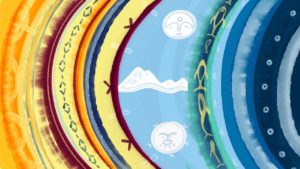
The painting is a wish, showing the transition to a healthy, prosperous new year, a gift from our creator, healthy land, animals, and people.
 About Hanna Agasuuq Sholl (Sugpiaq)
Hanna Agasuuq Sholl is Sugpiaq (Allutiiq) who was born in Kodiak, Alaska, and raised in the “lower 48.” Kodiak is the traditional homelands of the Sugpiaq (Allutiiq) people. She is an artist, educator, and culture bearer who merges traditional and modern-day Alutiiq art. She works in skin sewing, clay, acrylic paint, woodcarving, weaving, beading, mixed media, and photography. Today, Sholl is highly regarded within Alutiiq communities as a key leader and culture bearer in the Alutiiq revitalization movement. She regularly hosts workshops and classroom demonstration on weaving, skin sewing, and mask carving. Additionally, she helped develop materials for the Alutiiq language nest, school district and served as a cultural artist and dancer at annual culture camps. She carries herself as if she has 3,000 ancestors walking beside her to guide her with each brush stroke, each stitch she makes, each bead she threads, and each blade of grass she weaves.
As someone born in her homeland then raised outside of it, Hanna says she longed to reconnect fully. Her sense of belonging occurred when she joined the Kodiak Alutiiq dance family. She found a connection to her Sugpiaq identity through singing and dancing and gained a monumental perspective — she wanted to share this feeling of belonging with others. Transformed, she immersed herself, recognizing that Indigenous art and culture could help others feel empowerment.
Through art, Hanna says she would like to reach every Indigenous person, whether raised within or outside their homelands, remind them that their ancestors’ strength lives inside them, and encourage conversations by creating meaningful and timely pieces. Ultimately, she wants to create a dialogue between Natives and non-Natives to discuss challenging issues. Most of all, Hanna champions Indigenous people to use art as a form of healing, helping foster a strong, educated and empowered generation of Indigenous Peoples.
She acknowledges how important it would be to commit to teaching and learning to be part of the continuance of the Sugpiaq revitalization. In 2020, Hanna was selected to be a Luce Indigenous Knowledge Fellow. Hanna focused on encouraging future generations through Sugpiaq art and inspiring others to find their forms of expression.
Her goal is to foster a stronger, educated, and empowered generation of Alutiiq people through art. Find Hanna online at www.fineartsbyhannasholl.com.
2020/2021 Artists
New Year Card Artist: James Madison

About “Winter Moon”
The moon represents the Snoqualmie people. The wolf represents protection, wisdom, and warriors. The wolf protects the family and provides for the family. Winter is the time for creation, survival, and family time.
About James Madison
James R. Madison is a Coast Salish Native artist and a member of the Tulalip Tribes (Snohomish/Tlingit). He was born in December 1973 and lives in Tulalip, Washington. His carving and teachings started long ago, at the age of eight. Learning from his grandfather, father and uncle, sparked more than an interest to want to learn more. James studied at the University of Washington and received his bachelor’s degree in fine arts in 2000. He is known for his traditional, yet modern artwork and works with a wide range of mediums. These include glass, wood, bronze and stainless steel. “I create art with an open mind in the sense that I am always thinking of new ways to add a modern twist to a traditional piece. This allows for me to help to keep my culture alive. As we move in the future, so does the teachings of my ancestors.”
Holiday Card Artist: Tammy Joy Art

Le makho’ouŋčhaǧe kiŋ wičhahuŋkake wowaki’šake tȟáwapi kiŋ uŋ suta glus yuha uŋkinaziŋ pi kte hečel iyokpiya wowašté uŋyuhapi kte
“During this season, through the resilience of our ancestors, we stand strong with those teachings so that we will have happy blessings.”
Lakota Language — translated by Paulette High Elk, Wičháȟpi Kiŋyáŋ Wiŋ (Flying Star Woman), Howožu, Oohenunpa, and Itazipcho Elder on the Cheyenne River Sioux Reservation. Paulette is a first language speaker who has been a Lakota language instructor for over 25 years.
“Dashing Through the Snow” by Tammy Joy Art
This piece illustrates the strength and adversity of the people of Oceti Sakowin (Seven Council Fires).The winter is a time of creation and resilience for the People of the Plains. “Our winters are brutal and hard, but this is our homeland and we draw our strength from it. As Pte Oyate we stand strong against the storm, against the wind, against our trials and tribulations. We don’t run away or hide. We face it head on. We ‘Dash Through the Snow,’” notes Joy.
Tammy Joy Granados (Cheyenne River Sioux)
From the Itazipco and Hunkpapa bands of the Lakota/Dakota people, Tammy Joy Granados believes everyone needs an avenue for self-expression. Known professionally as “Tammy Joy Art,” the Cheyenne River Sioux artist honed her style through years of practicing at home, experimenting with different mediums and styles, primarily acrylic paint, graffiti and street art, and paper. Her paintings are described as expressionistic, and she draws inspiration from cultural components and storytelling, various subjects and objects that have great meaning to her, and her three young children who inspire her daily.