News
Thought Leadership
 As part of First Nations’ “Language is Life” campaign, we are honored to welcome this guest blog post from Kcheyonkote (Burton W. Warrington), co-founder and executive director of Menomini yoU, Inc., in Keshena, Wisconsin. Menomini yoU is a community partner through First Nations’ Native Language Immersion Initiative and is one of the many organizations supported through our campaign.
Here, Kcheyonkote talks about the importance of revitalizing Native languages, and how his path led him home to help “renormalize” the Menominee language and the centuries of lived knowledge and experience that are tied to every word.
Protecting the ‘Official Intelligence’ of Our Native Language
Tribal languages, such as Menominee, represent the unique worldviews and experiences of tribal people who have responsibly coexisted with the natural world for thousands of years. As tribal languages are inextricably tied to the natural world – and oral tradition served as the primary means of recounting collective and individual experiences – our languages are precious receptacles of thousands of years of lived ancestral knowledge. Our languages serve as guides to understanding and appreciating what a right relationship with the natural world could look like.
In a world vastly changing with information overload and surface-level understandings fueled by artificial intelligence, tribal knowledge systems and understandings built from long, natural, human experience could be considered the opposite – official intelligence.
According to UNESCO, approximately 40% of the 7,000 world languages still in use today are endangered. With respect to Native American languages in the United States, upwards of 95% are endangered, with a vast majority slated to go extinct within a generation without significant intervention.
These figures are alarming, as the potential disappearance of languages is not just a local issue but can have far-reaching impacts across the country and the globe. Despite the red lights flashing, Indigenous languages are far too often an afterthought of government and philanthropic funders.
Today, Menominee is down to one living first-language Menominee speaker from an unbroken line of speakers, and less than 1% of the local population consists of functional, second-language speakers. This recognition and awareness are what led to my own nontraditional path into language revitalization efforts.
Drawing From Menominee Roots
I was raised on the Menominee Indian Reservation in Northern Wisconsin. Upon graduating from the Menominee Indian High School in 2000, I set off on my Western educational journey at Haskell Indian Nations University and Kansas University School of Law. Shortly after passing the bar exam, I was called into public service as a counselor to Assistant Secretary Larry Echohawk during the first Obama administration. From there, I spent over a decade serving as chief executive officer of a financial holding company, and as legal counsel to clients across the country.
Despite reaching what some might consider pinnacles of my career, I knew that each of these career experiences was not the end goal for me. Rather, they were a means to better prepare me to serve a higher purpose in my life.
Early in 2020, I became uninspired and unfulfilled by my professional work. At the same time, my conversations with a close childhood friend/brother Mūqsāhkwat (Ron Corn Jr.) became more intentional.
Ron and I graduated high school together in 2000, and although we remained close over the years, we each took unique paths in life. While I was out gaining Western education and career experience, Ron remained deeply committed to a different form of education. He learned from, and worked with, the last wave of our first-language-speaking elders and taught the Menominee language in school tribal language departments.
Those early 2020 conversations ultimately led Ron and me to co-found Menomini yoU, informed by a potent combination of 40 years of lived experiences that we had collectively acquired over the 20 years since high school.
 About Menomini yoU
Menomini yoU, Inc., is a not-for-profit 501(c)(3) organization with a mission to contribute to the community-wide revitalization and renormalization of the Menominee language.
As we began structuring Menomini yoU, I was often reminded of something I picked up while working on large, complex business transactions: Complex challenges require well thought-out plans and strategies to be successful. With this in mind, we spent countless days, hours, months, and years in deep and frequent conversations about the different aspects and considerations we would have to navigate.
One of the key points that many of my colleagues helped me to appreciate over the years is the difference between language preservation and language revitalization. For many decades, there have been important and critical efforts to document, record, and preserve language materials across Indian Country. However, what has shown to be more challenging is the community revitalization and renormalization of our languages to the point where they return to a common means of community communication.
With this knowledge, we were able to collectively design an informed and strategic 25-year generational plan for Menomini yoU, which focuses on how to sequentially build and grow the additional community infrastructure necessary to support broader, community-wide language revitalization. Menomini yoU’s 2045 target goal is to reach 10% of the local population as functional second-language Menominee speakers.
We believe that 10% is a critical mass in the community that will provide a diversity of natural usage throughout the community, and natural intergenerational transmission will occur.
 Menomini yoU Successes
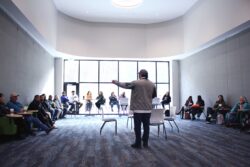
Since 2020, we have served the learning needs of nearly 1,000 language learners through online and in-person language class offerings, language camps, and full-time programs. Our campus hosts weekly and monthly language-focused activities and events that provide community members with the opportunity to hear, speak, learn, and experience the language in natural environments.
In furtherance of our renormalization efforts, we produce weekly language content and media that provides learners with an additional opportunity to hear our language used as a primary and natural means of communication.
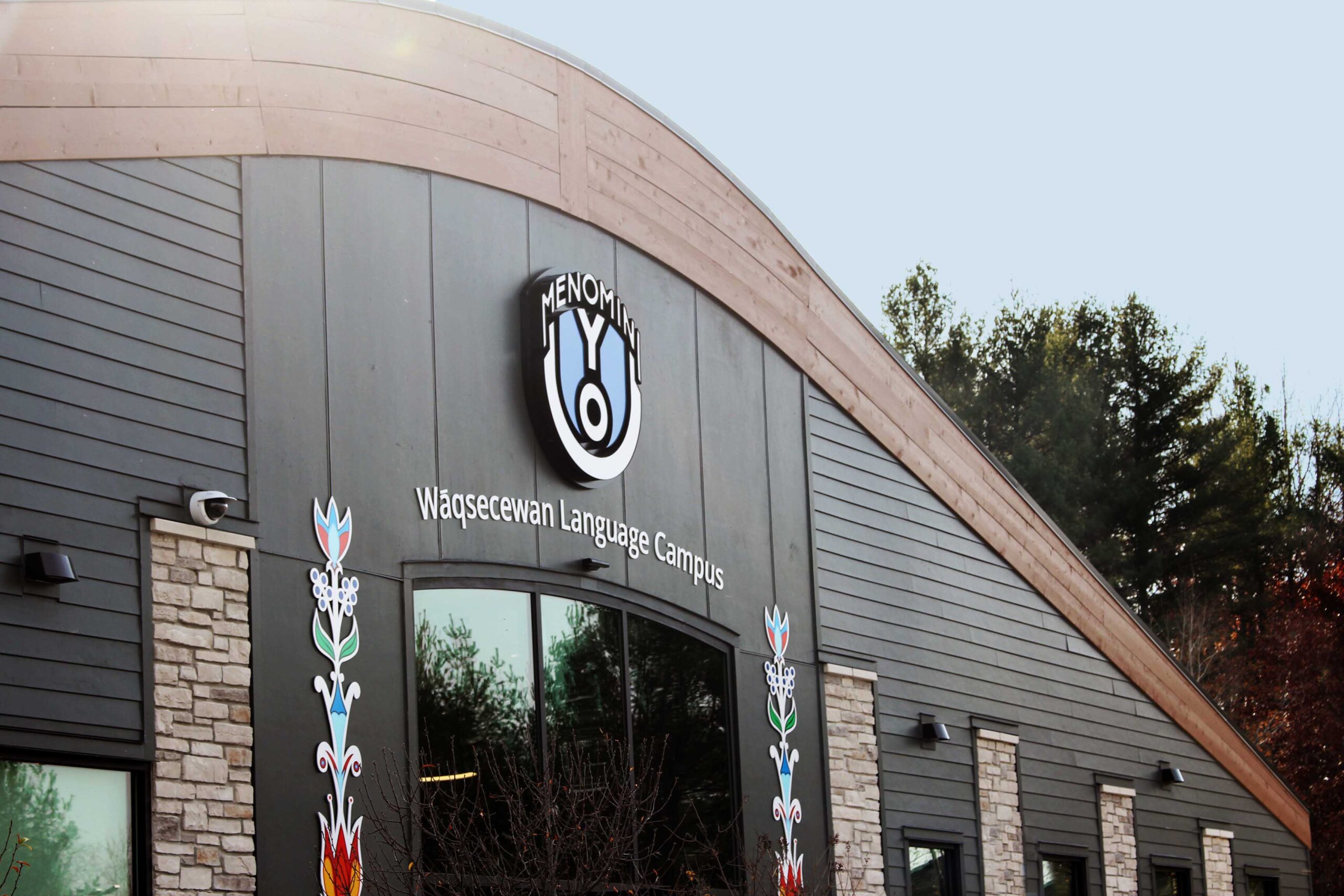
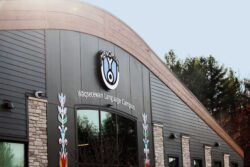
August 2024 marked a major milestone for Menomini yoU, as we opened the doors of our 3.5-acre Wāqsecewan language campus, including a 10,000-square-foot community language center that houses expanded office space, multiple classrooms, meeting and event space, a kitchen, and outdoor cultural activity space. The campus hosts our intense adult language acquisition program (Menomini Lifeways Institute), which is focused on creating new speakers of the language through a yearlong experience.
Menomini yoU is a 2024 grant recipient of First Nations’ Native Language Immersion Initiative program. Through the support of First Nations, we have experienced powerful networking opportunities with other First Nations community partners, nearly doubled the size of our 2025 and 2026 Menomini Lifeways Institute cohorts, and have been empowered and encouraged to take on innovative approaches.
Looking to the Future
Efforts and investments from the Menominee Indian Tribe of Wisconsin, particularly over the last 10 years, have resulted in a small, but mighty, number of functional second-language speakers, as well as a renewed focus on teaching the language in early childhood and formal school structures.
Through my work in the North American language revitalization community, I have had the privilege of meeting, working with, and learning alongside many wonderful and passionate human beings. Some of the more intriguing aspects of this community are the stories of how people come into this work and what inspires their commitment in the face of what can sometimes feel like insurmountable odds.
On a large scale, there are significant investments being made in areas such as climate change and conservation; however, very little of that funding makes its way to the language efforts that hold the keys to understanding climate change adaptation and conservation as a way of life.
Through lived experience in the government and philanthropic circles, I truly believe the lack of Indigenous language funding is largely attributable to a lack of understanding and appreciation of Indigenous peoples and our languages.
But despite what might seem like a bleak outlook, I remain hopeful that in the near future, both government and philanthropic leaders will invest the time, energy, and efforts to visit language revitalization efforts firsthand to learn not only about the amazing work being done, but also, why the work is being done.
If you are interested in learning more about Menomini yoU, donating, or supporting our work in other ways, please visit Menominiyou.org. Or better yet, arrange to visit us in person. We can also be reached at 715-994-1108 or by email at info@menominiyou.org.
Kcheyonkote (Burton W. Warrington)
Co-Founder/Executive Director – Menomini yoU, Inc.
Keshena, Wisconsin