Impact Story
Learning how to manage finances ensures that Native people are more likely to save and invest in their own economic freedom, strength, and prosperity. With that focus at heart, First Nations provides financial education to Native communities, and importantly, to schools and organizations that serve Native students. This year, as COVID-19 continued to shut down many outreach opportunities, First Nations’ financial education workshops were revamped to an online format. And, as doors of Native communities slowly reopened, new strategies and solutions for how to connect with individuals and families, including Money Smarts ’21, were developed.

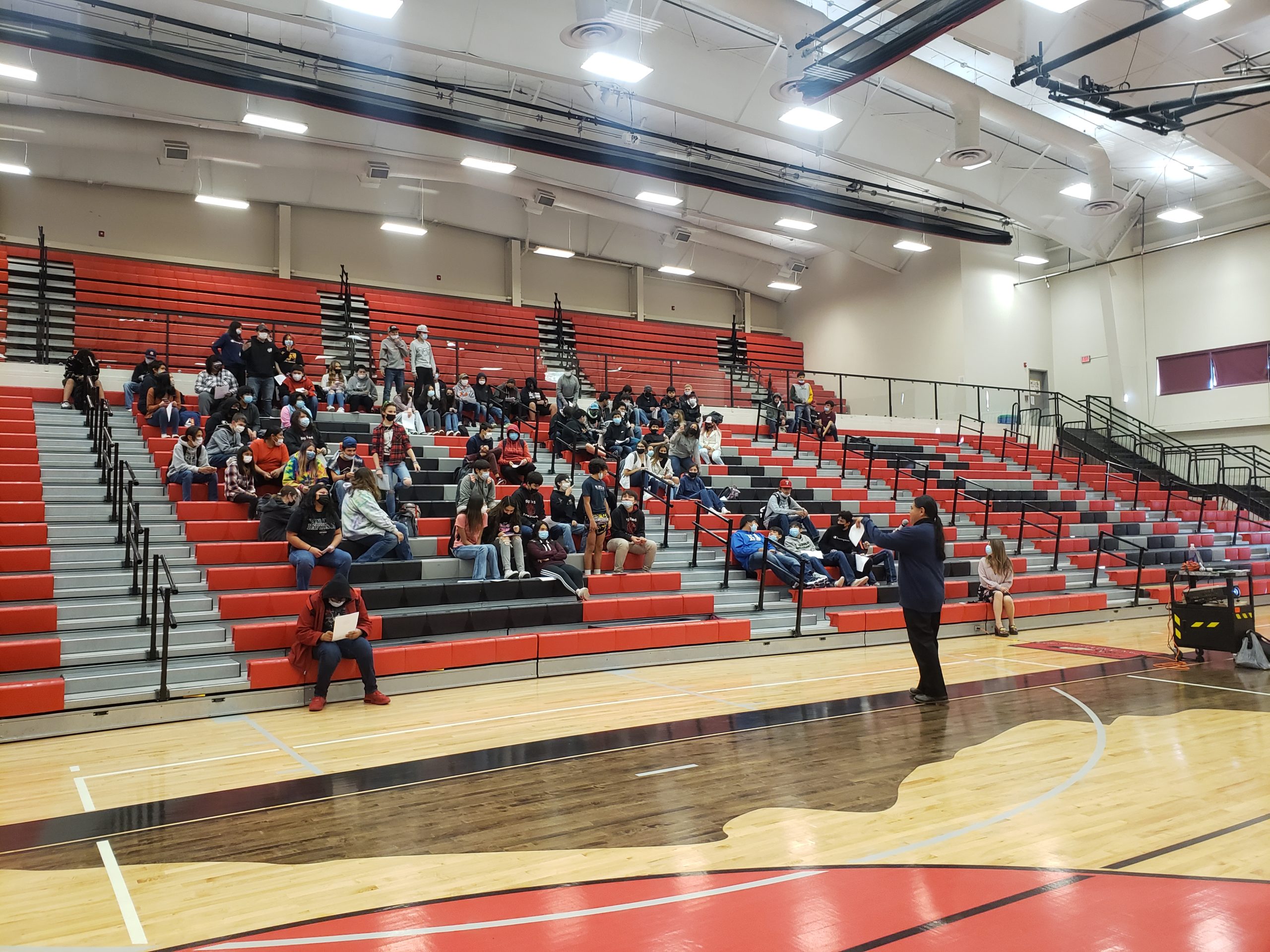
Money Smarts ’21 was piloted at Browning High School on the Blackfeet Reservation, which has been a model for social distancing and high vaccination rates.
Financial Education, Focused on the Future
First Nations’ financial education curriculum and products emphasize personal responsibility, cultural values, and action-based learning. Ongoing workshops, provided with support from the FINRA Investor Education Foundation, include fraud awareness trainings and Building Native Communities: Investing for the Future and Financial Skills for Families Train-the-Trainer Workshops.
In partnership with award-winning Native American financial education consultant and course instructor Shawn Spruce, First Nations also publishes the Ask Dr. Per Cap financial advice column that offers guidance and resources to help individuals take control of their financial futures. In addition, First Nations and Spruce offer $pending Frenzy, an interactive financial education program – and soon-be-released app – that lets participants use play money to spend, save, and budget while learning to make wise financial choices.

First Nations’ financial education consultant, Shawn Spruce and NACDC Youth Savings Program Coordinator Matt Harrington lead the Money Smarts ’21 class at Browning High School. This year, Spruce received the 2021 Ketchum Prize—the highest honor awarded by the FINRA Investor Education Foundation—in recognition of his outstanding advocacy, teaching and outreach as a champion of investor education and financial capability in Native communities.
Money Smarts ’21 is the newest addition to these outreach efforts, bringing an emphasis to topics such as fixed and flexible expenses, organization and recordkeeping, and savings strategies. The new workshop debuted in October 2021, with an in-person training to over 300 students at Browning High School in Browning, Montana.
Responding through Adversity
Like those of presenters and educators throughout the world, First Nations’ regular in-person workshops were shut down with the outbreak of the pandemic. In March 2020, Spruce was finishing an Investing in the Future training at the Pueblo of Acoma when Acoma Governor Brian Vallo announced that New Mexico’s first confirmed case of COVID-19 had been reported. Tribal offices and the entire Acoma Pueblo community immediately locked down.
“The next day I flew home and, like countless others working in Indian Country and beyond, I was forced to adapt to a completely virtual world of Zoom meetings, webinars, and remote training,” Spruce explained.
Many Native communities were soon ravaged by the pandemic from a health standpoint, as well as a financial one. Reduced work hours, lay-offs, and furloughs wreaked havoc on household finances and spelled uncertainty for the future. Ultimately, the pandemic not only made it more difficult for participants to access financial education workshops and trainings, it also amplified the need for financial education.
Fortunately, First Nations and Spruce were able to draw from a wealth of established financial skills training products and programs to conduct virtual outreach events in the months that followed. Throughout 2020, First Nations transitioned many presentations and trainings to an online format, such as a WebEx series titled The Coronavirus in Indian Country that featured insights on the pandemic’s impact on financial markets and tribal economies, information regarding COVID-19-related stimulus benefits for Native families, and resources for individuals managing retirement accounts and other investments.
Moreover, longstanding relationships with the Bureau of Trust Funds Administration, the Oklahoma Native Assets Coalition, Warm Springs Community Action Team, Denver Indian Center, Tiwa Lending Services, NACDC Financial Services, the Squaxin Island Tribe, and other community-based partners made it possible to quickly access and engage with countless Native communities.
These online trainings continued as the country started slowly reopening, and in early fall, NACDC Financial Services, a non-profit Community Development Financial Institution (CDFI) located in Browning, Montana, on the Blackfeet Indian Reservation, reached out for assistance with financial education training at Browning High School. NACDC Youth Savings Program Coordinator Matt Harrington explained that Browning High School had recently resumed in-person learning and students could benefit from a new class on budgeting, goal setting, and independent living.
Cool raffle prizes and gift cards helped Money Smarts ’21 become even more of a learning extravaganza.
A New Training at a Necessary Time
Spruce collaborated with NACDC Financial Services to deliver a workshop that would address pressing financial issues of students living through the coronavirus a pandemic.
“What makes the training different from other workshops is that it recognizes the impact that the pandemic has had on Native communities,” Spruce said. “Many of our youth now face additional challenges when it comes to savings and money management such as lockdowns, higher costs of living, and health risks. Drawing on Native culture for resilience and leadership is especially important right now.”
Joining Spruce in providing the training were Harrington; Alex Ward, a retired police officer and crime prevention specialist; and Browning Middle/High School GEAR UP Coordinator Melanie Magee, who scheduled assemblies in the gym supplemented by smaller socially distanced workshops with lessons on banking, understanding credit, and household budgets.
The result was a powerful two days of learning that benefited the students of Browning High School and created a foundation to bring Money Smarts ’21 to more audiences.
“I thought the workshops were really helpful,” said Anglia Dewolfe, a freshman who aspires to a career in law enforcement and who wants to save money for college. “It was a good opportunity to learn more about handling money, setting goals, and planning for the future.”
Fixed and flexible expenses and organization, recordkeeping, and savings tips were featured in engaging interactive learning activities for more than 300 students.
Harrington added that that the small-group activities were very engaging and the personal interaction in those settings was meaningful for the students. “This last year has been weird and, in many ways, very hard for students, he said. “But having this type of training happen again in-person and bringing real financial wisdom really injects energy and a different perspective into their learning experience.”
More Trainings, More Impact
Indeed, Money Smarts ’21 is a valuable addition to First Nations’ financial education products and will evolve as the world enters 2022 and beyond, said First Nations’ Vice President of Programs and Administration Jackie Francke. “Our role at First Nations is to empower Native Peoples to build strong economies and communities. This means offering the education and resources to implement their own approaches and solutions,” she said. “Providing ongoing and always-improving trainings to respond to the changing demands in Native communities is one way we achieve that.”
First Nations’ Financial Education trainings are available in person or virtually and can be customized for professional groups, such as federal and tribal employees, tribal councils, investment committees, and banking professionals, as well as for Native American individuals, retirees, students, and others who would benefit from financial education materials.
For more information, contact Shawn Spruce at agoyopi@gmail.com.