Impact Story
Curiosity, appreciation for nature, and a deep love for the outdoors have led Dillion Eustace to return to his community and work as a wildlife technician for the Pueblo of Santa Ana’s Department of Natural Resources (DNR).
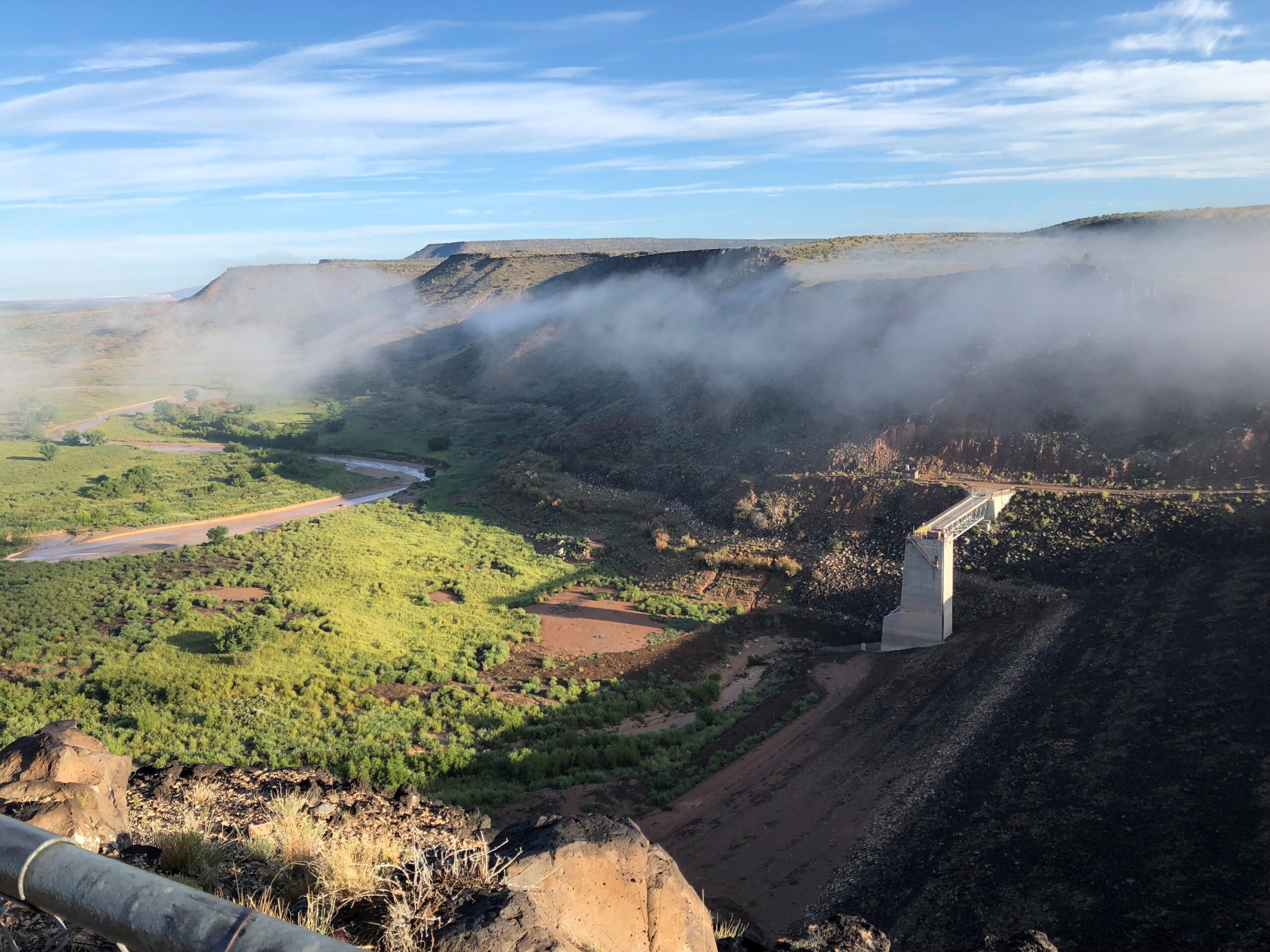
As a child, Eustace joined his uncle on hunting trips, searching for skahwash (woodrats) and learning about their habitat. Today, those early teachings guide his work as he monitors, advocates for, and shares knowledge with the Santa Ana Pueblo community about woodrats and wildlife that roam the high desert landscapes of the Tamaya Indian Reservation in north-central New Mexico.
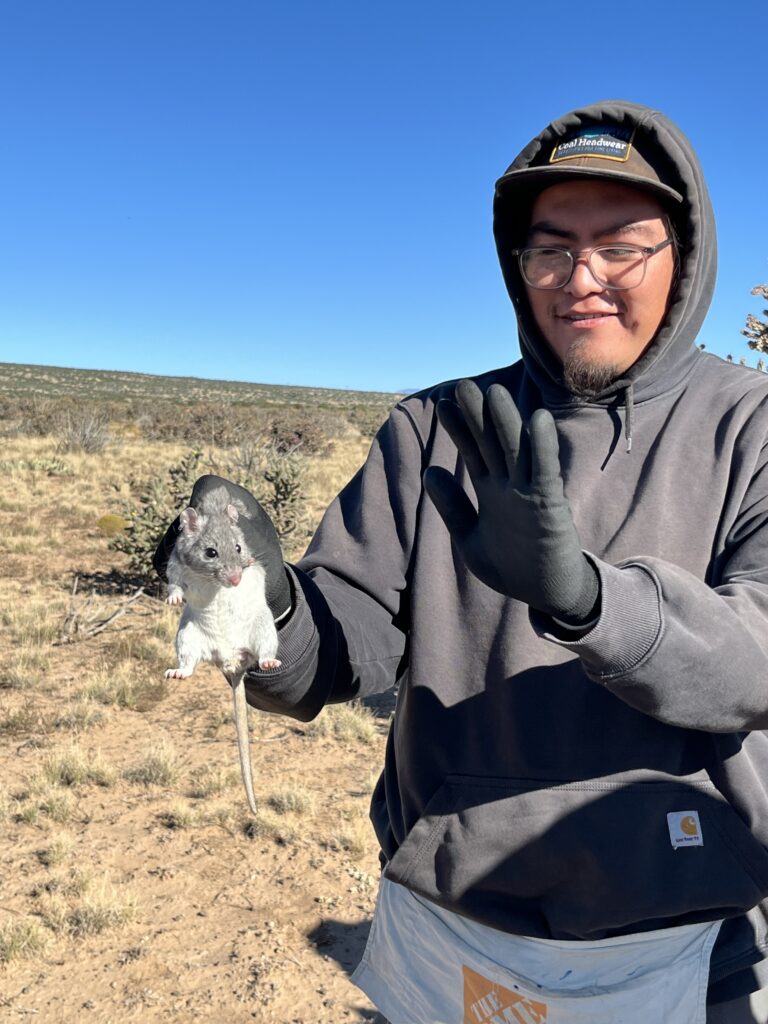
Dillion Eustace collecting data from a woodrat captured during the study.
“To come back and work in the place that I grew up in and actually hold these woodrats that I hunted when I was little, they’re alive and they’re kicking, it feels like an intimate connection with them now because before it was just me having fun,” expressed Eustace. Now, that connection has grown into an opportunity to inspire and educate the youth, strengthen cultural teachings tied to the land, and support the next generation of land stewards.
Commonly known as packrats, woodrats are primarily nocturnal and are highly adaptable to diverse environments. They are known to construct middens or nests with surrounding plant materials and animal remains. While some may view them as a nuisance, for the Tamaya – the people of Santa Ana Pueblo – woodrats hold cultural significance and are highly revered during the winter solstice period.
In recent decades, tribal members have observed a decline in woodrat populations across their homelands. This prompted the Range & Wildlife Division of the DNR to begin researching, monitoring, and surveying woodrat populations and to improve overall habitat quality and health in 2013.
Studies show that woodrat nests are primarily located at the base of cholla cactus plants, as they provide a safe space for woodrats to live. Dan Ginter, range program manager for the Pueblo, shared that “the cholla cactus provides an impenetrable layer of spines to keep predators at bay, and the plants offer valuable food and water sources throughout the year.”
Established in 2001, the Range & Wildlife Division identifies, develops, and implements projects and management plans that will benefit approximately 141,000 acres of Tamaya’s upland habitats. The eight-member Range & Wildlife team carries out work that includes: southwestern willow flycatcher survey and nest monitoring, fence installations and repair, livestock management, juniper thinning, wildlife habitat monitoring, and savanna grassland habitat restoration.
“It’s important for our tribal members and those of other Native communities to understand that this has been a long 25-year process to get our department to the place it is right now,” shared Ginter. Through internships, youth engagement opportunities, and community learning events, the department is building pathways for young tribal members to see themselves reflected in natural resource leadership.
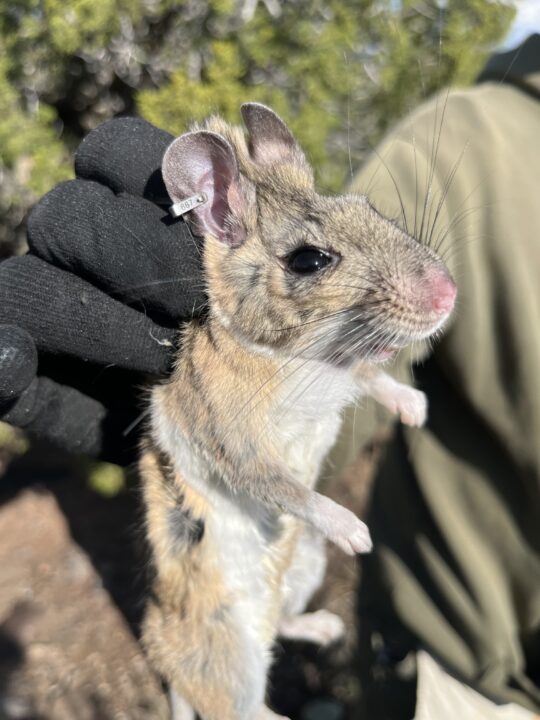
Ear tags used to identify individual woodrats during the study
A focus on culture and experiences
In 2024, with support from First Nations Development Institute’s Stewarding Native Lands program, the Santa Ana Pueblo’s DNR hosted a Wildlife Corridors Summit focused on educating, informing, and gathering community feedback on the design and development of the Sandia-Jemez Mountain Wildlife Corridor.
The event brought together the Tamaya community, state agency representatives, and neighboring Pueblos. In addition, First Nations further supported the department’s Water Resources Division’s Santa Ana Youth Hands-On Hydrology Outreach (SAYH2O) program and its ongoing efforts to educate and immerse youth and adults into the natural environment.
Launched in 2003, the SAYH2O program has evolved over the years, and has provided experiential learning opportunities, such as raft trips on the Rio Grande, field trips across Tamaya and neighboring Pueblo lands to learn about woodrat monitoring, and educational encounters in Pueblo language and culture, traditional planting and irrigation of corn, and more.
Youth have also visited nearby national parks, monuments, and museums to learn about Pueblo history, with cultural teachings from local knowledge-holders woven throughout.
Eustace and the Range & Wildlife Division’s contribution to the SAYH2O program includes introducing tribal members to a variety of woodrat species so that adults and youth can see them alive, understand their behavior, and learn about habitat and environmental factors that are not suitable for them. Because the Range & Wildlife Division presents both the cultural and scientific aspects of woodrat species and land stewardship, Eustace emphasized. “It gets them inspired to want to protect them.”
A rewarding aspect of Eustace’s position as a wildlife technician is community outreach, engaging and inspiring the next generation of knowledge-holders about the wildlife and landscape. “The rewarding part is to be someone who’s approachable, to have people feel comfortable to ask me anything about wildlife, about any techniques they have not thought of.”
The curiosity and openness of community members and tribal council leaders continue to guide Eustace’s work and the department’s overall priorities. He is dedicated, curious, dependable, and gentle – a few words shared by his supervisors to describe his character and the commitment he shows in the varying responsibilities of his position.
“He brings a sense of calm to the chaos and unpredictability that is wildlife biology,” shared Cathy Nishida, wildlife program manager for the Pueblo.
Eustace’s hope for the future is for Santa Ana Pueblo and neighboring Pueblos and tribes to work cohesively for the health of their ancestral lands and to leave a lasting impact on the health and wellness of the Santa Ana Pueblo community. For the next generation of leaders, he offers a few words of advice, “Don’t doubt yourself. Have confidence in yourself and what you want to do. You can do anything that you set your mind to.”
See More: Spotlight on Dillion
As part of our Indigenous Partnership to Advance Native American Communities and Producers project, First Nations partnered with Waters Media and Santa Ana Pueblo to support the production of the short film “Dillion.” The film tells the story of Dillion Eustance (Pueblo of Santa Ana) who serves as the Pueblo of Santa Ana’s Department of Natural Resources Technician I. His passion and commitment to uplifting traditional knowledge and stewardship practices will have a lasting impact on the livelihoods, health, and wellness of the Santa Ana Pueblo community. The film depicts the heart and intention of First Nations’ Community Pathways Initiative.