Impact Story
On the Wind River Reservation in Wyoming, children are being reintroduced to traditional foods, connecting with the history before them, and strengthening a resilient food system for the future. In line with the reservations’ overall goals to increase access to local, healthy, and affordable food, the Wind River Food Sovereignty Project collaborates with reservation schools, building mindful Native Farm to School programs, developing cafeteria recipes that include Indigenous foods, and teaching children how to be in a relationship with food.
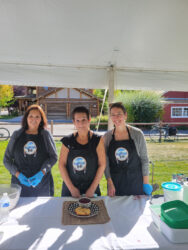
Native Farm to School Coordinator Billie Spoonhunter, and Co-directors Kelly Pingree and Livy Lewis share a commitment to teaching young people about traditional foods. Pingree asserts: “If we don’t teach kids what we want, someone else will teach them something else, and that’s not right.”
Kelly Pingree, project director for the Center for Popular Research, Education, and Policy on the reservation and co-director of the Wind River Food Sovereignty Project, has spent her life on the Wind River Reservation. She believes that healthy, culturally appropriate food should be accessible to everyone, and she is committed to making it a reality.
“Learning the ways we used to do things – the ways we still do – is what connects us to our lands, our spirituality, and our ancestors. It penetrates to us,” she says. “Bringing that knowledge back is essential to our people and particularly for our kids.”
Building on Successes, Harnessing Momentum
First Nations has long invested in the creation and sustainability of programs serving the Wind River Reservation. This has included grants to the Northern Arapaho Tribe to advance economic development, grants to build capacity of the Wind River Development Fund, multiple grants to the Wind River Tribal Buffalo Initiative to restore and strengthen the reservation’s buffalo population, and a 2020 grant to the Center for Popular Research, Education, and Policy to create a “Producers’ Cooperative” to advance food sovereignty.
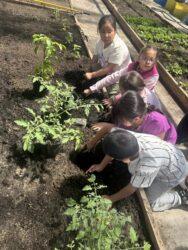
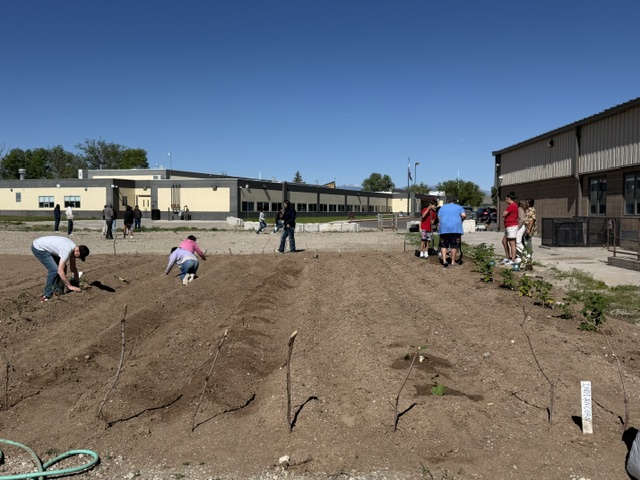
Children planting at the Arapahoe Garden. Billie Spoonhunter says, “This is what you want to see: Kids thriving and being happy, doing these tasks of preparing the dirt and harvesting.”
In 2024, with support through First Nations’ Native Farm to School project – a project through the Native Agriculture and Food Systems Investments Program and funded in part by the USDA Farm to School Program – the Center launched the “Indigenous Foods in Our Wind River Schools” project, which set out to foster collaborations with food service professionals at St. Stephens Indian School and pilot strategies to process and incorporate foods into the school lunch program. This project builds on the progress already underway throughout the reservation in promoting the use of traditional Indigenous foods and enhancing the cultural and nutritional value of school meals for students in all Wind River Schools.
A Focus on Gains, Not Losses
Pingree explains how the Center’s approach to reaching next generations is to focus on the future and the strength and resilience that are evident today. “Growing up, we saw so many examples of things we weren’t allowed to do – our language, our teachings, our ceremonies. Several generations lost touch, and we lost about 98% of our ways,” she says.
“There was a time when children knew these things. And that’s what we want to bring back. That knowledge was interrupted, but it was never really gone. We’re bringing it back to their lives, their schools, their worlds – an understanding of who they are.”
It is an approach built on teaching traditional practices to create a sustainable future, and it integrates student involvement and the voices of young students at every opportunity – from planting foods, to tasting, to the food delivery. As Pingree says, “We know it is very important that we look at and trust in our own solutions and make sure that kids today know what we know.”
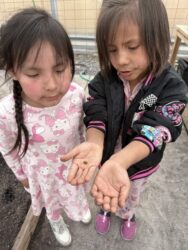
Young students discover a taste for chokecherries.
Planting, Tasting, Creating
Throughout the First Nations’ grant period, the Wind River Food Sovereignty Project continued to make great strides in reintroducing students to traditional foods, reconnecting them with where those foods come from, and empowering them to determine how those foods are integrated into their lives.
By design, a key component starts with the planting. Students at St. Stephens school were engaged in planting 50 chokecherry trees acquired by the Center. From there, they joined in establishing an edible garden and raised flower beds featuring Indigenous foods. As the project went on, the center piloted field trips to area gardens for over 100 St. Stephens students.
While these children live on the Wind River Reservation, seeing plants being grown and harvested is often a new experience for many of them. Many have lost that connection with the land and have never been introduced to the traditional, nutritious foods that have sustained Native peoples for generations – or the skill and pride involved in growing those foods.
“It’s beyond just food,” explains Pingree. “It’s teaching the traditional ways of gathering – how to give prayer as you harvest, and how not to pick too much. We show kids how you respect plants and how to have a relationship with them.”
Pingree says that once the students experience that association, it opens a doorway for them. “It lets them connect and understand how much our people sacrificed.”
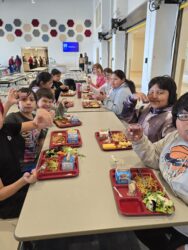
Third-graders at Fort Washakie School taste the chokecherry gravy recipe.
Another important aspect of the project is the taste testing. The center hosted a chokecherry gravy taste test at the St. Stephen’s School cafeteria, followed by two additional taste tests reaching 275 K-12 students at Fort Washakie School and 272 K-12 students at Arapaho School. Ultimately the project has reached students across four districts in total – Ft Washakie, Wyoming Indian, Arapao, and St. Stephens.
Billie Spoonhunter, Farm to School Coordinator for the Wind River Food Sovereignty Project, explains how the taste tests are an empowering opportunity for the students. “The kids are instructed to be honest in their considerations and answers – Do they like the food, do they not like it? Do they want to see that recipe served at their school?”
Being involved in making those decisions – and having their voices heard – goes a long way in ensuring that students seek out those traditional foods and the connection to land and culture that come with them, Spoonhunter shares.
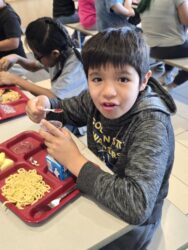
Feedback so far from the students has been overwhelmingly positive. One student expressed, “The day we had the chokecherry taste test at Fort Washakie school was, like, the best day ever.”
Now, based on those taste tests, the chokecherry gravy and three additional recipes have been introduced to all four school districts, and are being reviewed through the USDA recipe standardization process.
A Beautiful Puzzle Being Built One Piece at a Time
Through the ongoing outreach of the Center for Popular Research, Education, and Policy and the Wind River Food Sovereignty Project, more and more collaborations with administrators, families, food producers, and students are being established. Community members are working together and moving ahead with real opportunities to bring back traditional foods. Achieving a thriving, strong, and nutritious Native food system on the Wind River Reservation is well within reach.
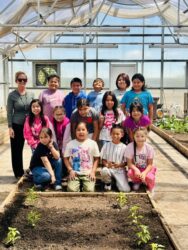
Growing food at the Arapahoe Garden. On the Wind River Reservation, community members know that reintroducing children to Indigenous foods and those traditional to their tribes will help reconnect youth to their history and help them build a stronger future.
Pingree asserts that the work is essential. “It’s our responsibility to make sure that our children don’t grow up without this knowledge. They need to grow up knowing that they belong to something, and bring that pride back,” she says. “When they learn to grow something – when they themselves put something in the ground, it gives them a whole different perspective. It’s a wonderful thing to see something you’ve planted grow.”
Spoonhunter reiterates the power of collaborations and partnerships, and both speak to the progress that will continue. “When we have support for community-based projects, when we build relationships and we’re all doing the work and helping, we can make it bigger and better in Native communities across the country,” she says. “It’s like a beautiful puzzle of bringing everything together.”
Read about the Wind River Food Sovereignty Project, as well as other community partners through First Nations’ Farm to School project, in Awakening the Seeds in Native Youth: Native Farm to School Evaluation Report. Also, learn more and support the project directly at Wind River Food Sovereignty Project at https://www.windriverfoodsovereignty.org/