News
Thought Leadership
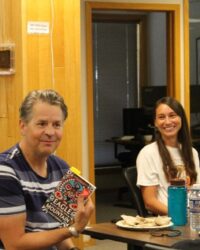
 In July 2026, First Nations staff were fortunate to host Caskey Russell (Tlingit) in our Colorado office for a discussion about his latest book, The Door on the Sea, the first of the Raven and Eagle trilogy. The story follows Elān, a young man who embarks on the adventure of a generation. The story fuses cultural teachings, comedy, and adventure and includes charismatic characters like a foul-mouthed raven and a giant wolf. Caskey shared the inspiration behind the story and characters, and key insights about what remains to come in the trilogy. He also read a portion of the second book, The Eagle in the Mountain.
Russell describes The Door on the Sea as “an epic quest fantasy debut that is the Tlingit Indigenous response to The Lord of the Rings.
Enjoy this Q&A from our interactive and inspiring afternoon with Russell:
Tell us about yourself.
My name is Caskey Russell. Mike Roberts and I are related: Our great-grandmothers were sisters. I was close to my grandmother, Teew, who passed away in 1997, when I was 17. Her first language was Tlingit. She was born and raised in Heenya Kwáan (Klawock, Alaska). My grandmother attended Western Washington University in the 30s, with help from the Bureau of Indian Affairs, to become a teacher. It is a full-circle moment for me because I am now a professor at Western Washington University.
I grew up in Seattle. My mom is from Bellingham, Washington, and my father is from Aberdeen, Washington—a small, depressed logging town and the home of Kurt Cobain and Nirvana. There was social dysfunction and alcoholism in his family. He went to Oregon State on a football scholarship and met my mom in Seattle.
My mom’s side of the family is Tlingit. They are a fun-loving group, full of humor and stories. My families didn’t always get along. My book highlights those interesting struggles and contradictions of bringing the two families together.
Can you share your educational journey?
I earned my bachelor’s and master’s degrees at Western Washington University, and my Ph.D. at the University of Oregon in English with a focus on Native American Literature. I always had the feeling after listening to stories from my great uncles and grandmother about growing up in the Tlingit village of Klawock, Alaska, that if you didn’t grow up in an Alaskan village in the ‘20s and ‘30s, you didn’t get the full flavor of what it means to be Tlingit. So for my dissertation, I focused on six areas of Tlingit culture I wanted to learn more about: language, totem-pole carving, civil rights, education, storytelling, and a poet named Nora Marks Dauenhauer.
My grandmother spoke Tlingit and I practiced the language with her. I went to Alaska to interview relatives to learn more about my tribe.
After college, I got a job at the University of Wyoming, where I taught American Indian Studies and English for 18 years. Five years ago, I became the dean of Fairhaven College at Western Washington University. But I’m not an administrator and quickly stepped down. Now, I’m a professor there.
 Why aren’t there many Tlingit writers? Why write from this perspective?
There are about 30,000 combined Tlingit and Haida tribal members, including musicians, carvers, writers like Nora Dawnhauer—who was featured prominently in my dissertation—Lance Twichell, and Robert Davis. I don’t know why there aren’t many Tlingit writers. Maybe it’s hard to find publishing? I went through hell to get this book published. No American publisher wanted it, and finally a British publisher picked it up.
How did you find a publisher?
I finished my book during the pandemic and sent it to about 60 agents, but many rejected it. Finally, an assistant agent who was reading it for another agent, who rejected it, liked the book. I sent her an outline of the trilogy and she agreed to represent me. We sent it to American publishers, but no one was interested. So she sent it to a publishing house in England called “Solaris” and they loved it! They wanted more Indigenous voices from America since working with Rebecca Roanhorse on her trilogy. My book did even better than I, and maybe my agent and the press, had imagined!
What is the recipe for blending metaphor with literal meaning?
The genre started off as fantasy and moved into the realm of fantasy and sci-fi. I didn’t use real clan stories because I didn’t want to step on any cultural toes. The Raven, which blends mythos and mythology when you think about the raven talking in a human voice, blends the line between being grounded in reality and mythology.
Who inspired Raven? Why did you keep Raven as a trickster?
I heard Raven stories growing up from my grandmother and great-grandmother. I loved how irreverent and ungod-like he was at times. He is sacred, but messes with people and tricks them. I made him a trickster to make it clear that he doesn’t care about humans; his motivation is the salmon, and by extension, the health of the rivers, trees, and forest. He is a contrarian, even to the point of questioning human traditions, so I wanted everything to be questioned by Raven.
Why do you push back against tradition in the book?
I’ve always had that disposition. If I’m told, “This is how we do it,” I can’t help but ask, “Why?” That attitude was infused into the main character, who questions why we have these social rules and norms. Because I am not in the tribe to ask about tradition, I thought, “Can the story incorporate other ways of thinking?” I had colliding traditions growing up. I never saw my two sets of grandparents together. Naturally, that made me question if the adults in my life couldn’t get it together, then what’s up with these traditions that they cling to?
 Do you write for yourself or your audience?
When I was young, I wrote for the expectations of an imaginary audience, influenced by literature professors and the books they assigned me. Now that I’m older, I write for myself and the enjoyment I get from writing.
What words of advice would you give a young or new Native writer?
Use the characters and plots from your tribe’s storytelling traditions as the basis for new stories. Don’t use anything protected by clan protocol—be sensitive to your tribe’s storytelling customs—but invent new sci-fi, fantasy, alternate futures, mystery, romantasy, time-travel, space-travel, etc.
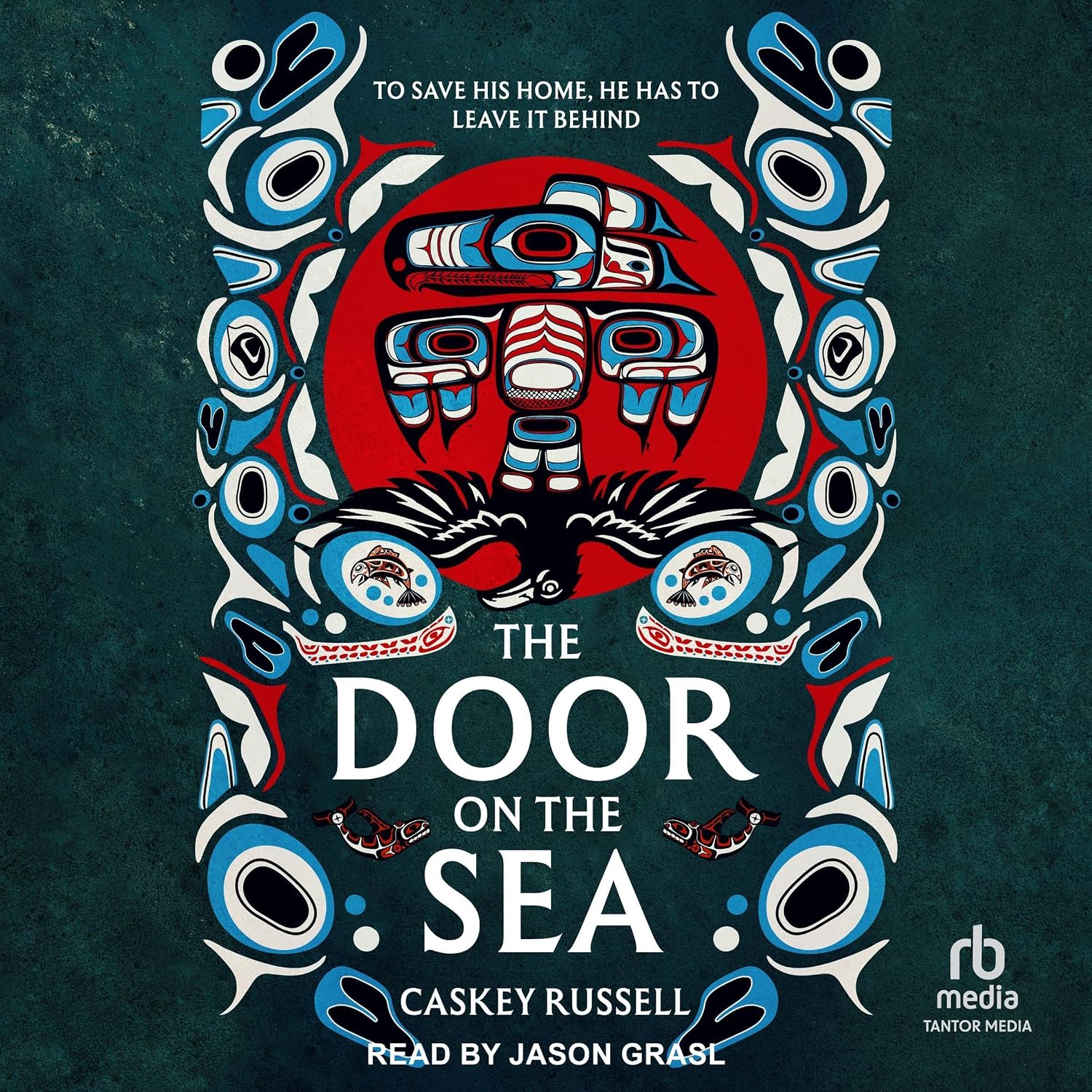
What is the story behind the cover and title?
I wanted a Tlingit artist to create the cover. The first artist created a mockup with AI, but the press had an anti-AI policy, so it was rejected. The next two Tlingit artists I recommended were too expensive. So the publisher suggested an in-house artist. I worked closely with our Sealaska Heritage Institute on appropriate images of my clan symbol, ravens, and eagles. The cover we chose was made by a non-Native artist, but with a lot of guidance from Sealaska Heritage Institute.
Originally, I titled my book “Fathead” to entertain my boys. But the agent advised against it. I then called it “Flicker on the Sea.” Flicker is the clan and the house of the main character. But when they mocked up the cover, the “l” in “Flicker” looked like a “u” from 20 feet away, like you would see it in a bookstore. So, we settled on “Door on the Sea.”
Russell ended the Q&A with an exclusive reading from the second book in his trilogy, “The Eagle in the Mountain.” We look forward to reading the next book in the series, as we follow Elān, the protagonist, on his journey.
A MESSAGE AND THANK YOU FROM MIKE ROBERTS
It is not lost on First Nations’ CEO Mike Roberts (Tlingit) how important it is to amplify the Native people from his home state:
“Living in the lower 48, people rarely think about Native people in the United States, much less about the tribes in Alaska. In my position, I’ve made sure that in every aspect or programming, we include and highlight Alaska Natives and create space to showcase new knowledge creators.
“Thank you, Caskey, for traveling such a long way to join our staff in the Longmont office. We are very grateful to have met you.”
The second book in the trilogy, Eagle in the Mountain, comes out September 24, 2026. The third book will be released in September 2027.
To learn more about the author, visit Caskey Russell – Author of the Raven and Eagle Series.
To order his book, visit The Door on the Sea | Book by Caskey Russell | Official Publisher Page | Simon & Schuster.