News
Thought Leadership
This blog post is the second in First Nations’ four-part series, sharing updates and ways to strengthen tribal renewable energy. It is by Co-Director and Founder Jasmine Lamb and Co-Director Genevieve Doughty of the Sipayik Resilience Committee, a community partner through First Nations’ Stewarding Native Lands’ climate focus area.
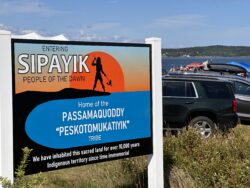
Split Rock for the Passamaquoddy Tribe at Pleasant Point.
The Sipayik Resilience Committee (SRC) is a small community-based organization dedicated to increasing the climate and energy resilience of the Passamaquoddy Tribe at Pleasant Point. Our goal is to increase the tribe’s energy sovereignty – our ability to control where and how the energy we consume is produced.
Led by us as Passamaquoddy women and guided by an advisory council of tribal members, the SRC is committed to assisting Passamaquoddy tribal members in taking citizen-led action on the issues that impact tribal members the most and enabling tribal members to live in accordance with traditional values as Passamaquoddy people.
This means helping each other, which is how our ancestors survived, and how Passamaquoddy will continue to survive as a people.
Acknowledging history
The Passamaquoddy (Peskotomuhkati) Tribe is one of four tribal nations that make up the Wabanaki (Waponahki) Confederacy, located in the northeast region of North America in what is now Maine and parts of Canada. The Passamaquoddy Tribe at Sipayik (Pleasant Point) is situated between the Passamaquoddy Bay to the east and Cobscook Bay to the west. The Passamaquoddy Tribe resides in three communities, two in the United States and one in New Brunswick, Canada.
The Peskotomuhkati, translated as the people who spear pollock, have stewarded this area since time immemorial, advocating to ensure that future generations have continued access to traditional lands and waters. The Peskotomuhkati have shown great perseverance and strength in the face of societal stresses imposed by settler colonial people.
One of those stressors involves the climate. Relations with the government of Maine have created barriers to climate resilience for the Passamaquoddy Tribe, mainly due to the restriction of access to traditional lands. Through colonization, approximately 12 million acres of land were unlawfully seized from the tribe. While these acres were ultimately returned through the Maine Indian Land Claims Settlement Act (MISCA) of 1980, the act led to unique political and legal situations.
As part of MISCA, tribal nations of the Wabanaki Confederacy, including the Passamaquoddy Tribe, are subject to the jurisdiction of the State of Maine, similar to municipalities in the State1 2. At the same time, these tribal nations are excluded from federal Indian laws that pertain to federally recognized tribes, unless they are explicitly mentioned in the act. As a result, the tribal nations of the Wabanaki Confederacy have experienced stunted economic growth and political development compared to other federally recognized tribes in the United States.
For example, per capita income from 1989 to 2020 for Wabanaki tribes increased by only 9%, whereas per capita income for other tribes in the United States during this time increased by 61%1. The State of Maine’s refusal to amend policies that restrict the Wabanaki Confederacy’s overall Tribal Sovereignty interplays with Native-led approaches and solutions to the Passamaquoddy Tribe’s reusable energy and energy sovereignty.

Through collaboration, tribal members learn how to build window inserts to weatherize homes.
Serving community through strategic commitment
Life expectancy of Passamaquoddy people is 49 years old3. Based on this, it is particularly important to support the sovereign right of the Passamaquoddy Tribe to sustain our lifeways, steward our traditional lands, and carry our traditions forward. The SRC is advancing this work in collaboration with the Tribal Government and several Native-led organizations.
Key to our approach is engaging a large volunteer base of community members and other similar, community-serving organizations. We work with and for the community in driving citizen action, helping one another, and stewarding our traditional lands and waters. We ensure that Passamaquoddy values are engrained in all our programs and initiatives to increase the climate and energy resilience of the Passamaquoddy Tribe.
We envision a future where our tribe is enabled to live in more sustainable ways that align with Peskotomuhkati traditional values. We aim to do this by reducing our energy consumption, decreasing our reliance on fossil fuels, and increasing our ownership of sustainable energy generation that respects and allows our traditional homelands and the non-human relatives that inhabit them to flourish.
Mapping to sustainable energy
As part of the Peskotomuhkati Energy Sovereignty Initiative, the SRC has included a significant amount of community engagement across a period of five years, with the understanding that a sustainable energy initiative that is co-designed with the community will be more successful and culturally responsive.
During this process, the SRC created a community energy sovereignty roadmap that aggregates the results of five years of community engagement, including surveys, interviews, educational workshops, and community meetings. The purpose of the energy roadmap is to create short- and long-term goals for sustainable energy development for the tribe, guided by the most pressing needs, concerns, and hopes of Passamaquoddy Tribal members.
The roadmap is being used to inform a broader strategic energy planning process within the Tribal Government. This plan includes targeted interventions to reduce energy consumption, transition to more sustainable methods of energy generation, and reduce costs for both tribal administrative buildings and tribal members in their homes.
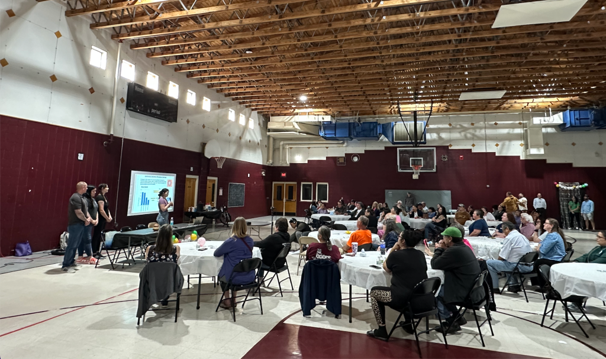
The community has shown great interest in co-designing the tribe’s energy future, with one of the most successful community engagements being the 2025 Power Up meeting that was attended by more than 150 tribal members. This event brought people together to learn more about home energy efficiency and weatherization, renewable energy, and the strategic energy planning process. Tribal members heard from visitors across Indian Country who shared their success stories.
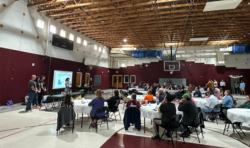
Community members came away from the SRC’s Power Up meeting with resources for home energy efficiency and weatherization and a hopeful shared vision for the tribe’s energy future.
Building collaborations
The SRC also focuses on cultivating collaboration and partnerships with many organizations to support climate initiatives, including food sovereignty, economic development, and youth development. For example, the SRC is currently partnering with the Sipayik Passamaquoddy Tribal Government to create a strategic energy plan to guide the tribe’s sustainable energy future.
We are also building relationships with WindowDressers, Wabanaki Youth in Science (WaYS), College of the Atlantic (COA), and Maine Climate Science Information Exchange (MCSIE) through the University of Main, which has created opportunities for community members to engage in projects that directly benefit their families and homes. WaYS interns assist the SRC in implementing a variety of projects such as working with COA student interns in performing free energy audits in Passamaquoddy homes, helping weatherize homes by building window inserts, assembling greenhouses and caring for plants, and connecting seaweed/kelp to community gardens through multiple aquaculture partnerships. A key part of the SRC includes incorporating cross-generational engagement between Passamaquoddy youth and elders through hands-on projects.
Powering the path
In the spirit of reciprocity, SRC is committed to sharing about our work as a small citizen-led group so that other tribes can adopt similar goals and incorporate community engagement in their energy and community resilience planning. We hope this work will serve as a beacon that shines light on the potential for community-led climate resilience initiatives that are centered on traditional values.
If you are interested in supporting this work: