Impact Story
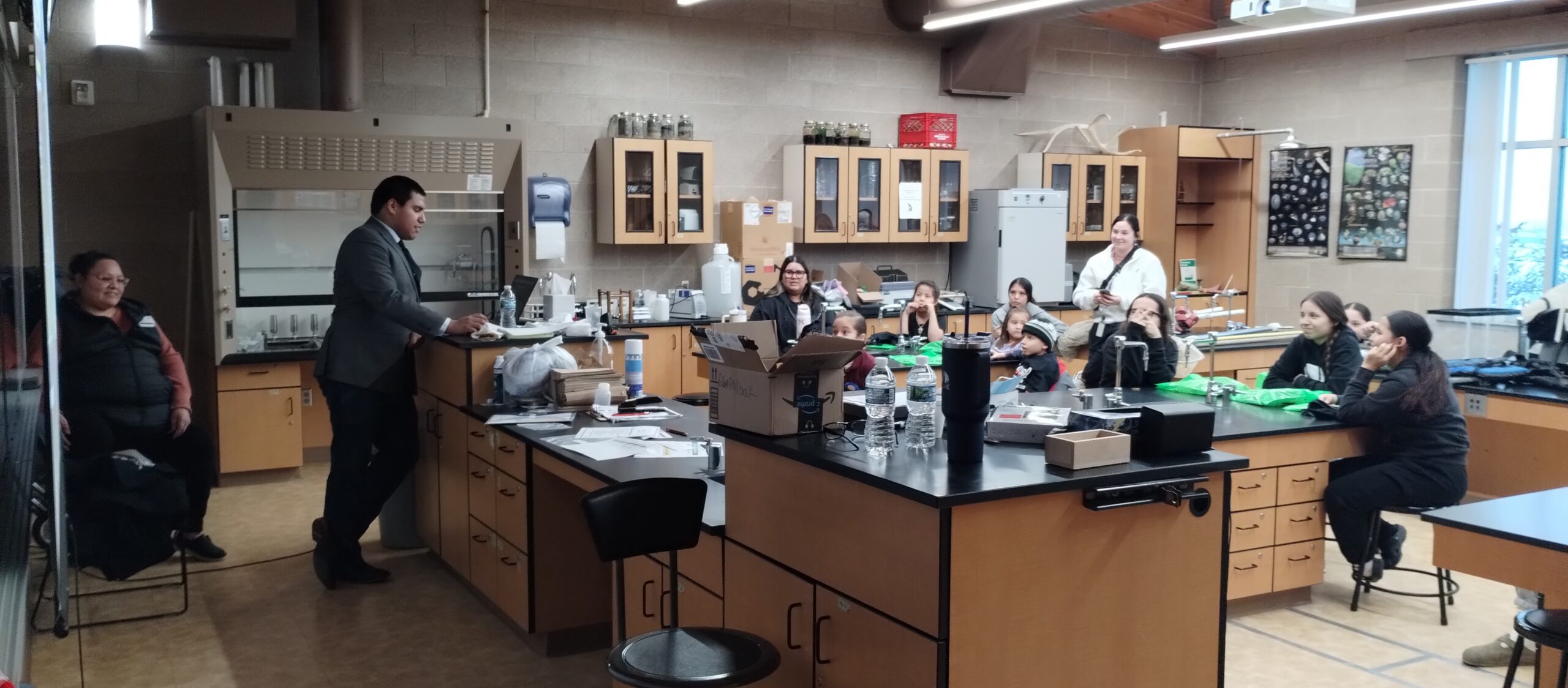
In a classroom at a small tribal college on the Standing Rock Sioux Reservation in Fort Yates, North Dakota — home to the Dakota and Lakota Nations — big things are happening. It is here that a group of students belonging to the American Indian Business Leaders (AIBL) chapter at Sitting Bull College (SBC) can be found collaborating on any number of projects, from working out the nuts and bolts of a business plan to present in a competition at a national conference, to organizing a Halloween zombie paintball hunt for community members, to creating original designs for an apparel line to be sold through an online marketplace.
With each of these activities, a new generation of young entrepreneurs and business leaders is being shaped, reflecting the mission of their guiding organization whose aim is “to increase representation of American Indians and Alaska Natives in business and entrepreneurial ventures through education and leadership development opportunities.”

The American Indian Business Leaders (AIBL) chapter at Sitting Bull College (SBC) placed first in 2024, and second in 2025 at AIBL’s National Business and Leadership Student Conference.
The hard work of becoming leaders
Under the guidance of longtime SBC Business Administration Instructor and AIBL Advisor Glen Philbrick, the club attended AIBL’s National Business and Leadership Student Conference. Held in March 2025, the gathering brought together 250 students from over 15 universities and tribal colleges throughout the country and gave out over $15,000 in awards directly to students. For the past three years, the conference has been held in conjunction with the Reservation Economic Summit (RES). RES provides tribal leaders, members of Congress, federal agency representatives, state and local officials, and top CEOs an opportunity to network and engage in business-development sessions and one-on-one consultations. It is into this mix that AIBL students, like those from SBC, are welcomed.
One SBC AIBL member, Brendan Traversie (Cheyenne River Sioux), reflects on the immediate and long-term benefits of attending the conference: “I was able to meet the other students, mentors, and others who were representing their establishments. With that, I highly encourage others to step outside of their comfort [zone] because doing so can possibly lead to further opportunities.”
Hours go into preparing for the business plan competition, including brainstorming, writing, editing, and practicing the presentation of the plan, which itself is comprised of a basic description of the proposed product or service, industry analysis, marketing analysis (identifying the target market and how to promote the product), and financials. During the actual competition, students are held to a strict time limit when presenting their plan; the microphone is cut off after five minutes. Therefore, timing is essential and the reason the presentation must be refined down to the second. A panel of judges poses to the students a series of questions that Philbrick describes as “challenging.” Na-Ja Marshall (Standing Rock Sioux), who attended the most recent conference, describes what it was like when finally given the opportunity to present beyond practice runs. “I was so nervous and felt like I couldn’t speak. I spoke anyways during the questions because I had to ensure we wouldn’t fail. I braved the anxious feeling and pursued the questions.”
Even though the competition is filled with uncertainty, it is worth the effort, according to another student, Melissa Dwarf (Standing Rock Sioux). “At the beginning of our group project, we were all unsure how our different strengths would come together working on the business plan, but through open communication and teamwork, I think we discovered how powerful collaboration can really be.”
The chapter placed first in 2024, and second in 2025. “Last year [in 2024], when they [SBC AIBL] took first place, one of them [the students] said at the banquet, at the table, ‘Glen, I’m glad we did this, this year.’ That, to me, says that they’ve forgiven me for gently nudging them,” Philbrick states jokingly.

Activities, such as running an online marketplace, inspire a new generation of entrepreneurs and business leaders.
This year, students proposed a plan to create and sell a line of healthy household products online, and last year, they developed a plan for an Indigenous beauty line comprised of lotions, creams, and fragrances made from natural resources grown in their local area.
The ripple effect
Thanks to the efforts of the SBC chapter, the AIBL community continues to grow. The $25,000 Comcast NBCUniversal grant awarded by First Nations — through the Advancing Entrepreneurialism in Native Youth Project, which aims to cultivate youth leadership opportunities that foster economic opportunity and digital equity — has made it possible for SBC AIBL to extend its reach to area high schools. SBC AIBL members have delivered entrepreneurial programming to high school students, such as engaging students in a game of Financial Football, an online interactive video game that teaches personal financial skills.
SBC AIBL has also used some of its funds to help Selfridge High School, Wakpala High School, and McLaughlin High School establish their own AIBL chapters. The high school chapters plan to participate in the national AIBL conference; the organization puts on a separate high school-level conference during the summer. These schools have also undertaken their own business ventures; McLaughlin students make and sell t-shirts, while Selfridge students run their own snack shop.
About the enthusiasm among high school students for exploring business and entrepreneurship through the SBC AIBL chapter, Philbrick states, “I think that’s just gold.” Like the college students, he has also seen the high schoolers blossom. He continues, “I have had some really quiet students join and participate. I kept encouraging them and I have seen their speaking abilities improve. Because [before] it was really hard to get a peep out of them. I’m so happy about that.”
The relationship has also allowed the high schoolers to observe firsthand the AIBL college experience, hopefully inspiring them to pursue higher education and possibly join AIBL at the college level. Some of Philbrick’s students are the first in their families to attend college. “Because of the events we’ve held through the year — like for Halloween — a lot of high school students can see what we do,” he elaborates. “Some high school students have helped with our AIBL events because their parents were in college, and now they’re in college and involved, too.”
While SBC AIBL has put a lot of effort toward extending AIBL’s reach, SBC AIBL members are also committed to incubating and launching their own projects, including an online apparel store that they plan to launch in the fall. Through Shopify — a platform that allows the students to upload their own designs and have a third-party manufacturer ship the final product — consumers will have the opportunity to purchase Indigenous-designed products. Although other apparel lines may utilize Native-inspired designs, they are not always designed by Native people. The money earned from this, like other SBC AIBL ventures, will go back into the club.
SBC AIBL has had immeasurable impacts on the community that reverberate beyond the college’s student body of about 300, an impact that is compounded by the ruralness of the area, where even the smallest of actions stand out. According to Philbrick, “People watch, they know who we are. We’re one of the most active clubs on campus, and I think that’s a big deal for a small campus.” He adds, “I have one student who participated [in AIBL] both years and wants to work on a housing project after graduation, and that’s a big deal in a rural area.”
About the AIBL experience overall, Tia Luger (Standing Rock Sioux), says, “Participation in AIBL this past year has taught me to be a more confident public speaker, and to be brave. I served as the president of the AIBL chapter and participated in activities that challenged me.” Luger, like the rest of the SBC AIBL cohort, have pushed themselves outside of the familiar with the encouragement of mentors, like Philbrick, assuring that this generation of confident leaders will continue to advance economic opportunities in their respective communities.