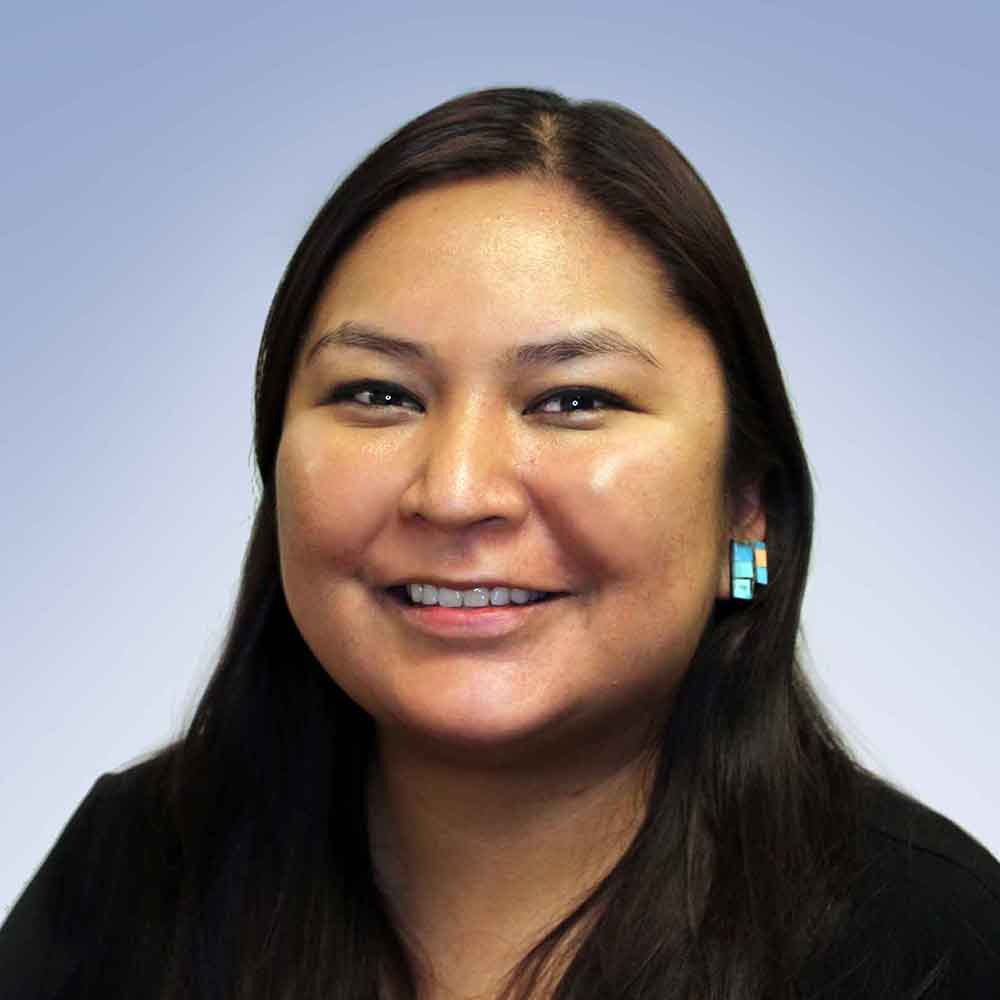

Brandi Russell
Program Officer, Stewarding Native Lands
Lower Brule Sioux Tribe

 Through the Woven Lands Initiative, First Nations explores and implements new models, investments, and tools to secure and expand Native stewardship of tribal homelands.
For too long, Tribes and Native communities have been forced to conform to western conservation practices and tools to secure financial resources. Western conservation frameworks have not been designed – from a legal or cultural perspective – to include Tribes, and, as a result, directly exclude them.
New funding models and tools must bring together existing conservation statutes, public-lands law and, most importantly, federal Indian law, with deeply held tribal values and practices.
In direct partnership with Tribes and Native communities, the Woven Lands Initiative creates and strengthens Native-centered approaches, which honor and respect tribal values, cultural traditions, traditional knowledge, and Tribal Sovereignty.
Key to scaling Native stewardship is increasing tribal access to tribal homelands. Land is essential to the expression of our kinship, stewardship responsibilities, and cultural traditions. Native communities manage land and cultural resources in reciprocity, and maintaining this balance is essential to the health and wellbeing of our lands and communities. Rematriating lands lost because of colonization, federal policies, and other unjust takings is a necessary step toward healing, reparations, and justice, and significantly benefits global climate and biodiversity.
Support under this initiative is made possible thanks to generous contributions from the Doris Duke Foundation, Margaret A. Cargill Philanthropies, Tribal Lands Conservation Fund, U.S. Forest Service, and National Fish and Wildlife Foundation (with funding from the U.S. Department of Agriculture, U.S. Forest Service).

This project will the support the commission to complete pilot studies and deliver the ongoing measurement, reporting, and verification needed for a biodiversity credit pathway.
This project will support the expansion of WRTBI's Science Department to enhance capacity to monitor increases in biodiversity within buffalo habitats.
This project will support land acquisition, multi-source fundraising, and a community-led planning process that centers Native voices and cultural values.
This project will support a Tribal Steering Committee that will review private ecosystem markets and sovereignty concerns with the goal of expanding tenure across ancestral lands. The project will also foster community building and knowledge exchange between our Tribal Nation membership.
This project will support Kashia Band of Pomo Indians to pursue a conservation easement that will enable access to and protection of tribal cultural resources. This easement will enable the Tribe to access a site that they haven't been able to access for over 30 years.
This project supports the planning, reimagining, and implementation of conservation easements to perpetually protect the culturally significant buffalo habitat within and adjacent to the Wind River Indian Reservation, while strengthening land sovereignty for the respective tribal communities.
This project supports Barbareño/Ventureño Band of Mission Indians (BVBMI) to enact a cultural conservation easement on a 6,500-acre portion of their ancestral land. BVBMI plans to use a cultural conservation easement to strengthen connection and access to land and strengthen community.
This project supports the Rappahannock Tribe in developing a conservation easement template that respects Tribal Sovereignty and encourages tribes to negotiate when using an easement for land back. This template supports the rematriation of 200 acres of tribal land bordering Fones Cliffs.
This project supports the use of conservation easements to permanently protect the subsistence and conservation values of approximately 80,000 acres owned by Igiugig Native Corporation. The acres identified for protection are of both subsistence and cultural significance to the tribe.
This project supports Molokai Heritage Trust in implementing an easement on newly acquired coastal lands of significant value to the Hawaiian community in order to permanently protect land while codifying and upholding existing spiritual, cultural, and subsistence practices.
This funding supports the purchase of essential equipment, supplies for logging and forest monitoring operations. Activities integrate modern tools with traditional stewardship values, ensuring environmental and cultural sustainability to support the Harvest to Home initiative.
This project will help create economic opportunities on Moloka‘i by providing a permanent land base for community-driven initiatives such as renewable energy, a community food hub, and a forest economy.
Our project will support developing an understanding of carbon, biodiversity and other novel stewardship finance schemes, in order to help the Wabanaki Commission develop culturally relevant frameworks and data sovereignty tools.
Our program will establish a Tribally-led biodiversity crediting framework using eDNA tools to monitor and protect species across the Chugach region, aligning Indigenous values with emerging markets to support long-term stewardship, climate resilience, and sustainable Tribal economic opportunities.
WRTBI's Buffalo Biodiversity Crediting Program will support the planning and development of our bio crediting program, which will increase economic, environmental, and community health, along with diversifying our funding streams for the nonprofit.
Our project will support the development program capacity to monitor biodiversity and carbon hemiboreal forests in the 1836 Treaty Ceded Territory with a focus on Sault Tribe's Shingle Bay Preserve as a demonstration site
Our project will support the development of a new fund for land re-matriation that can be accessed by our Tribal Nation members to re-acquire and protect their ancestral lands.
Our project will support the planning and development of our land return biocultural crediting project. This project will create a pathway for tribes and ethical investors to partner in the return of Blackfeet lands for a sustainable effort at land, culture, language, and Bison rematriation.
Kalispel Indian Community of the Kalispel Reservation
To create a durable long-term co-management/co-stewardship agreement with the US Forest Service allowing for tribally based objectives and outcomes to be implemented on FS System lands. This would include increasing the pace and scale of restoration and conservation-based projects on Colville NF lands.
Bridgeport Indian Colony
This project will create a unified council of the four Tribes surrounding the Bodie Hills and increase their collective power to protect the Bodie Hills' high volcanic tableland (Tuvogatudu), a sacred landscape. It will increase tribal capacities by jointly producing a co-management proposal to protect Tuvogatudu from ground disturbing activities.
Igiugig Village
This project will create a draft caribou monitoring plan to develop a monitoring program, retaining local expertise to enhance the co-management capacity of Igiugig Village with the National Park Service. By leveraging traditional ecological knowledge (TEK) alongside scientific data, this effort will increase our control over crucial decision-making processes.
Cheyenne River Sioux Tribe of the Cheyenne River Reservation, South Dakota
This project will increase the Tribe's natural resource management capacity and help develop a trained workforce to better manage its treaty territory in the Black Hills that are now encompassed by federal lands by creating co-management agreements with the federal agencies currently managing them including the USFS and the NPS.
Cold Springs Rancheria of Mono Indians of California
This project will increase Tribal capacity to restore ecosystem health by supporting the planning and development of a co-stewardship plan for the Teakettle Experimental Forest area of Sierra National Forest that upholds tribal values, honors Tribal sovereignty, draws on traditional ecological knowledge, and incorporates cultural burning.
Navajo Nation, Arizona, New Mexico, and Utah
This project will utilize/build upon accomplishments from Navajo Nation programs previously funded via existing federal legislation to create a co-management plan between the National Park Service and Navajo Nation. It will increase community involvement and foreground Tribal perspectives in the management of cultural resources at a landscape level.
Pueblo of San Felipe, New Mexico
The Pueblo of San Felipe will create a Co-Stewardship Agreement with the Bureau of Land Management for highly culturally sensitive ancestral tribal land within the Pueblo's exterior boundaries held by the BLM. We seek to control access to our cultural resources, increase preservation of paleontological resources, and retain Pueblo culture.
Lower Brule Sioux Tribe of the Lower Brule Reservation, South Dakota
This project will support the Lower Brule Digital Archive, the mission of which is to gather documents associated with Lower Brule – lands, people, history – anything that can help fill in the enormous gaps in knowledge during the many years of forced removal.